Resident Evil: Revelations
 77
★ /10
77
★ /10
 Nintendo 3DS,
  Nintendo Switch,
  PC,
PC,  PS 3,
PS 3,  PS4,
PS4,  Wii U,
  Xbox 360,
  Xbox One
 Capcom
Where to buy



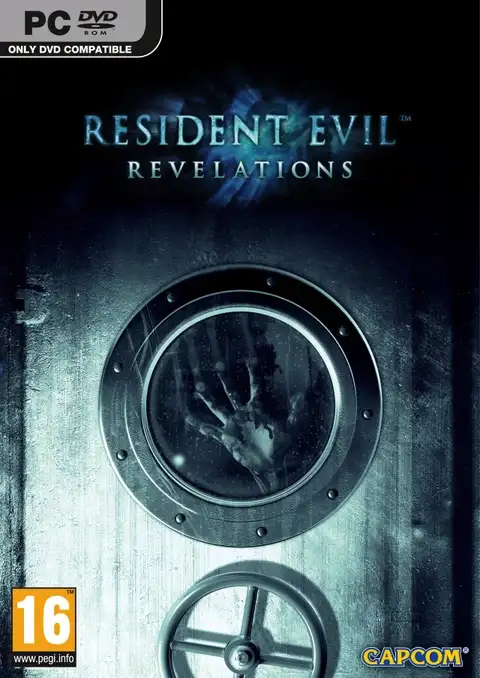
Resident Evil: Revelations is a 2012 survival horror game developed and published by Capcom, originally released for the Nintendo 3DS on January 26, 2012 in Japan, January 27 in Europe, and February 7 in North America. Set in 2005 — chronologically between Resident Evil 4 and Resident Evil 5 — it was the directorial debut of Koushi Nakanishi, who would go on to direct Resident Evil 7: Biohazard and Resident Evil Requiem. It holds a Metacritic score of 82 on 3DS, the highest of any version, and Famitsu awarded it a near-perfect 39/40.
Because Revelations has since been re-released across eight platforms over three separate waves — 3DS in 2012, an HD version for PC, PS3, Xbox 360 and Wii U in 2013, then PS4 and Xbox One in 2017, then Switch later that same year — its Metacritic score varies noticeably depending on which port you look up, ranging from 70 on PS4 up to 82 on the original 3DS. The game itself is identical story-to-story across all of them; only the visual polish and a couple of quality-of-life changes differ.
Technical Specifications
| Attribute | Details |
|---|---|
| Developer | Capcom |
| Publisher | Capcom |
| Director | Koushi Nakanishi (first game as director) |
| Producers | Masachika Kawata · Tsukasa Takenaka |
| Writer | Dai Satō |
| Original Platform | Nintendo 3DS |
| Original Release | January 26, 2012 (Japan) · January 27, 2012 (Europe) · February 7, 2012 (North America) |
| Also released on | PC, PS3, Xbox 360, Wii U (HD Remaster, May 2013) · PS4, Xbox One (Aug 2017) · Nintendo Switch (Nov 2017) |
| Metacritic | 82 (3DS) · 80 (Wii U) · 78 (Xbox One / Switch) · 77 (PC) · 75 (Xbox 360) · 74 (PS3) · 70 (PS4) |
| Famitsu | 39/40 |
| ESRB | M for Mature 17+ (Blood and Gore, Intense Violence, Language) |
| Genre | Survival horror |
| Mode(s) | Single-player campaign · Raid Mode (solo or co-op, local/online) |
Coming Home to Survival Horror
By 2010, Resident Evil had a problem. Resident Evil 4 reinvented third-person action; Resident Evil 5 pushed further into co-op shooting; and a growing portion of the fanbase felt the series had drifted a long way from the slow, resource-starved dread of the original games. Koushi Nakanishi — a designer on RE5 making his directorial debut — set out to build something that put horror back at the center, without abandoning the modern control scheme players had gotten used to.
The project grew out of Resident Evil: The Mercenaries 3D (2011), a smaller 3DS spin-off Capcom used partly to learn how far the console’s hardware could be pushed. That experience let the Revelations team hit the ground running: the game shipped on a 4GB cartridge — the largest used by any 3DS game at the time — carrying a full-length campaign that many critics and players considered visually the best the handheld ever produced. Capcom also brought in outside talent for the writing: anime scriptwriter Dai Satō was hired specifically to build a serialized, suspicious, hard-to-predict narrative, and given enough creative latitude to invent two new characters, Keith and Quint, from scratch.
The Queen Zenobia and the Terragrigia Panic
The game’s central setting is the Queen Zenobia, a luxury cruise ship adrift in the Mediterranean and, on paper, abandoned. Nakanishi has said the ship was chosen specifically for its narrow corridors and the specific helplessness of being stranded at sea with nowhere to run — a deliberate return to the corridor-and-dread architecture of the original games, ported onto a more modern engine.
The backstory is heavier than a simple ghost-ship premise. A year before the game opens, the bioterrorist group Il Veltro unleashed a horde of genetically altered creatures on Terragrigia, an artificial floating city, in what became known as the Terragrigia Panic. To contain the outbreak — or, as it later turns out, to bury the evidence — Federal Bioterrorism Commission (FBC) director Morgan Lansdale ordered Terragrigia destroyed outright using an orbital solar weapon called the Regia Solis. When signs suggest Il Veltro has resurfaced aboard the Zenobia a year later, the BSAA sends agents to investigate — and the same satellite that erased an entire city becomes a direct threat to the ship itself partway through the story.
Jill Valentine and Parker Luciani
Jill Valentine — a survivor of the original Spencer Mansion incident and one of the BSAA’s founding “Original Eleven” agents — leads the investigation onto the Zenobia alongside her new partner, Parker Luciani, a former FBC agent who was present at the Terragrigia Panic himself. Jill’s side of the story is the game’s throughline: the pair board the ship expecting to find Chris Redfield, instead find it crawling with mutated horrors, and spend most of the campaign separated, recaptured, and fighting to get back to each other.
Parker is written as competent but visibly carrying baggage from his FBC days, which the game explores through flashbacks to Terragrigia itself. Late in the story he suffers what looks like a fatal fall from the sinking ship to save Jill and Chris — a moment players and critics singled out as one of the campaign’s more effective beats, even though the game ultimately walks it back.
Chris Redfield and Jessica Sherawat
Running in parallel is Chris Redfield, another Original Eleven veteran, and his BSAA partner Jessica Sherawat, searching a snowy European mountain range for evidence that Il Veltro is regrouping. Structurally, these sections are the game’s most action-forward — closer to RE5‘s pacing than the claustrophobic ship sequences — and several reviewers at the time felt they undercut the tension the Zenobia scenes worked hard to build. Jessica herself became a memorable, divisive character: glib, overconfident, and given some of the campaign’s most quoted (and most mocked) one-liners.
O’Brian’s Gambit (story spoilers)
The game’s back half recontextualizes almost everything that came before it. The “Il Veltro resurgence” both search parties were sent to investigate was, in large part, a setup: BSAA director Clive R. O’Brian orchestrated the whole operation to smoke out an FBC mole believed to be embedded inside the BSAA. Jessica Sherawat and a masked operative aboard the Zenobia named Raymond Vester — Parker’s old FBC partner — are both revealed to be that mole and her handler, and by the end of the game they walk away having secured a sample of the T-Abyss virus, which they hand off to Tricell, the same corporation behind Albert Wesker’s plans in Resident Evil 5. It’s a twist that ties a spin-off cruise-ship mystery directly into the series’ wider Umbrella-and-Wesker mythology, even if, as discussed below, critics were split on whether the mystery itself justified the reveal.
The Genesis Scanner and a Return to Scarcity
Mechanically, Revelations restores the series’ classic scarcity: ammunition, herbs, and even movement speed are all deliberately limited, and the traditional item-box inventory management is gone in favor of pre-set weapon loadouts. The signature new tool is the Genesis scanner, a handheld device used to sweep rooms for hidden ammo, herbs, and collectible handprints, and to scan enemies at close range for bonus items. Reception to the Genesis was mixed even among people who otherwise liked the game — several reviewers found it a clever idea that didn’t pay off mechanically, since scanning enemies simply filled a meter that rewarded a green herb rather than building any lasting knowledge about that enemy type.
Ooze, Hunters, and the Ship’s Menagerie
The T-Abyss virus produces the game’s signature enemy, the Ooze — a translucent, jellyfish-like mutation that replaces the classic zombie here — alongside a returning cast of series staples, including the Hunters first introduced in the original 1996 game. The Zenobia’s tight corridors and low visibility do most of the atmospheric work, though several critics felt the enemy roster itself was thinner and more repetitive than earlier entries, with a handful of memorable set-piece bosses carrying much of the horror on their own.
Raid Mode
Raid Mode is the game’s separate, loot-driven arcade mode: players clear remixed sections of the campaign, solo or in co-op (local or online), against increased and altered enemy counts, earning weapon upgrades and unlockable characters along the way. On 3DS it also tied into StreetPass, turning other players’ passed-by data into enemies to hunt down for unique rewards. Raid Mode is consistently cited by the community as the single strongest thing Revelations produced — long after opinions on the campaign’s plot have settled into “fine but inessential,” players still point to Raid Mode as one of the most replayable side modes the series has ever shipped, in some cases logging hundreds of hours in it alone.
Twelve Episodes, Two Languages
Rather than one continuous campaign, Revelations is structured as twelve short episodes, each opening with a “Previously on Resident Evil: Revelations…” recap in the style of a television drama — a presentation choice suited to the 3DS’s handheld, play-in-short-bursts audience. The game was also the first in the series recorded in Japanese before English, and the first to let players pick which language’s voice track to use regardless of region, a genuinely new accessibility option for the franchise at the time.
From Handheld Exclusive to Every Platform
The original 3DS release is still the version with the strongest critical reputation, in part because it was measured against handheld competition rather than console/PC benchmarks. The 2013 HD version for PC, PS3, Xbox 360, and Wii U carried over the same content with sharper textures and no stereoscopic 3D, and sold more than two million copies across all platforms combined — a strong result, though it landed with somewhat less critical enthusiasm than the original. The 2017 wave, bringing the HD version to PS4, Xbox One, and Switch, was by that point a five-year-old port of a 2012 handheld game, and several reviewers were upfront that it showed its age visually, even while still recommending the campaign and Raid Mode on their own merits.
Remake Rumors and Where Revelations Sits Today
Revelations was designed, by Capcom’s own account at the time, as a side story — something that could explore lesser-used characters without touching the mainline numbered games. In practice, its plot threads (the FBC, Tricell, the BSAA’s early years) turned out to matter more to the wider series than originally advertised, and in 2026 industry insider Dusk Golem (AestheticGamer) reported that Capcom internally discusses Revelations and its sequel as closer to mainline canon than side content, pointing out that Nakanishi and Yasuhiro Anpo — the directors of Revelations 1 and 2 respectively — are now among the people steering the franchise’s present direction. The same reporting floated the idea of a Revelations remake as something Capcom has discussed internally, though nothing has been confirmed, and any such project would likely sit well behind the Code: Veronica and Resident Evil Zero remakes already in motion.
Reception and Legacy
Resident Evil: Revelations launched to strong reviews on 3DS — IGN gave it 8.5/10, Game Informer scored it a 9/10 and called its story one of the best the series had produced in years, and Famitsu’s 39/40 remains one of the highest scores any handheld Resident Evil has received. The most common criticism, repeated across outlets, was that the story’s contribution to the wider mythos felt inconsequential relative to how seriously it was told, and that the enemy roster didn’t quite match the strength of the setting. It sold close to 300,000 copies in Japan in its first year and was among the best-selling titles in North America the month it launched, numbers Capcom considered a genuine 3DS success story.
Its long-term reputation has settled into something specific: a game fans of the series recommend readily — often in the same breath as RE4 — while being honest that its plot is a footnote rather than a pillar. What keeps people coming back, by the community’s own account, is less the twelve-episode mystery aboard the Queen Zenobia and more the hours logged hunting down Raid Mode’s toughest enemy variants, one scanned Ooze at a time.
Resident Evil news
More news
Capcom Plans to Evolve RE Engine Into an AI-Generation Engine

Roy Lee Reportedly Developing a New Silent Hill Movie

Valve Deliberately Leaked Left 4 Dead 2 Trailer to Dodge ESRB Rules

Steam Gross Revenue Tops $15 Billion in First Eight Months of 2026