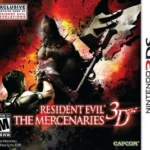
Resident Evil: The Mercenaries 3D
 Nintendo 3DS
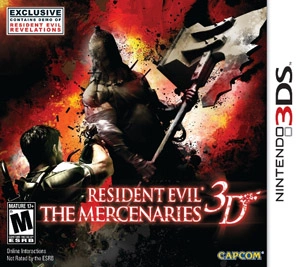
Resident Evil: The Mercenaries 3D is a 2011 tactical third-person shooter developed by TOSE and published by Capcom for the Nintendo 3DS. Released on June 2, 2011 (Japan), June 28, 2011 (North America), and July 1, 2011 (Europe), it expands the score-attack Mercenaries bonus mode from Resident Evil 4 and Resident Evil 5 into a standalone full-price retail release, using locations, characters, and enemies drawn almost entirely from those two games.
Technical Specifications
| Attribute | Details |
|---|---|
| Developer | TOSE |
| Publisher | Capcom |
| Director | Koushi Nakanishi |
| Platform | Nintendo 3DS |
| Release | Jun 2, 2011 (Japan) · Jun 28, 2011 (NA) · Jun 30, 2011 (AU) · Jul 1, 2011 (EU) |
| Metacritic | Mixed (critic scores range 5–8.2) |
| Genre | Tactical third-person shooter, Score attack |
| Availability | Physical only (3DS cartridge) · Amazon, eBay, GameStop retro |
Score Attack, Not Story
The Mercenaries 3D has no campaign and no narrative. The entire game is the “Mercenaries” format established as a bonus unlock in RE4 (2005) and expanded in RE5 (2009): a fixed time limit, waves of enemies, and a scoring system that rewards kill efficiency, combo chains, and finishing moves over sheer survival. The clock can be extended by killing enemies quickly; running it down ends the mission.
Two modes structure the content: Scene Attack (individual timed missions across specific arenas) and Survival (extended endurance runs). Characters can be levelled up between runs, improving health, weapon handling, and combat stats — the game’s only concession to persistent progression outside of unlockables.
The Roster
Playable characters are drawn exclusively from the RE4/RE5 era of the franchise: Jill Valentine, Claire Redfield, Chris Redfield, and Barry Burton are confirmed in the roster. Notably, Leon S. Kennedy — the protagonist most associated with the Mercenaries mode’s originating game, RE4 — is absent, a choice multiple reviews flagged as “odd” given his prominence in the mode’s history.
Each character carries a distinct weapon loadout and stat profile. Costumes and alternate skins are unlockable unlock content, achieved through play rather than purchase.
Familiar Arenas, Familiar Enemies
Every environment in the game is recycled from Resident Evil 4 and Resident Evil 5 — the RE4 village, the RE5 Kijuju locations — rebuilt for 3DS hardware using Capcom’s MT Framework engine scaled down from its console implementation. Enemy types are similarly familiar: the Chainsaw Majini, the Garrador, and the Executioner all return, rendered with enough fidelity that reviewers specifically praised character animation and enemy menace as retaining their console-quality impact despite the hardware downgrade.
The 3DS’s stereoscopic 3D display was a specific marketing focus — the game was among the platform’s launch-window titles intended to showcase what the hardware’s glasses-free 3D effect could do with an established, visually detailed franchise.
The Permanent Save Data Controversy
The Mercenaries 3D generated controversy at launch when players discovered that save data could not be erased. Once a cartridge’s save file was created, all unlocked content — characters, costumes, medals, levels — remained permanently tied to that save with no reset option.
Capcom VP Christian Svensson stated publicly that this was not a deliberate business decision aimed at curbing the used-game market, and indicated that Capcom would likely avoid the feature in future titles given the backlash it generated. Nintendo Life’s review specifically noted the practical consequence: secondhand copies purchased with existing unlocked progress lose the appeal of unlocking that content yourself, making used copies “practically worthless” to the specific audience the game’s structure was built to reward.
Reception
Reviews were genuinely mixed rather than uniformly negative — a distinction the game’s critical record makes clear. NGamer gave it 82%. Tech Digest gave it a perfect score, calling it “the second must-have 3DS title in as many weeks.” IGN gave 6.5, and its review title — describing the game as designed to be an extra, not a retail release — became the most quoted characterisation of the game’s fundamental problem.
Cubed3’s review captured the split directly: “downright fantastic” in isolated moments of gameplay, but “not a mainline entry with a gripping storyline,” sold at full retail price for content that had previously been a bonus attached to two other complete games. Nintendo Life’s assessment: “a fantastic experience…while it lasts,” with longevity limited to “die-hard score chasers.”
User reviews on Metacritic are notably more positive on average than critic reviews — a pattern visible in several comments praising matchmaking stability and co-op enjoyment years after release, including one 2020 review noting the game’s online matchmaking “works perfectly to this day,” nine years after launch.
Context: The 3DS Launch Window and Revelations
The Mercenaries 3D arrived during the Nintendo 3DS’s first year, positioned as a stopgap ahead of Resident Evil: Revelations (2012) — the “real” full Resident Evil experience Capcom had planned for the handheld, with an original story and full survival horror structure. Multiple contemporary reviews explicitly framed Mercenaries 3D as a taste of what Revelations would deliver, and several noted that a preview demo of Revelations was included on the Mercenaries 3D cartridge itself.
The general critical consensus, in retrospect: Mercenaries 3D is a competent, occasionally excellent action mode stretched thin across a full retail release, whose greatest achievement was proving the 3DS hardware could run a recognisable RE4/RE5-quality experience — groundwork that paid off more fully when Revelations arrived the following year.