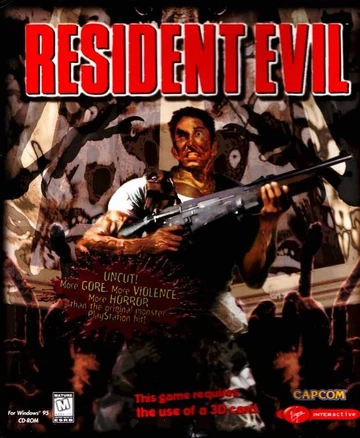
Resident Evil
 91
★ /10
91
★ /10
 Nintendo DS,
  PC,
PC,  PS 1,
PS 1,  Sega Saturn,
  Xbox
Xbox
 Capcom


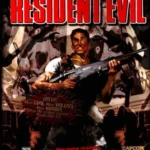
Resident Evil is a 1996 survival horror game developed and published by Capcom. Originally released for PlayStation in Japan on March 22, 1996, and in North America the same month, it was directed by Shinji Mikami, produced by Tokuro Fujiwara, and written by Kenichi Iwao. It is the first entry in the Resident Evil franchise and one of the foundational works of the survival horror genre.
It is available in multiple substantially different versions; this card covers the 1996 original specifically. On April 1, 2026 — eleven weeks ago — Capcom released the original 1996 game on Steam for the first time, based on the enhanced GOG version from June 2024. It generated immediate backlash over the inclusion of Enigma DRM.
Technical Specifications
| Attribute | Details |
|---|---|
| Developer | Capcom Production Studio 1 |
| Publisher | Capcom |
| Director | Shinji Mikami |
| Composers | Makoto Tomozawa · Akari Kaida · Masami Ueda |
| Original Platform | PlayStation |
| Original Release | March 22, 1996 (Japan) · March 1996 (NA) |
| PC Release | December 6, 1996 (Japan) · September 17, 1997 (NA/EU) |
| Current (PC) | Steam (Apr 1, 2026) · GOG (Jun 26, 2024, DRM-free) · Xbox |
| Genre | Survival horror, Action-adventure |
| Mode | Single-player |
Spencer Mansion: The Setting and Premise
The game is set in 1998 outside Raccoon City, a fictional American Midwestern city. A series of violent murders in the Arklay Mountains has drawn investigation. S.T.A.R.S. (Special Tactics and Rescue Service) Bravo Team was sent first and vanished; Alpha Team is dispatched to find them. Their helicopter is forced down near a large mansion. Under pursuit by something in the woods, the team takes shelter inside.
Spencer Mansion — the residence of the Umbrella Corporation’s founder — is also one of its most secure research facilities, built above a complex of underground laboratories where biotechnology experiments have been conducted for years using the T-Virus: a mutagenic retrovirus capable of reanimating dead tissue and producing powerful biological weapons (BOWs). The T-Virus has escaped containment. The research staff are dead, or undead. The mansion is sealed, the underground complex is operational, and the player has just walked into it.
Chris and Jill: Two Protagonists
The game offers two fully realised playthroughs through the same mansion:
Jill Valentine is the recommended starting character. She carries 8 inventory slots (more carrying capacity), has access to a lockpick that opens some doors without key items, and has Barry Burton as an active companion who appears at intervals to provide ammunition and brief dialogue. Her campaign is considered accessible enough to teach the game’s mechanics without overwhelming the player.
Chris Redfield is the harder playthrough. He has more hit points but only 6 inventory slots (significantly less space), cannot pick locks, and has Rebecca Chambers as his occasional companion. Several encounters that Jill navigates with Barry’s assistance are more demanding without that support. His campaign is designed for players who have learned the mansion’s layout and want a harder experience.
Both playthroughs reach the same conclusion through largely the same locations. The differences in inventory management create meaningfully distinct tactical experiences.
Survival Horror Mechanics
Resident Evil established the mechanical vocabulary that defined its subgenre:
Fixed camera angles on pre-rendered backgrounds. Each room is shown from a fixed cinematic angle. As the player moves into a new area of the room, the camera cuts to a new angle. This produces cinematic tension (the player cannot see what is around corners) at the cost of navigation complexity.
Tank controls. Movement is relative to the character, not the camera: pressing forward moves the character in the direction they are facing regardless of which way the camera points. This is disorienting for players who have not encountered it, and becomes second nature over time. The controls are the game’s highest barrier to entry in 2026.
Limited inventory. Items take discrete slots. The player must decide at every point what to carry and what to leave in the item box (accessed at specific storage points). Every item carried has an opportunity cost; managing this under pressure is the game’s primary intellectual exercise.
Ink ribbons. Saving requires finding a typewriter (scattered through the mansion) and consuming an ink ribbon. Ink ribbons are limited. Running out of ribbons means running out of saves. The mechanic enforces commitment to decisions in a way that checkpoint systems do not.
Herbs and mixing. Three herb types — green (healing), red (amplifies green when combined), blue (cures poison) — can be mixed in the inventory for combined effects. The system is simple and tactile.
File system. Research notes, diary entries, and operational documents are scattered throughout the mansion. Reading them reveals the history of what happened, the locations of key items, and the nature of the experiments. The primary exposition delivery mechanism is reading someone else’s description of events that took place before the player arrived.
The Dialogue
The original English localisation of Resident Evil produced some of the most quoted lines in gaming history. Barry Burton’s dialogue in Jill’s campaign is the primary source: “Jill, here is a lockpick! It may come in handy if you, the master of unlocking, take it with you.” Wesker’s dramatic exclamations. The delivery, the line quality, and the stilted scripting converged to create something that is genuinely difficult to describe as bad without acknowledging that it achieved a kind of immortality no better localisation could have managed.
The Director’s Cut (1997) added a Japanese audio option for Western players who wanted to hear the original performances. The camp of the English dub became a franchise characteristic rather than a flaw to be corrected: subsequent Resident Evil entries leaned into and occasionally subverted it.
Wesker and the Umbrella Conspiracy
Albert Wesker, captain of S.T.A.R.S. Alpha Team, is the game’s primary human antagonist and the character whose presence connects the original through to the later games most directly. He arranged for both S.T.A.R.S. teams to enter the mansion as live test subjects, sold the operational data to Umbrella’s research division, and during the game’s climax injects himself with an experimental virus during the confrontation with the Tyrant (the T-Virus project’s flagship biological weapon).
He appears to die. He does not die. His story across the subsequent franchise becomes increasingly baroque; this first appearance is simply a man who betrayed his colleagues for money and ambition, then executed a contingency plan that saved his life. Everything after that is franchise territory.
The Tyrant — released from its container in the game’s final act — is the T-Virus’s most developed product: a seven-foot BOW with a modified heart visible through its chest, whose final boss encounter occurs on the mansion’s roof after an evacuation helicopter arrives. A rocket launcher appears on the roof. The game trusts the player to understand what it’s there for.
The Versions
The 1996 original is one of several substantially different versions of this game:
Director’s Cut (1997): Added Arranged Mode (different item and enemy placement, higher difficulty), a new Beginners difficulty, and later added DualShock support. Same story and structure.
PC version (1996/1997): Ported in-house by Capcom; uses some different music tracks from the PlayStation version and suffered serious compatibility issues with hardware advances. The 2024 GOG release specifically addresses these issues.
GameCube Remake (2002): Directed by Mikami and widely considered the definitive version of the story. Complete rebuild: real-time 3D environments replacing pre-rendered backgrounds, new areas, new character (Lisa Trevor), the Crimson Head zombie revival mechanic, improved music and graphics. Not the original game; a reimagining of it.
HD Remaster (2015): Based on the 2002 GameCube remake. Available on PS3, PS4, Xbox 360, Xbox One, and PC (Steam app 304240). The standard current-generation version on PlayStation. Not the same as the 1996 original.
The 2026 PC Release and the Enigma DRM Controversy
On June 26, 2024, Capcom released the original Resident Evil (1996), Resident Evil 2 (1998), and Resident Evil 3: Nemesis (1999) on GOG as enhanced PC editions — DRM-free, with fixes for modern system compatibility, all four localisations, uncut content, improved Direct3D rendering, and wider controller support. The games were priced at $9.99 each.
On April 1, 2026, these same versions were released on Steam. They are identical to the GOG releases in content, with one addition: Enigma DRM, Capcom’s proprietary protection layer. The DRM caused two specific problems: it created compatibility issues with Steam Deck (which uses Linux-based software and handles DRM differently), and it prompted immediate community backlash from players who had purchased the game specifically to play it on handheld hardware or who objected to DRM on a thirty-year-old game on principle.
The GOG version remains available without Enigma DRM at the same price. The PCGamingWiki entry for Resident Evil (1996) documents the full technical situation for both versions. The Steam version is 86% positive from 962 reviews despite the controversy; the GOG version receives uniformly positive reception without the DRM dimension.
Reception and Legacy
Resident Evil (1996) received reviews that, measured by contemporary standards, were uniformly enthusiastic — the game predates Metacritic’s existence and cannot be retrospectively scored with confidence, but PCG UK gave it 89%, GameFan gave it multiple perfect scores, and it became one of the PlayStation’s highest-profile titles in its year.
Its legacy is the survival horror genre itself. Shinji Mikami‘s design philosophy — scarcity of resources, the tension of fixed camera perspectives, the inventory as a puzzle, the save system as stakes — was replicated across the decade: Silent Hill (1999) took the atmosphere further; Alone in the Dark (1992) technically preceded it; Dino Crisis (1999) applied the same framework to different enemies. The 2017 Resident Evil 7 and 2023 Resident Evil 4 Remake cite Mikami’s original design decisions as direct influences on their own. The genre named for this game remains one of the most actively developed in the medium.
DLC & Expansions 2
Resident Evil news
More news
Capcom Plans to Evolve RE Engine Into an AI-Generation Engine

Roy Lee Reportedly Developing a New Silent Hill Movie
Valve Deliberately Leaked Left 4 Dead 2 Trailer to Dodge ESRB Rules

Steam Gross Revenue Tops $15 Billion in First Eight Months of 2026