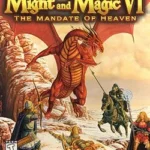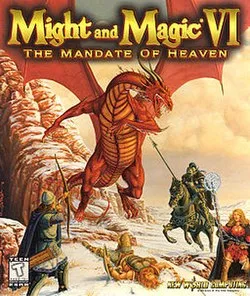
Might and Magic VI: The Mandate of Heaven
 PC
PC
 New World Computing
 Buka,
Buka,  The 3DO Company
Where to buy

Might and Magic VI: The Mandate of Heaven (1998) is widely celebrated as the crowning masterpiece, absolute renaissance, and commercial high-water mark of the franchise’s role-playing branch.
Following a five-year hiatus after Darkside of Xeen, New World Computing and The 3DO Company completely rebuilt the game from scratch. By throwing out the rigid, 2D step-by-step movement grids of the early 90s, The Mandate of Heaven pushed the boundaries of the genre with a sprawling, fully open-world pseudo-3D engine. It combined unmatched map sizes with deep, addictive mechanics and established a direct lore pipeline into the franchise’s strategy titles.
The Narrative: The Geopolitical Chaos of Enroth
The plot serves as a direct bridge to the strategy timeline, taking place concurrently with the events leading into Heroes of Might and Magic III.
A horrific race of world-consuming alien demons known as the Kreegan crash-lands on the continent of Enroth via a meteor strike. During the initial chaos, King Roland Ironfist is ambushed and captured by the alien army. With the King missing, his wife Queen Catherine sailing to her homeland of Erathia, and young Prince Nicolai left under the guidance of Regent Wilbur Humphrey, the realm falls into a state of panic.
- The Cult of Baa: Exploiting the power vacuum, the Kreegan king secretly funds the Temple of Baa, a sinister doomsday cult. The cult successfully convinces the public that the Ironfist dynasty has lost its divine right to rule—its “Mandate of Heaven.”
- The Survivors: Players control a custom team of four citizens from the town of Sweet Water, which was completely vaporized during the initial Kreegan landing. Rescued and trained by the powerful warlock Falagar, the party must unite the High Council of Free Haven, gain the unanimous backing of six regional lords, and consult a sentient Ancient supercomputer known as The Oracle.
- The Sci-Fi Endgame: True to the franchise’s science-fantasy roots, saving Enroth requires raiding ancient high-tech vaults to uncover high-frequency Blaster rifles. Players must infiltrate the primary Kreegan Hive and safely detonate its core engine using the Ritual of the Void scroll to vaporize the aliens without accidentally cracking the planet in half.
Mechanical Evolutionary Leaps
1. The Real-Time / Turn-Based Toggle
The headline technical marvel of the 1998 engine was its fluid combat flexibility. By tapping the Enter key, players could instantly switch the gameplay logic on the fly:
- Real-Time Mode: Excellent for outdoor kiting, running away from danger, or raining massive area-of-effect spells like Meteor Shower or Starburst across whole legions of neutral creeping mobs.
- Turn-Based Mode: Instantly freezes the action into a tactical round queue. In Might and Magic VI, characters cannot move across coordinates during turn-based mode; your party remains completely stationary on its assigned tile, converting the match into a pure puzzle of mathematical trading, item utilization, and spellbook coordination.
2. Normal, Expert, and Master Tiers
This entry pioneered a sweeping overhaul to character specialization by splitting skill growth into explicit expertise milestones:
- Ranks: Players invest points earned from training centers to raise a skill’s baseline level.
- Expert & Master Teachers: Once specific rank levels are met, players must track down hidden, specialized teachers in taverns or remote towers to buy permanent skill tier promotions. Upgrading a skill to Master drastically mutates its baseline rules (e.g., Master Water Magic allows your Town Portal spell to target any explored town hub regardless of proximity, completely bypassing travel time).
3. Unprecedented Environmental Scale
The engine threw out linear dungeon corridors in favor of vertigo-inducing vertical scaling. Utilizing the legendary Fly spell, your party can take off into the atmosphere, soaring over mountains and casting spells on enemies below. Dungeons and cities were packed with clickable environmental interaction—hidden treasure hidden behind loose bricks, levers that dynamically shifted cavern geometry, and cursed shrines that granted massive permanent buffs if visited during the correct calendar month.
The Six Playable Classes
Instead of six characters, players build a focused squad of four human heroes selected from an asymmetrical matrix:
| Class Class Type | Spell Disciplines | Baseline Progression Profile | Tactical Identity in the Party |
| Knight | None (No Magic) | Gains the absolute highest baseline Hit Point pool and can wear heavy Plate armor. | The ultimate physical vanguard and packhorse; acts as a utility anchor to clean out traps and repair armor. |
| Sorcerer | Elemental (Fire, Air, Water, Earth) + Light/Dark | Possesses massive Spell Point scaling but is restricted to light Leather armor. | The primary glass-cannon damage dealer; essential for macro map-clearing and global fast-travel loops. |
| Cleric | Self (Spirit, Mind, Body) + Light/Dark | Balanced physical options with high-tier defensive magic caps. | The defensive core; provides life-saving party heals, conditions removal, and high-powered status buffs. |
| Paladin | Self Magic (Spirit, Mind, Body) | A hybrid crossover between Knight and Cleric stats. | A durable physical brawler who doubles as a secondary backup healer if the main Cleric is knocked out. |
| Archer | Elemental Magic | A hybrid crossover between Knight and Sorcerer stats. | Combines high-damage ranged bow modifiers with mid-tier elemental spell versatility to support backlines. |
| Druid | Elemental + Self Magic | Gains access to all base magic pools, but is strictly locked out of Light and Dark magic. | A dedicated pure caster designed to maximize spell variety, though crippled late-game by the lack of high-tier Light/Dark options. |
Release & Modern Preservation
- PC (Microsoft Windows): April 30, 1998 (North America) / May 22, 1998 (Europe)
- Modern Availability: The game is preserved in its definitive digital form on GOG via the Might and Magic® 6-pack Limited Edition bundle. It comes pre-wrapped for modern Windows compatibility and packages the original massive cluebooks, interactive map charts, and historical development materials.