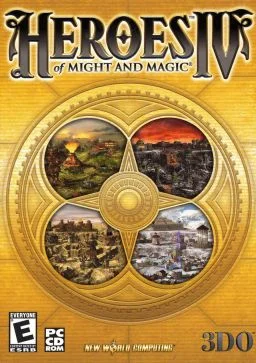
Heroes of Might and Magic IV
 84
★ /10
84
★ /10
 PC
PC
 New World Computing
 Buka,
Buka,  The 3DO Company,
  Ubisoft
Where to buy

Heroes of Might and Magic IV (2002) is the most polarizing, fiercely debated, and radically experimental chapter in the history of the legendary turn-based strategy franchise. Developed by New World Computing and published by The 3DO Company during its final, turbulent financial days, Heroes IV took the universally worshipped, flawless blueprint of Heroes III and boldly tossed it out the window.
Instead of delivering a safe, iterative sequel, the developers executed a series of sweeping, fundamental mechanical overhauls that turned the game into a fascinating hybrid of macroscopic empire management and hardcore, open-ended role-playing.
The Narrative Backdrop: The Reckoning
The game’s prologue serves as the apocalyptic end-cap to the classic era of the franchise. Picking up directly where Heroes Chronicles: The Final Chapters left off, Gelu’s Armageddon’s Blade and King Kilgor’s Sword of Frost violently collide in battle. The resulting cataclysm—known as The Reckoning—completely obliterates the ancient planet of Enroth and the continent of Antagarich.
Amidst the planetary collapse, mysterious magical portals flare to life, allowing a desperate fraction of the population to flee into the rifts. The survivors emerge onto a completely new, lush, and untamed fantasy world called Axeoth, where the displaced factions must carve out a fresh existence from scratch.
The Great Disruptions: Radical Gameplay Inversions
What made Heroes IV deeply controversial to series purists—yet fiercely beloved by a dedicated cult following—comes down to a few massive, structural re-engineering choices:
1. Heroes on the Frontlines
In every prior Heroes game, your General was an ethereal commander who stood safely on the sidelines, passively boosting troop stats and casting spells from afar. In Heroes IV, Heroes are physical combat units on the hex grid.
- They occupy a literal slot in the army formation.
- They can physically swing weapons, take retaliatory damage, and be targeted by enemy archers.
- A Hero can be knocked unconscious or permanently killed mid-combat. If your army wins the battle but your Hero dies, you must physically haul their corpse in a casket back to a town’s sanctuary to resurrect them.
2. No Hero Required & The Fellowship Meta
Because creatures can now move, scout, and claim resource mines independently across the adventure map without a general leading them, the baseline rules of army composition completely dissolved:
- The Monster Swarm: You can field an army consisting entirely of wandering monsters with no Hero attached.
- The Adventuring Party: Conversely, you can stack up to seven individual Heroes into a single army slot with zero creatures. This allowed players to play the game like a traditional party-based RPG (e.g., Might and Magic or Baldur’s Gate), creating an unstoppable, synchronized squad of high-level warriors and wizards who traveled the map plundering dungeons.
3. The Branching Choice of Dwellings
The town infrastructure abandoned the standard 7-tier vertical unit tracks of Heroes III. Heroes IV streamlined towns into four distinct Tiers of power, entirely eliminating upgraded unit variants.
More drastically, it introduced exclusive structural choices. For Tiers 2, 3, and 4, you are forced to choose between two mutually exclusive creature dwellings. Building one permanently locks out the other in that specific city for the rest of the match, forcing you to constantly adapt your army composition:
| Faction/Alignment | Tier 2 Choice | Tier 3 Choice | Tier 4 Choice |
| Haven (Life) | Ballistas vs. Spearmen | Crusaders vs. Monks | Champions vs. Angels |
| Academy (Order) | Magi vs. Gold Golems | Genies vs. Nagas | Titans vs. Dragon Golems |
| Preserve (Nature) | Elves vs. White Tigers | Griffins vs. Unicorns | Faerie Dragons vs. Phoenixes |
| Asylum (Chaos) | Medusas vs. Minotaurs | Nightmares vs. Efreet | Black Dragons vs. Hydras |
| Necropolis (Death) | ghosts vs. Cerberi | Vampires vs. Liches | Bone Dragons vs. Devils |
4. The Caravan System
Perhaps the most universally praised quality-of-life feature introduced in Heroes IV was the Caravan. Prior to this, reinforcing a forward army meant hiring a weak “courier” Hero to manually walk across the map every single week to collect units from secondary towns and outer dwellings. The Caravan automated this entirely, allowing players to order units from across your empire to autonomously travel directly to a centralized hub or frontline fort over a set number of turns.
The Factions and the Prestige Class System
The game features six primary alignments, completely ditching traditional static hero templates in favor of a massive, dynamic skill-matrix. Heroes can learn traits across 9 primary skills and 5 distinct magic schools. Mixing and matching two different secondary skill tracks automatically unlocks one of over 40 specialized Prestige Classes, which bestows an exclusive, powerful passive trait onto your commander:
- Haven (Life Magic): High defensive preservation, healing, and resurrection. Developing life magic and physical combat unlocks the Paladin class, granting permanent extra warding and melee damage multipliers.
- Academy (Order Magic): The absolute masters of battlefield control, teleportation, illusions, and mind control. Mixing Order Magic and Scouting unlocks the Seer, significantly expanding map vision and movement parameters.
- Preserve (Nature Magic): Specialized in terrain mobility and infinite summoning loops. A high-tier Nature Hero can spend their combat turns endlessly summoning Mantises, Elementals, or Water Elementals directly behind enemy lines.
- Asylum (Chaos Magic): Pure, destructive asymmetric warfare. Home to raw offensive fire/lightning spells. Combining Chaos Magic with Combat skills creates the Battle Mage, boosting the raw spell power of direct offensive nukes.
- Necropolis (Death Magic): Infamous for its broken execution of the Necromancy skill. High-tier Death Heroes don’t just raise simple Skeletons anymore; they can actively reanimate fallen enemy casualties as elite, self-healing Vampires.
- Stronghold (The Might Counter-Meta): Stronghold is the ultimate subversion of the game’s magic system. They are fundamentally forbidden from building Magic Guilds. To balance this, their Heroes specialize in pure, brutal physical attributes. A Stronghold Barbarian who scales into a Grandmaster of Combat and Magic Resistance morphs into an unstoppable, magic-immune, one-man army capable of physically punching out Dragons and Titans by themselves.
Overhauled Combat and Isometric Presentation
The game dropped the flat, side-scrolling hex grid of its predecessors in favor of a vibrant, highly detailed isometric perspective. Combat was rebuilt around true line-of-sight and cover rules. Continuous battlefield obstacles (like rocks, trees, or city castle ruins) physically block ranged projectile trajectories or significantly degrade incoming arrow damage, forcing ranged units to constantly reposition to secure clear firing lines.
Expansions & Modern Lifecycle
- The Gathering Storm (2002): The first expansion added six narrative campaigns tracking five distinct Heroes who must hoard legendary ancient artifact sets to defeat a rogue, mad arch-mage named Hexis.
- Winds of War (2003): The final expansion took place on the continent of Axeoth, mapping a massive, chaotic 5-way invasion of the magnificent kingdom of Channon, culminating in highly tactical, scenario-driven siege maps.
- The Equilibris Mod & Modern Availability: Because New World Computing was forced to rush the game out the door right as 3DO was collapsing into bankruptcy, the base retail launch was notoriously plagued by buggy AI, unpolished pathfinding, and a complete lack of multiplayer infrastructure. Today, the strategy community keeps the title perfectly preserved on GOG through the essential Equilibris Mod—a massive, community-driven balance patch that overhauls multiplayer netcode, fixes campaign script logic, adjusts asymmetrical creature costs, and restores the game to its intended mechanical glory.
The Auditory Masterpiece
No overview of Heroes IV is complete without celebrating its soundtrack. Composed by Paul Romero, Rob King, and Steve Baca, the audio architecture abandons traditional orchestral bombast in favor of a breathtaking, acoustic collection of Celtic, operatic baroque, and Renaissance folk music. Utilizing real flutes, live violins, and haunting vocal solos, the soundtrack is widely considered by video game historians to be one of the greatest musical arrangements ever recorded for the medium.
Release Platforms & Timeline
- Heroes of Might and Magic IV (Base Game): * PC (Windows): March 28, 2002 (North America) / April 25, 2002 (Europe)
- Mac OS: November 13, 2002
- The Gathering Storm (First Expansion): * PC (Windows): September 24, 2002
- Winds of War (Second & Final Expansion): * PC (Windows): February 25, 2003
- Modern Availability: Fully optimized and bundled together natively as Heroes of Might and Magic IV: Complete on digital storefronts like GOG.