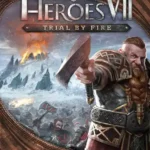
Might & Magic Heroes VII: Trial by Fire
Expansion of Might & Magic Heroes VII PC
PC Ubisoft
Where to buy

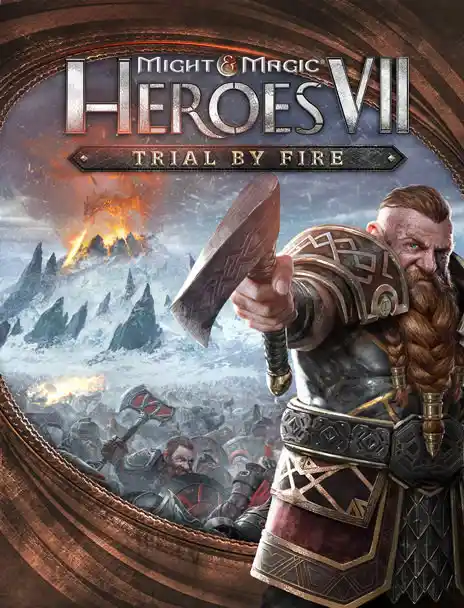
Might & Magic Heroes VII: Trial by Fire (2016) is the first, final, and only official standalone expansion pack developed for the seventh generation of the turn-based strategy franchise.
Created by Limbic Entertainment and published by Ubisoft, Trial by Fire is a highly bittersweet milestone for the community. While it succeeded in injecting highly requested mechanics and a massive new faction into the game, its release coincided with Ubisoft’s abrupt announcement that official development of the Heroes VII engine had permanently concluded, leaving this expansion as the definitive retail curtain call for the Ashan universe continuity.
The Narrative: The Ambassador’s Parables
The expansion takes place five years after the grueling war of succession won by Emperor Ivan Griffin in the base game. A tense geopolitical crisis breaks out on the imperial borders as rogue raiding bands of mountain Dwarves breach human territory, pushing the newly formed Holy Griffin Empire to the absolute brink of a total catastrophic war.
Hoping to freeze the conflict before blood is spilled, Vilma, a respected leader of the Sudgerd Dwarves, arrives at Ivan’s court as an ambassador. The game’s two standalone campaigns are framed as Vilma’s historical parables. She recounts the darkest, most hidden chapters of Dwarven history, teaching Ivan how past misunderstandings between humans and mountain clans nearly shattered the world, providing him the diplomatic tools needed to forge a peaceful truce.
The Fortress: A Norse Mythology Inversion
The primary mechanical inclusion of the expansion is the return of the Fortress Faction. While Heroes V introduced a fairly traditional fantasy execution of the Dwarves, Trial by Fire heavily overhauled their faction aesthetic, filtering the architecture and unit rosters directly through deep Norse mythology and subterranean monster lore:
| Unit Category | Base Creature | Upgraded Variant | Tactical Grid Identity & Lore |
|---|---|---|---|
| Core | Kobold Scout | Kobold Pathfinder | Nimble subterranean line fillers; trade heavy physical health points for excellent trap-laying and tracking stats. |
| Core | Defender | Shieldguard | The classic armored frontline vanguard; boasts incredibly high physical defensive parameters and blocks structural chokepoints. |
| Core | Bear | Blackbear | Low-tier, high-mobility cavalry; physical charges push enemy formations backward across hex tiles. |
| Elite | Rune Priest | Rune Patriarch | Ranged fire mages; attacks leave dynamic, multi-tile magma firewalls on the grid that burn units walking through them. |
| Elite | Disir | Valkyrie | Shield-maiden airborne units; swoop across battlefield obstacles to cleave formations and radiate inspiring morale modifiers. |
| Elite | Lava Elemental | Magma Elemental | Slow-moving physical tanks; sport complete elemental immunity to fire and reflect status-effect burn damage to adjacent melee attackers. |
| Champion | Fire Giant | Einherjar | Colossal, armored Norse giants wielding colossal, lava-infused swords that strike multiple stacked squares via a sweeping arc. |
| Champion | Red Dragon | Ardent Dragon | High-speed aerial apex predators; breathe catastrophic cones of pure fire that decimate clustered ranged lines. |
Export to Sheets
The Return of Rune Magic
Just like their previous iteration, the Fortress faction operates on a separate combat spell system called Rune Magic. Rather than only burning traditional mana pools to drop offensive nukes, a Dwarven hero can apply raw combat runes directly to their moving unit stacks.
Activating a Rune consumes raw physical materials (such as Wood, Ore, Starsilver, or Dragonblood Crystals) directly from your kingdom’s macro global treasury. These runes grant immediate, game-turning, single-turn buffs—such as instantly doubling a unit’s movement speed pool, granting a temporary 50% physical dodge evasion rate, or causing a squad’s attacks to hit with armor-piercing accuracy.
The Patch 2.0 Engine Evolution
Because Trial by Fire was built as a standalone client, its launch natively introduced Patch 2.0, which fundamentally modernized the base Heroes VII ecosystem even for players who didn’t buy the Dwarven campaigns:
- In-Game Random Map Generator (RMG): Officially fixed the game’s extreme map scarcity, allowing players to instantly generate randomized multiplayer and single-player skirmish maps supporting varied geographical scales and underground map layouts.
- Visual Skill Wheel Improvements: Stripped away confusing interface formatting to make hero ability mapping perfectly clear and visible from turn one.
Release Platforms & Timeline
- PC (Microsoft Windows): August 4, 2016 (Global Digital & Standalone Retail Release)
- Definitive Package Integration: The expansion represents the absolute final balance state (Version 2.21) of the engine. It is currently natively integrated into Might & Magic Heroes VII: Complete Edition on platforms like Ubisoft Connect and Steam, unifying all base factions, the Lost Tales of Axeoth DLC packs, and the Dwarven campaigns under one single launch window.