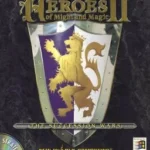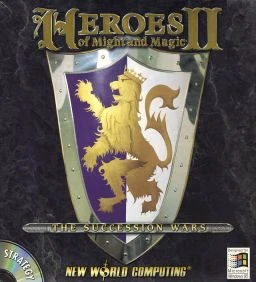
Heroes of Might and Magic II:The Succession Wars
 PC
PC New World Computing
 The 3DO Company
 Ubisoft
Where to buy

Heroes of Might and Magic II: The Succession Wars (1996) is widely considered the true architectural foundation of the franchise. While the 1995 original proved the concept of blending turn-based empire-building with tactical RPG progression, Heroes II refined the presentation, mechanics, and faction diversity into a formula that would ignite the golden era of the series.
The Narrative: Civil War in Enroth
The game’s overarching structure is anchored to a high-stakes royal succession crisis. Lord Morglin Ironfist has died, leaving behind a power vacuum and two completely polarized sons who launch a bloody civil war for the crown of the continent of Enroth:
- Prince Roland: The noble, traditionalist archetype who commands the “good” alignment factions (Knights, Sorceresses, Wizards).
- Prince Archibald: The ruthless, deceptive opportunist who relies on the “evil” alignment domains (Necromancers, Warlocks, Barbarians).
The campaign allows players to choose a brother, introducing branching mission trees where you can accept bribes to switch allegiances mid-war or execute high-risk tactical strikes to sabotage your brother’s economic supply lines.
The Faction Shakeup
Heroes II expanded the roster from four factions to six, fundamentally diversifying the asymmetric battlefield:
- The Necromancer (New): A highly unique faction that converts the bodies of fallen enemies into permanent skeleton squads via the Necromancy skill. Their ranks feature life-stealing Vampires, long-range Liches, and terrifying Bone Dragons.
- The Wizard (New): A highly technical, late-game powerhouse operating out of floating cloud castles. They boast heavily armored steel Golems, spell-casting Magi, and the supreme Giants/Titans, who serve as the game’s ultimate ranged unit.
- The Returning Classes: The physical Knight and aggressive Barbarian retain their focus on “Might” logistics, while the woodland Sorceress and subterranean Warlock control high-speed, spell-forward armies.
The Mechanical Trinity
The reason Heroes II felt like an entirely different beast compared to its predecessor comes down to three massive gameplay overhauls:
- Secondary Skills System: For the first time, leveling up wasn’t just a basic stat boost. Heroes could now learn and level up 14 unique secondary traits (such as Logistics for extra land movement, Wisdom for learning high-tier magic, or Diplomacy to convince neutral armies to join your side). A hero could hold up to 8 of these skills, scaling from Basic to Advanced to Expert.
- The Spell Point Revolution: The game abandoned the restrictive “spell memorization” mechanic of the first game. Knowledge was re-engineered to act as a proper Mana Pool baseline (1 Knowledge = 10 Spell Points). This gave spellcasters the tactical flexibility to cast Lightning Bolt or Haste repeatedly in a single combat loop, provided their pool held out.
- Unit Upgrades: Town management became infinitely more strategic. Players could now pay extra resources to upgrade production buildings, morphing basic creatures into elite variants (e.g., Green Dragons into completely magic-immune Black Dragons, or Vampires into Vampire Lords who regenerate health by drinking enemy blood).
Operatic Presentation
Beyond its addictive gameplay, Heroes II is legendary for its artistic identity. The game dropped the crude visuals of the first title in favor of breathtaking, brightly saturated, hand-drawn fairytale pixel art.
More famously, it introduced a sweeping, highly theatrical soundtrack composed by Paul Romero and Rob King. Whenever a player entered a town screen, the game deployed full-blown, classical operatic vocal arrangements matching the faction’s theme (such as booming, dark baroque vocals for the Necromancer or ethereal choral tracks for the Sorceress).
Release, Expansions, and Modern Lifecycle
- The Succession Wars: November 16 1996
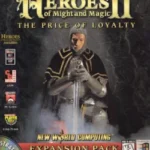
- The Price of Loyalty (1997 Expansion): Developed by Cyberlore Studios, this add-on packed in four massive standalone campaigns, new artifacts, and structures. It famously introduced the controversial Barrow Mounds ghost generator, which allowed players to easily snowball a game-breaking, invincible army of self-replicating spirits.
- Heroes II Gold (1998): The definitive retail bundle containing the base game, the expansion, and dozens of premium custom maps.
- The Open-Source Resurrection (fheroes2): Today, the game enjoys an incredibly vibrant modern ecosystem thanks to fheroes2 (Free Heroes 2), a meticulous, open-source engine recreation project. It allows modern players to experience Heroes II flawlessly on current hardware, adding native widescreen/4K resolution scaling, instantaneous AI turn times, a revamped combat interface, and tons of customizable bug-fixes.