Shifters
 37
★ /10
37
★ /10
 PS 2
PS 2 The 3DO Company
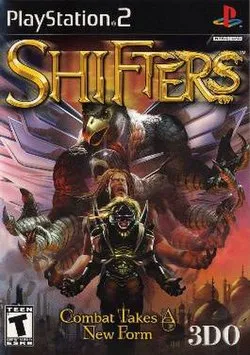
Shifters (also known during development as Shifters of Might and Magic) is a 2002 third-person action RPG developed and published directly by The 3DO Company.
Serving as the direct sequel to the PlayStation 2 version of Warriors of Might and Magic, the title stands out as a fascinating, weirdly experimental entry in the franchise’s final console push. Released just a year before 3DO completely collapsed into bankruptcy, it took the dark-fantasy backdrop of the series and smashed it head-first into steampunk aesthetics, completely replacing traditional equipment grinding with a massive monster-shapeshifting mechanic.
The Narrative: The Steampunk Invasion
The story marks the return of Alleron, the disgraced former Captain of the Guard who successfully broke the “Mask of Shame” curse in the previous game. However, any peace he earned is instantly shattered by a bizarre, reality-warping cosmic threat.
- Flesh and Metal: A massive, terrifying horde of cyborg-like invaders—part flesh, part cybernetic metal machinery—has breached the realm.
- The Industrialization of Ashan: Led by a ruthless mechanical mastermind, these invaders are actively tearing down ancient elven forests and human kingdoms, forcefully replacing them with polluted, steam-powered industrial cities.
- The Gift of Change: Early in his quest to intercept the invasion, Alleron crosses paths with a powerful wizard who grants him an extraordinary, mutating capability: the power to absorb the essence of fallen monsters and physically morph his body into their shapes to turn the invaders’ weapons against them.
Core Gameplay Mechanics: The Shapeshifting Sandbox
While Warriors relied on a standard loot loop where you visually swapped out armor plates and weapons, Shifters completely discarded this. Alleron’s primary method of progression is his ability to assume 24 entirely different creature forms.
- The Matrix of Forms: The monster roster is divided into multiple distinct species lines (such as Humanoid Rams, Gryphon hybrids, Automotrons, and Genies), with each family tier possessing 4 progressively stronger evolutionary variants.
- Environmental Key-and-Lock Puzzles: Shapeshifting isn’t just used to increase your raw physical damage output in combat; it acts as an active exploration mechanic. The game features six distinct worlds littered with secret locations that are completely inaccessible to a standard human. For example, a hallway blocked off by tight iron grates can only be bypassed if you shift into a Genie and cast a specialized Gaseous Form spell to slide through the slots.
- Simplified Attribute Tiers: Instead of juggling a massive grid of stats, character progression is streamlined into three fundamental pillars: Mind (governing magic capabilities and spellbook capacity), Body (governing hit points and structural defenses), and Spirit (boosting physical strength and range multipliers).
Critical Reception & Flawed Execution
Upon release, Shifters was hit with heavily mixed to intensely negative critical scores from gaming outlets. While historians and fans heavily praised 3DO’s bold attempt to do something radically distinct with the Might and Magic brand—particularly the impressive variety of the 24 playable monster forms and the smooth framerate—the game was severely bottlenecked by technical execution flaws:
- The Camera Nightmare: The game suffered from a notoriously clunky, rigid camera tracking system that regularly got stuck directly inside wall textures during tight corridor battles.
- Slippery Physics: Character movement models felt unpolished and “floaty,” making basic jumping segments across industrial platforms incredibly frustrating.
- Bland Baseline Combat: Despite the wild visual variance of the monster skins, the basic core combat loop quickly devolved into repetitive button-mashing.
Release Dates & Technical Platforms
- PlayStation 2 (Europe): April 26, 2002
- PlayStation 2 (North America): June 17, 2002
- PlayStation 2 (Australia): Late 2002
Digital Availability Notice
Just like its predecessor, Shifters is completely unavailable on modern digital storefronts like GOG or Steam. While there is a community wishlist page hosted on GOG, the game remains bound entirely to legacy 3DO publishing rights and console-exclusive code. To play it today, strategy and action-RPG history buffs must rely entirely on original physical PS2 black-label discs or open-source software emulation (PCSX2).