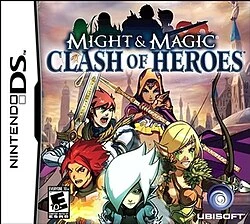
Might & Magic: Clash of Heroes
 86
★ /10
86
★ /10
 Android,
  iOS (iPhone/iPad),
  Nintendo DS,
  Nintendo Switch,
  PC,
PC,  PS 3,
PS 3,  PS4,
PS4,  Xbox 360
 Ubisoft
Where to buy

Might & Magic: Clash of Heroes is widely considered one of the greatest hidden gems, structural triumphs, and addictive spin-offs in the entire history of the franchise. Originally developed by Capybara Games and published by Ubisoft, the title seamlessly blends turn-based fantasy role-playing with intense, combative “Match-3” puzzle logistics.
By tossing out traditional grid movement in favor of a dual-screen tactical puzzle board, the game delivers an elegant “easy to learn, brutally hard to master” loop that has sustained its popularity across multiple hardware generations.
The Narrative: The Orphans of Ashan
The storyline serves as a direct prequel set roughly 40 years before the cataclysmic events of Heroes of Might and Magic V, taking place in the unified universe of Ashan.
The prologue introduces five young nobles and heirs whose parents and guardians are suddenly and brutally slaughtered during a surprise demonic ambush designed to steal the Blade of Binding—a cosmic relic capable of controlling demon lords. To escape execution, the five children scatter through unstable magical portals, emerging in completely different corners of the world.
The extensive, 20+ hour single-player campaign is split across five distinct chronological chapters, tracking these children as they grow into hardened tactical generals, assemble regional armies, and systematically coordinate a multi-front counter-offensive to avenge their families and avert a demonic apocalypse:
[Anwen]    ->    [Godric]    ->    [Fiona]    ->    [Aidan]    ->    [Nadia]
(Sylvan)          (Haven)       (Necropolis)       (Inferno)      (Academy)
Core Gameplay Mechanics: Puzzle-Strategy Warfare
Exploration plays out on a stylized, node-based overworld map where your hero travels case-by-case to plunder resource chests, hunt for side-quests, and purchase elite creatures. However, when you engage an enemy, the game transitions to a vertical battlefield grid split cleanly down the middle: the enemy commands the top screen, and you command the bottom screen.
Combat relies on matching identical, color-coded units to execute macro military maneuvers:
- Attack Columns (Vertical Match): Creating a vertical line of three identical units of the same color fuses them into an active attacking force. This activates a countdown timer (e.g., 2 or 3 turns); when the timer hits zero, the column charges forward in a straight vertical line, smashing through opposing defenses to strike the enemy leader’s HP pool.
- Defensive Walls (Horizontal Match): Lining up three identical units horizontally instantly mutates them into a solid protective barrier. Walls intercept incoming enemy columns, absorbing the brunt of the kinetic damage to safeguard your backline.
- Elite & Champion Mechanics: Beyond standard “Core” units, your army layout can include massive multi-tile entities (like Knights, Wraiths, or Dragons). To trigger these super-units, you cannot simply match them; you must physically place the required number of matching-colored Core units directly behind them to feed them charge energy.
- The Combo Link Meta: The ultimate skill expression lies in chaining movements. Erasing a unit to cause a cascading double-match triggers Link or Fusion buffs, which instantly slashes countdown timers or doubles your outgoing attack power.
Faction Variations
Every chapter changes your mechanical parameters by handing you a completely different faction army, exclusive artifact items, and a unique, tide-turning Hero Spell:
- Sylvan (Elves): Focused heavily on agility and passive terrain manipulation. Their base Walls automatically grow and heal themselves over time, and their core Pixies can instantly channel mana to speed up adjacent countdowns.
- Haven (Humans): Built for high physical durability and defensive healing. Their Priests actively restore health points to your hero every single turn they remain on the board, while their Knights hit with devastating physical momentum.
- Necropolis (Undead): Specializes in absolute battlefield attrition and psychological crowd-control. Their Plague Zombies inflict corrosive poison that drains enemy action pools, while their Vampires drain the physical health of opposing blocks to heal your leader.
- Inferno (Demons): Pure asymmetrical, destructive chaos. Their Sorceresses can bypass enemy walls entirely via portal projectiles, and their Pit Lords hit with cataclysmic splash damage that sets adjacent columns on fire.
- Academy (Wizards): A highly technical faction designed for intricate spell mastery. Their Golems absorb incoming kinetic impacts to boost their own offensive power, and their Djinns freeze target enemy units in solid blocks of ice.
The Evolution of Versions
The game’s brilliant design has seen it continually updated and ported across various media formats:
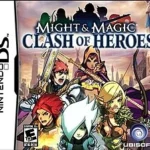
- The Nintendo DS Original (2009): The foundational blueprint. It utilized beautiful 2D pixel-art and masterfully assigned tactical commands to the lower touch-screen while displaying active animations on the top screen.
- The High-Definition Era (2011): Released for PC and home consoles, this version completely scrubbed the low-res sprites, replacing them with hand-painted HD artwork, fully animated cutscenes, completely re-balanced multiplayer parameters, and 1v1/2v2 local and online competitive matchmaking.
- The Definitive Edition (2023): Developed and published by the retro revitalization masters at Dotemu, this ultimate release perfectly preserved Capybara’s masterpiece for the current generation. It integrated all historical piece-mail DLC (including the I Am the Boss villain pack), completely redrew high-resolution character portraits, introduced comprehensive quality-of-life interface speed toggles, and fully overhauled the netcode framework for smooth online ranked ladder play.
Release Dates & Platforms Timeline
- Nintendo DS (Original): December 1, 2009 (North America) / February 26, 2010 (Europe)
- PlayStation 3 (HD Version): April 12, 2011
- Xbox 360 (HD Version): April 13, 2011
- PC (Microsoft Windows – HD): September 22, 2011
- iOS Mobile Port: January 24, 2013
- Android Mobile Port: June 27, 2013
- Definitive Edition (PC, Nintendo Switch, PlayStation 4): July 20, 2023