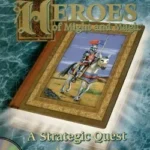
Heroes of Might and Magic: A Strategic Quest
 Game Boy Color,
  PC
PC
 New World Computing
Where to buy

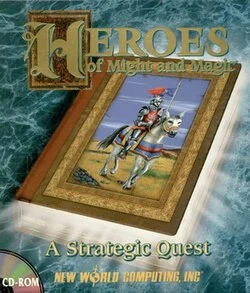
Heroes of Might and Magic: A Strategic Quest (1995) is the legendary foundational spark that ignited one of the most celebrated turn-based strategy franchises in PC gaming history. Developed by Jon Van Caneghem and his team at New World Computing, this iconic title began as a tactical spin-off of their flagship Might and Magic first-person RPG series.
By marrying deep fantasy role-playing progression with tight, resource-driven map control, it established a “just one more turn” loop that would define strategy gaming for decades.
The Four Founding Factions
Long before the franchise expanded into Necromancers, Elves, and Steampunk airships, the entire universe was balanced across four fundamental factions, each led by an iconic warlord vying for control over the continent of Enroth:
- The Knight (Lord Morglin Ironfist): The baseline “Might” faction. Operating out of traditional farms and castles, they rely on cost-effective, sturdy human troops. Their army chain stretches from fragile Peasants and Archers up to heavily armored Paladins.
- The Barbarian (Lord Slayer): The aggressive, brute-force “Might” faction. They dominate the plains by sacrificing magical prowess for raw offensive multipliers. Their roster features fast-moving Goblins, Orcs, and the towering Cyclops.
- The Sorceress (Queen Lamanda): A high-mobility “Magic” faction deeply rooted in the enchanted woodlands. They specialize in evasive units, high initiative, and battlefield control, deploying Sprites, Elves, and mystical Unicorns.
- The Warlock (Lord Alamar): The undisputed, late-game power trip “Magic” faction. Operating from dark volcanic rifts, they boast the most expensive but devastating creature lineup in the game, culminating in the near-invincible, magic-immune Dragons.
The Dual-Layer Gameplay Loop
A Strategic Quest perfected a highly addictive, split-screen gameplay loop that became the blueprint for the entire series:
- The Adventure Map: Played out like a digital board game. Players send their recruited Generals (“Heroes”) through the fog of war to claim daily resource mines (Gold, Wood, Ore, Crystal, Sulfur, Gems, and Mercury), scoop up treasures, and uncover ancient artifacts to permanently buff stats.
- The Combat Hex Grid: When two armies clash, the game transitions to a close-up, turn-based tactical arena. Because the first game features a highly simplified combat structure, units cannot be upgraded, and your Heroes cannot physically hit anyone. Instead, the Hero stands safely on the sidelines, boosting their troops’ defense/attack stats and dropping game-changing spells.
The Archaic Magic System
For modern players accustomed to standard mana bars, the magic system of the original Heroes is a fascinating, unforgiving time capsule:
- Spell Book Memorization: There are no mana points. To learn a spell like Lightning Bolt or Armageddon, your Hero must physically buy a Spell Book and visit a town’s upgradeable Mage Guild.
- The Knowledge Cap: A Hero can only cast a spell a finite number of times equal to their Knowledge statistic. If your Knowledge is 3, you get exactly three casts of Fireball. Once those slots are emptied mid-expedition, your wizard is functionally firing blanks until they track all the way back to a friendly town to manually re-memorize the incantations.
Summary
Heroes of Might and Magic: A Strategic Quest is an absolute masterpiece of minimalist, impactful design. While it lacks the mechanical complexity, secondary skills, and vast rosters of its legendary sequels (like Heroes II and III), its sheer purity is its greatest strength. It remains highly playable today, offering a bright, vibrant fantasy landscape where a single army management misstep can result in your empire collapsing in the blink of an eye.
Release Platforms
- MS-DOS (PC): August 1995 (The original floppy disk and CD-ROM release)
- Windows 95: 1996 (Remastered port adding a native map editor)
- Game Boy Color: 2000 (A remarkably scaled-down 8-bit technical miracle)
- Modern Availability: Fully optimized for modern operating systems and natively bundled on digital storefronts like GOG and Ubisoft Connect.