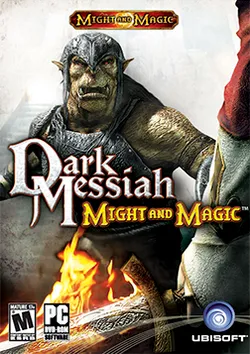
Dark Messiah: Might and Magic
 72
★ /10
72
★ /10
 PC
PC Xbox 360
 Buka
Buka Ubisoft
Where to buy

Dark Messiah of Might and Magic (2006) occupies a legendary, highly respected spot in PC gaming history. Developed by the celebrated masters of the immersive sim genre, Arkane Studios (the team that would go on to create Dishonored, Prey, and Deathloop), and published by Ubisoft, this title took the Might & Magic brand name and violently threw it into a gritty, first-person action crucible.
Rather than relying on safe, traditional fantasy RPG tropes, Arkane licensed Valve’s famous Source Engine (the powerhouse behind Half-Life 2) and heavily modified it to build one of the most physically responsive, kinetic, and hilariously brutal first-person melee combat engines ever coded.
The Narrative: The Walk Between Worlds
The plot serves as a direct, dark narrative continuation of the Ashan universe timeline established in Heroes of Might and Magic V.
According to an ancient, apocalyptic prophecy written by the disciple Sar-Shazzar, a half-human, half-demon child—the Dark Messiah—will one day emerge to claim the relics of the Seventh Dragon and permanently shatter the fiery prison holding the demon lords.
- The Apprentice: Players step into the boots of Sareth, an orphan trained in the lethal arts of magic and steel by his mysterious, cold guardian, the wizard Phenrig.
- The Mission: Sareth is dispatched to the grand city of Stonehelm to assist an expedition looking to plunder a catastrophic ancient artifact: The Skull of Shadows.
- The Voice in the Head: To guide him on his journey, Phenrig magically tethers Sareth’s soul to a seductive, highly manipulative demonic entity named Xana. Xana acts as a continuous, telepathic narrator, actively whispering promises of absolute power, encouraging Sareth to embrace his inner dark side, and triggering a branching moral choice at the game’s finale that determines the fate of Ashan.
Gameplay Mechanics: The Legendary “Kick” & Environmental Physics
While Dark Messiah featured traditional linear RPG leveling across Warrior, Mage, and Assassin skill trees, the core minute-to-minute gameplay loop is remembered as a masterclass in spatial combat and hilarious physics interactions:
- The Mighty Boot: The true protagonist of Dark Messiah isn’t Sareth—it’s his Kick button. Arkane masterfully implemented physics-driven level layouts explicitly designed to turn the environment into a weapon. Rather than just chipping away at a massive Orc’s health pool with a sword, players could simply kick them off mountain ledges, boot them directly into conveniently placed walls of rusted wall-spikes, or kick down wooden scaffoldings to crush a platoon of Necromancers.
- Directional Melee Awareness: Combat discarded mindless button-mashing. Clicking the attack button triggered a simple swing, but holding it down initiated a power strike. Crucially, the direction you were moving Sareth at that exact second determined the attack profile—strafing sideways resulted in a sweeping horizontal cleave, while pushing forward triggered a devastating, shield-shattering impale.
- Emergent Magic System: Spellcasting heavily prioritized tactical battlefield manipulation over simple damage numbers. Casting a simple Freeze spell onto a stone floor didn’t just damage incoming enemies; it created a frictionless patch of ice, causing charged guards and sprinting goblins to realistically slip, lose their footing, and slide off cliffs to their deaths.
- The Adrenaline Meter: Landing clean strikes filled a localized Adrenaline bar. Once maximized, your next physical swipe or ranged projectile instantly triggered a slow-motion, highly cinematic, and deeply gory decapitation execution.
The Two Versions: PC vs. Xbox 360 “Elements”
True to the multiplatform era, the title received a console adaptation that fundamentally shifted its baseline identity:
- The PC Original (2006): Developed strictly by Arkane Studios, this version is the definitive experience. It leaned entirely into the open-ended “Immersive Sim” design philosophy, allowing players to fluidly cross-class skills (e.g., creating a stealthy assassin who uses a Rope Bow to climb rafters but drops Fireballs from above).
- The Xbox 360 “Elements” Port (2008): Handed off to Ubisoft Annecy, this console remaster was severely compromised. To account for hardware limitations, it completely stripped away the flexible multi-class skill evolution layout. Instead, it forced players into rigid, unchangeable character templates chosen at the start of a new game, significantly dialing back the sandbox experimentation that made the PC version a cult classic.
Release Platforms & Timeline
- PC (Microsoft Windows): * October 24, 2006 (North America)
- October 27, 2006 (Europe)
- Xbox 360 (Dark Messiah: Elements): * February 12, 2008 (North America)
- February 15, 2008 (Europe / PAL)
- Modern Lifecycle: While fans continue to campaign for a remastered re-release on GOG’s DRM-free storefront, the PC version remains perfectly accessible and heavily active today directly on Steam. Thanks to modern hardware power and community community-run engine patches, players can crank up the Source Engine’s physics parameters to enjoy flawless widescreen frame rates without the heavy performance crashes that plagued its 2006 retail debut.