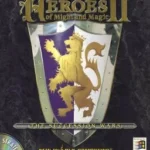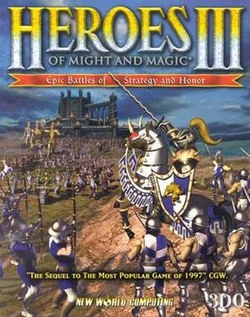
Heroes of Might and Magic III:The Restoration of Erathia
 PC
PC
 New World Computing
 Buka,
Buka,  The 3DO Company,
  Ubisoft
Where to buy

Heroes of Might and Magic III: The Restoration of Erathia (1999) is not just a game; it is a monument. Developed by New World Computing and published by the 3DO Company, it is universally celebrated as the absolute zenith of the turn-based strategy genre and one of the greatest PC games ever created.
By taking the pixel-art operatic charm of Heroes II and transforming it into a grittier, hyper-detailed fantasy ecosystem, the developers perfected a legendary “just one more turn” loop that continues to consume thousands of hours of playtime worldwide.
The Narrative: A Kingdom in Ruins
The campaign plunges you into the immediate aftermath of the assassination of King Nicolas Gryphonheart. With the ruler dead, the once-proud kingdom of Erathia is violently invaded from all sides by underworld lords, dark necromancers, and demonic forces.
You step into the boots of Queen Catherine Ironfist (the King’s daughter and wife of Roland from Heroes II), returning from overseas to rally the surviving loyalist factions, push back the foreign invaders, uncover her father’s murderer, and restore the crown of Erathia.
The Eight Pillars of Asymmetry
The base game features eight completely unique town factions (expanded to nine in the expansions), each with seven tiers of units that can all be individually upgraded into elite variants—a massive step up from Heroes II:
- Castle (Good): The quintessential human knight faction. Reliant on morale, excellent ranged marksmen, sturdy crusaders, and the supreme, tide-turning Archangels.
- Rampart (Good): The harmonious woodland sanctuary of Elves, Dwarves, Pegasi, and Unicorns, culminating in the majestic Gold Dragons.
- Tower (Good): The frozen mountaintop citadel of mages, alchemists, and mechanical constructs. Boasts gremlins, genies, nagas, and the devastating, long-range Titans.
- Inferno (Evil): A chaotic, brimstone-soaked domain of demons, imps, and cerberi, led by reality-warping Arch Devils.
- Necropolis (Evil): The terrifying home of the undead. Using the Necromancy skill, their heroes systematically convert every living enemy unit they kill into a permanent, snowballing swarm of Skeletons. Backed by life-stealing Vampire Lords and Ghost Dragons.
- Dungeon (Evil): The subterranean domain of warlocks and monsters. Features troglodytes, minotaurs, manticores, and the completely magic-immune, late-game terrors: Black Dragons.
- Stronghold (Neutral): An aggressive, brute-force barbarian horde. They ignore high-tier magic in favor of raw physical damage, deploying orcs, ogres, cyclopes, and massive Ancient Behemoths.
- Fortress (Neutral): A highly defensive swamp faction specialized in stalling tactics and counter-attacks, utilizing gnolls, lizardmen, gorgons (famous for their instant-kill Death Stare), and multi-headed Hydras.
Masterful Mechanical Evolution
Heroes III took the rough edges of its predecessor and polished them into mechanical perfection:
- The Subterranean Layer: Maps were effectively doubled in size by introducing a complete Underground Map. Players could slip into dark caves to navigate beneath enemy armies, ambush unprotected castles, and hunt for hidden treasures.
- The “Wait” Mechanic: Combat was revolutionized by the addition of a simple “Wait” button on the turn-based hex grid. This allowed high-speed, fragile units to delay their move until the enemy stepped forward, effectively letting you hit them twice in a row.
- Artifact Assembly: The game built upon the item sets of Heroes II, eventually allowing players to combine multiple specific relics on their hero’s paper-doll inventory screen to create legendary, game-altering super-artifacts.
Summary & Modern Lifecycle
Heroes of Might and Magic III remains a flawless tactical playground. Its balance of map exploration, economic resource starvation, hero customization, and deep hex-based combat is timeless.
While Ubisoft released an official HD Edition in 2015, it shockingly lacked the source code for the expansion packs. To get the true, definitive experience, the strategy community overwhelmingly points players toward the original GOG version, which is heavily bolstered by two legendary fan-made projects:
- Horn of the Abyss (HotA): A massive, community-developed expansion that is officially treated as the gold standard of balance. It fixes bugs, adds a new pirate-themed faction (Cove) and a steampunk faction (Factory), updates graphics, and hosts a competitive online multiplayer matchmaking lobby.
- HD Mod: A wrapper that introduces high-resolution support, widescreen scaling, and incredible quality-of-life interface hotkeys to the original game.
Release Timeline
- Microsoft Windows (PC): March 3, 1999 (Original release)
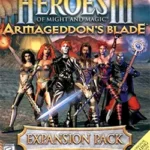
- Armageddon’s Blade (1999 Expansion): Added the elemental Conflux town and the random map generator.
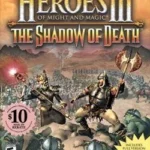
- The Shadow of Death (2000 Expansion): Served as a prequel, introducing a massive focus on combinable super-artifacts.