Might and Magic III: Isles of Terra
 Amiga
Amiga PC
PC SNES
SNES New World Computing
Where to buy

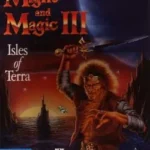
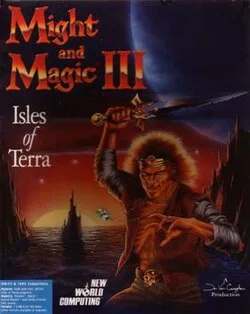
Might and Magic III: Isles of Terra (1991) is widely heralded as the monumental, revolutionary renaissance of the early franchise.
While Book One and Book Two laid down the strict structural math rules for New World Computing, Isles of Terra blew the doors off the technical limitations of the late 80s. Directed by Jon Van Caneghem, it transitioned the series into the modern era of PC gaming by introducing striking 256-color VGA graphics, full sound card audio, and a completely rewritten point-and-click mouse interface.
The Narrative: The True Nature of the “Grand Experiment”
The plot drops you onto the Isles of Terra—a beautiful, massive ocean world broken into six major inhabited island biomes. Canonically, you command a fresh team of local heroes (led by series icons like Crag Hack and Maximus) tracking the ancient journals of the archmage Corak.
- The Faction War: The surface of Terra is torn apart by a three-way political conflict between localized lords governing Good, Neutral, and Evil alignments.
- The Cosmic Revelation: As the party uncovers hidden keys, solves labyrinthine riddles, and explores ancient metallic pyramids, the medieval high-fantasy aesthetic fractures to expose the ultimate sci-fi truth. Terra is not a natural planet; it is a highly advanced Ancient seedship designed to travel the cosmos and seed planets with sentient life as part of a galactic “Grand Experiment.”
- The Sympathetic Villain: You discover Sheltem—the recurring antagonist—locked in physical combat with Corak. In a brilliant narrative twist, the game reveals Sheltem isn’t a demon; he is the official biome mechanical Guardian of Terra. A flaw in his programming caused him to view the Ancients’ colonist lifeforms as a hostile invading army. Everything he has done was an aggressive attempt to protect the native monsters of Terra.
- The Cliffhanger Escape: Before your party can subdue him, Sheltem bolts to the ship’s bridge and launches into deep space inside an escape capsule. Corak immediately commandeers a second pod to give chase, and your party hitches a ride on a trailing spacecraft—setting up a straight trajectory into the universe of Xeen.
Mechanical Evolutionary Leaps: Point-and-Click Warfare
The jump from Might and Magic II to III was mechanically jarring in the best possible ways:
1. Visible Encounter Fields
The franchise completely discarded blind random encounters. For the first time, monsters are physically visible on the pseudo-3D overworld map. You can watch enemy sprites approach you step-by-step.
- The Real-Time / Turn-Based Hybrid: As long as enemies are multiple steps away, exploration plays out in real-time. Your Archers and Sorcerers can fire ranged arrows or project magical nukes across map tiles to thin the herd before steel ever clashes.
- Once an enemy steps directly into your party’s immediate interaction square, the engine seamlessly locks into standard, turn-based close-quarters tactical melee combat.
2. The 10-Class Matrix (Introducing the Druid and Ranger)
The game preserved the 8 original classes from Book Two (Knight, Paladin, Barbarian, Ninja, Archer, Cleric, Sorcerer, Robber) and added two new hybrid entries, expanding the roster to 10 choices:
- The Druid: A specialized nature caster. While terrible in standard melee, they cast Nature Magic—a unique discipline combining select low-to-mid tier spells from both the Cleric and Sorcerer books alongside game-turning exclusives like Elemental Storm.
- The Ranger: A flexible “Jack-of-all-stats” hybrid. They fight moderately well, carry a shield, and cast lower-tier Druid magic, making them highly versatile map-clearers.
3. Living UI & The Magical Clock
The user interface became a responsive, living sandbox.
- Portrait Status Feedback: Your 6 chosen character portraits are highly interactive. If a character is poisoned, their face physically turns neon green; if they are hit with an unconscious status, their portrait slumps over; if they are eradicated by a sci-fi robotic laser weapon, their image is replaced by a tombstone.
- The 5:00 AM Reset: Magic operates on a strict global internal clock. Every morning at exactly 5:00 AM, a new magical calendar day begins, causing all active long-term buffs, defensive shields, and pathfinding spells cast the previous day to instantly dissolve, forcing tactical recast management.
Release Dates & Platform Lifecycles
- MS-DOS (PC Original): 1991 (North America) / 1992 (Europe)
- Macintosh / Amiga / PC-98: 1992
- TurboGrafx-CD (PC Engine): October 29, 1993 (Japan/US)
- Super Nintendo (SNES Port): January 1995 (Developed by Iguana Entertainment, this version scaled back text layers and implemented controller shortcut radial wheels.)
- Sega CD Build: 1993 (Japan) / 1994 (US)
Modern Preservation
The definitive, fully patched PC version of Isles of Terra is preserved and legally accessible on modern Windows 10 and 11 environments via GOG. It is natively bundled inside the Might and Magic® 6-pack Limited Edition. The digital client comes pre-loaded with an automated DOSBox architecture, packaging high-resolution original scanned map files and the digital 1991 cluebook.