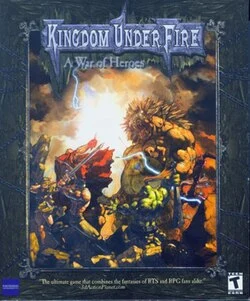
Kingdom Under Fire: A War of Heroes
 59
★ /10
59
★ /10
 PC
PC Gathering of Developers
Where to buy

Kingdom Under Fire: A War of Heroes (2001) is a dark fantasy real-time strategy (RTS) game that feels like the heavy-metal cousin of early Warcraft and StarCraft. Developed by the South Korean studio Phantagram, it distinguishes itself by being a “dual-genre” hybrid, grafting a deep, inventory-based RPG system directly onto the bones of a traditional resource-gathering RTS.
While its sequels eventually pivoted to massive battlefield action on consoles, the original was a PC powerhouse known for its high-fidelity 2D sprites and punishingly powerful hero units.
The Hero-Centric Strategy
In Kingdom Under Fire, the battlefield is ruled by Heroes. While you still harvest gold and iron to build bases, your primary tactical assets are individual champions who function as walking army-killers.
- RPG Progression: Heroes gain experience, level up, and can be equipped with a variety of items found in chests or dropped by enemies. A high-level hero with the right gear can often hold off entire platoons of standard units single-handedly.
- Mana Management: Unlike most RTS games of the era, the heroes have diverse active abilities that require precise timing and mana management, making them feel like characters out of a dungeon crawler.
- Impactful Casters: Beyond the main heroes, standard units like Clerics and Sorceresses have deep spellbooks, allowing for complex tactical plays like mind control, invisibility, and mass healing.
The Two-Tiered Battlefield: Surface and Underground
One of the game’s most ambitious features was the Underground layer.
- Tactical Depth: Many maps feature cave entrances or dungeons that lead to a subterranean level. This allows for flanking maneuvers that bypass surface fortifications entirely.
- Dungeon Crawling: Certain missions strip away the base-building entirely, forcing you to navigate your heroes through trap-filled corridors, turning the game into a pure isometric RPG for a stretch.
The Factions of Bersia
The game features two primary factions, each with a long-running narrative in the world of Bersia:
- The Human Alliance: A traditional coalition of Humans, Dwarves, and Elves. They rely on disciplined formations, strong defensive structures, and high-tech weaponry like Steam Tanks and Balloon Bombers.
- The Dark Forces: A chaotic horde of Orcs, Ogres, and Dark Elves. Their units are often physically stronger and rely on devastating black magic and biological monstrosities like the “Black Wyvern.”
Key Features
- High-Resolution 2D Art — Featuring some of the most detailed sprite work and animations of the early 2000s, with a grit that leaned more toward “Mature Fantasy.”
- Branching Hero Campaigns — Experience the war from both perspectives: follow Curian and the Human Alliance, or lead Rick Blood and the Dark Forces.
- Inventory Management — Collect and swap armor, weapons, and magical trinkets to customize your hero’s stat sheet.
- Massive Unit Variety — From standard footmen to giant mechanical walkers and legendary dragons, the unit roster is diverse and visually distinct.
- Voice-Acted Narrative — Full voice acting for major story beats, which was a significant production value for the time.
Release Platforms
- Microsoft Windows (PC) — January 16, 2001