Kingdom Under Fire II
 62
★ /10
62
★ /10
 PC
PC
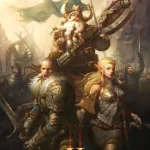
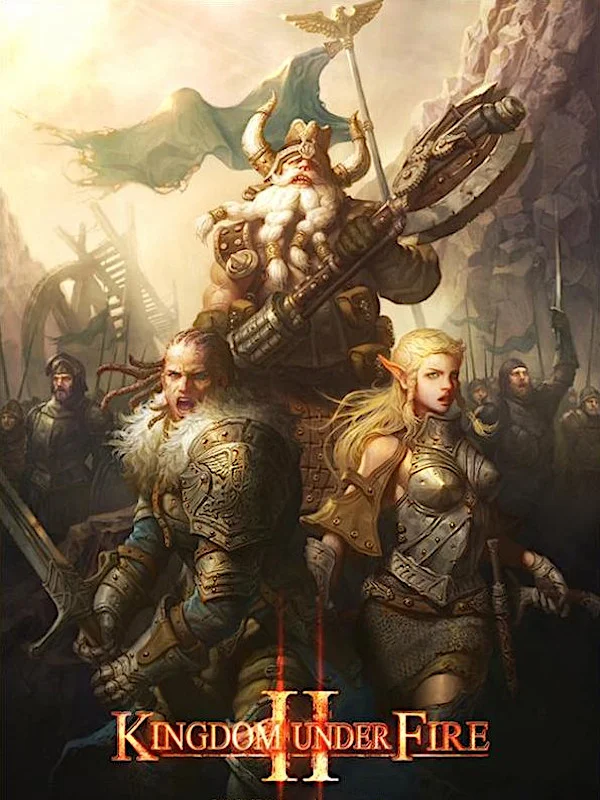
Kingdom Under Fire II is the “white whale” of the franchise—a project that spent over a decade in development to realize the ultimate vision of a Massively Multiplayer Online (MMO) Real-Time Tactics hybrid. Developed by Blueside, it successfully fused the hero-led action of The Crusaders with the persistent world and social systems of a modern MMORPG, resulting in some of the most visually spectacular large-scale battles in gaming history. Global version of the game’s servers were closed on October 26, 2021.
The Massive Hybrid: MMO Meets RTT
Kingdom Under Fire II was designed to be the definitive Bersian war simulator, operating on three distinct mechanical layers:
- The Hero Layer: Players choose a specialized hero class (such as the Berserker, Gunslinger, or Spellsword) and engage in third-person hack-and-slash combat. This layer feels like a modern evolution of the brawler mechanics from the Xbox titles.
- The Tactical Layer: While fighting, players simultaneously command up to three diverse “Troop” units. You can switch to an overhead tactical view to position your archers, initiate cavalry charges, or deploy massive siege engines like Mortars and Scorpions.
- The MMO Layer: Outside of combat, players explore large hub cities, participate in a persistent story campaign, join guilds, and engage in massive 16-player raids where thousands of units clash on screen at once.
Unit Synergy and Customization
The core of the game’s strategy lies in your Troop Roster. Unlike previous games where you had a fixed army, KUF2 features a massive collection system:
- Unit Variety: There are over 80 types of units, ranging from standard human infantry and elven rangers to massive “Epic Units” like Frost Dragons and Swamp Mammoths.
- Evolution and Gear: Units can be leveled up, equipped with specialized gear, and evolved into higher-tier versions. A basic Spearman can eventually become an Elite Paladin, gaining new active and passive abilities that can be triggered by the player during combat.
- The “Deck” System: Before entering a mission, players curate a specific “deck” of units to take with them, forcing them to predict the tactical needs of the map (e.g., bringing anti-air units to a map dominated by drakes).
Visual Spectacle and Engine
Blueside utilized their proprietary Fame Tech 2 engine to achieve a sense of scale that was unprecedented at the time:
- Thousands of Units: The engine was capable of rendering thousands of high-detail soldiers on screen simultaneously without sacrificing the individual animations and physics that make the combat feel visceral.
- Destructible Battlefields: Castles can be leveled, forests can be scorched, and the terrain itself is often permanently altered by the impact of “Tactical Spells” and heavy artillery.
Key Features
- Three-Way Faction War — Navigate the complex politics and shifting alliances between the Human Alliance, the Dark Legion, and the mysterious Encablossians.
- Class-Based Progression — Master unique hero classes, each with their own complex skill trees, combos, and “Ultimate” abilities.
- Massive PvP & PvE — Engage in everything from small-scale arena duels to 1,000-unit territorial wars where guilds fight for control of the Bersian map.
- Persistent Storytelling — A fully voiced campaign that continues the dark fantasy saga, picking up years after the events of Circle of Doom.
- Tactical “Hero Action” — Seamlessly swap between controlling your hero’s combos and issuing high-level tactical commands to your surrounding battalions.
Summary
Kingdom Under Fire II was an ambitious attempt to create a “forever war” in the world of Bersia. By taking the tactical DNA of the original series and scaling it to an MMO level, it provided a sense of cinematic grandeur that few other strategy games could match. It remains the peak of the series in terms of raw scale, proving that in Bersia, the only thing more dangerous than a lone hero is a hero with a thousand soldiers at their back.
Release Platforms
- PC (Windows) — First released in Southeast Asia (2014), followed by Russia (2017), China (2017), and finally North America/Europe (2019).