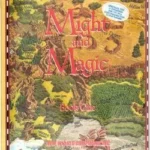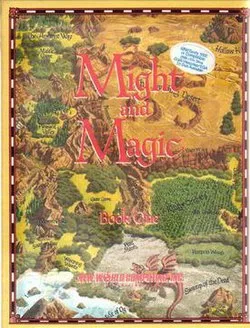
Might and Magic Book One: The Secret of the Inner Sanctum
 Apple II,
  Commodore 64,
  PC,
PC,  SNES
SNES
 New World Computing
Where to buy

Might and Magic Book One: The Secret of the Inner Sanctum (1986) is the foundational genesis of one of the most celebrated and longest-running western computer role-playing game (CRPG) legacies in history.
Written almost single-handedly over three years by franchise creator Jon Van Caneghem, this debut title launched New World Computing and established a legendary blueprint. By combining a first-person, grid-based step perspective with a massive, open-world continent and a shocking narrative twist, Book One boldly challenged contemporaries like Ultima and Wizardry.
The Narrative: The Galactic Fantasy Subversion
At face value, Book One presents itself as a boilerplate, high-fantasy medieval sandbox. Your party begins in the town of Sorpigal and is left completely to its own devices to accept local quests, hunt bounties, and map out sprawling wilderness grids.
However, as you pierce the local political layers and seek out the mythic Inner Sanctum, the game masterfully unfurls the franchise’s signature genre blend: Science Fantasy.
- The Colony Ship: The high-fantasy medieval land of VARN is not a natural planet. It is a literal sci-fi acronym standing for Vehicular Astropod Research Nomad—a colossal, artificial, self-sustaining interstellar colony starship cruising across the cosmos.
- The Imposter King: The primary goal shifts from mere dungeon crawling to a galactic chase. You learn that the legitimate ruler of VARN, King Alamar, has been forcefully overthrown and imprisoned. His throne has been claimed by a malicious, reality-hopping renegade android named Sheltem. Sareth and his party must breaches the Inner Sanctum, unlock the ship’s ancient security vaults, and force Sheltem to flee via an escape pod to a neighboring biosphere world (setting up Might and Magic II).
Gameplay Blueprint: Hardcore Survival Mechanics
Mechanically, Book One was a step-based, first-person dungeon crawler that dropped players into a deeply unforgiving ecosystem:
- The Brutal Early Game: Your customized party begins with simple wooden clubs, exactly zero gold pieces, and basic status health parameters. Stepping outside the starter town inn immediately exposes you to neutral wandering monster packs that can permanently wipe an under-leveled squad.
- The Food and Rest Economy: Much like Ultima, exploration requires physical resource management. Your team carries finite Food Stores. Resting on the adventure map completely regenerates your party’s Hit Points and Spell Points—a generous quality-of-life trait for 1986—but each resting cycle consumes a day of time and forces your party to consume a meal.
- The Age Deficit: Characters begin their journey at age 18. Over time—or by getting targeted with specific corrupting enemy spells—your heroes dynamically age. Past age 50, character attributes naturally begin to decay, and passing age 80 introduces a permanent baseline percentage chance that a hero will die peacefully in their sleep during a resting cycle. Players must rely on high-tier Cleric Rejuvenate spells to manually reverse aging, though a failed casting roll adds random extra years instead.
Faction Geometry: Characters & Attributes
Parties are composed of six custom-made characters generated from an interlocking skill matrix. The game heavily prioritized diversity, as specific town gates, puzzles, and temple quests are completely locked off unless approached by a character matching a mandatory race, gender, or moral alignment:
The Seven Core Attributes:
- Might, Intellect, Personality, Endurance, Speed, Accuracy, and Luck.
The Roster:
- The Five Races: Human, Elf, Dwarf, Gnome, and Half-Orc.
- The Three Alignments: Good, Neutral, and Evil.
- The Six Classes: * Knight: Pure frontline physical damage sponge; gains maximum HP multipliers.
- Paladin: Hybrid physical fighter capable of casting protective Clerical magic.
- Archer: Ranged marksman capable of firing projectiles from back rows while slinging low-tier Sorcerer nukes.
- Cleric: Essential defensive support; utilizes Personality to cast healing and anti-aging spells.
- Sorcerer: Pure glass-cannon offensive magic; utilizes Intellect to teleport or drop area-of-effect elemental spells.
- Robber: The essential utility rogue; boasts exclusive passive modifiers required to disarm lethal dungeon chest traps.
The Great Version Discrepancies
Because of the game’s immense baseline popularity, it was continuously ported across the late 1980s and early 1990s, resulting in two vastly distinct graphical eras:
- The Computer Originals (Apple II / MS-DOS / C64): These builds are deeply archaic by modern parameters. Combat is completely text-based with zero combat animations, environment tiles are heavily repetitive, and the spell system features no in-game UI menus—players had to physically look at the game’s printed paper instruction manual to find out what spell code (e.g., entering “3-2”) corresponded to specific spells.
- The Console Remake (NES – 1992): Ported late in the Famicom/NES lifecycle by American Sammy, the Nintendo version was a massive, complete overhaul. It introduced vibrant color graphics, fully animated enemy combat sprites, a sweeping chip-tune soundtrack, an automated automap assistance feature, and a streamlined, fully interactive controller icon menu system that completely eliminated the need for a physical paper code manual.
Release Dates & Platform History
- Apple II (Original Launch): 1986
- MS-DOS / Commodore 64: 1987
- Macintosh / PC-98: 1988
- Nintendo Entertainment System (NES): 1992
- Modern Lifecycle Availability: The definitive, optimized PC version of Book One is perfectly preserved and legally accessible today on modern computers via the Might and Magic 1-6 Collection bundle hosted on GOG. It runs inside a pre-packaged DOSBox configuration wrapper, ensuring the ancient, grid-mapping classic runs seamlessly on modern Windows platforms.