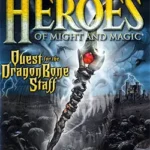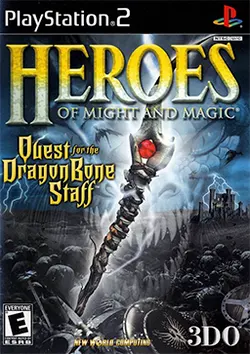
Heroes of Might and Magic: Quest for the Dragon Bone Staff
 64
★ /10
64
★ /10
 PS 2
PS 2 New World Computing
 The 3DO Company
Heroes of Might and Magic: Quest for the Dragon Bone Staff (2001) stands as a fascinating, highly unusual anomaly in the history of the franchise. Released exclusively for the PlayStation 2 during the peak of the console’s early lifecycle, this title frequently confuses players looking back at the series timeline.
While it proudly wears the Heroes of Might and Magic branding, the game bears almost no mechanical relation to the flagship PC strategy entries. Instead, publisher 3DO used the famous name as marketing leverage to sell a fully 3D, console-centric remake of the 1990 classic King’s Bounty—the original New World Computing game that served as the evolutionary precursor to the entire Heroes franchise.
The Plot: Racing the Doomsday Clock
The narrative drops you into a traditional, high-stakes fantasy race against time. The benevolent King of the realm is dying, afflicted by a terrible, magical sickness. The only thing capable of curing his ailment and securing the safety of the kingdom is the legendary Dragon Bone Staff.
A powerful, rogue villain has stolen the staff and hidden it somewhere across the world, tearing up the coordinates into fragments of a treasure map. You step into the boots of a mercenary hero commissioned by the crown to hunt down rogue villains, piece the map back together, locate the buried staff, and defeat the mastermind before the clock runs out and the kingdom plunges into absolute chaos.
Gameplay Architecture: The King’s Bounty Blueprint
Because the game functions as a direct structural clone of King’s Bounty, the gameplay abandons macro empire management. There are no towns to upgrade, no resources to harvest, and no multiple hero chains to optimize. The entire experience is focused on a singular loop:
- The Hero Archetypes: At the start of a new campaign, players choose from a small selection of classic classes, such as the brute-force Barbarian or the spell-forward Sorceress. Your choice dictates your base starting gold, weekly salary, leadership capabilities, and your capacity to cast magic.
- The Leadership Cap: You do not purchase creatures from a castle menu. Instead, you explore a fully 3D adventure map to locate neutral towns, castles, and wandering encampments to hire mercenary squads (such as Elves, Orcs, Ghosts, or Dragons). However, your army size is strictly bottlenecked by your Leadership stat; if you recruit more units than your current leadership capacity can control, the troops will violently mutiny mid-combat and turn against your own hero.
- Tactical Combat: When your avatar touches a rogue villain or a wandering monster stack on the world map, the camera zooms into a classic grid-based battlefield. Combat is entirely turn-based, utilizing simple physical positioning, squad-stack positioning, and spellbook invocation.
Presentation: Early 3D Assets & A Familiar Audio Tapestry
Quest for the Dragon Bone Staff replaced the classic top-down 2D pixel-art style of the PC titles with fully 3D-polygon environments and character models. While innovative for the console scene at the time, the blocky visuals and slow-moving grid transitions drew somewhat mixed reviews from mainstream gaming critics who felt it stripped away the high-end scannability of the PC versions.
However, the game’s undeniable saving grace was its auditory identity. Legendary series composers Paul Romero, Rob King, and Steve Baca returned to handle the audio architecture. Instead of composing a generic new tracklist, they masterfully recycled and updated many of the most iconic, critically-acclaimed orchestral and operatic town themes from Heroes of Might and Magic II and III, granting the console spin-off an incredibly grand, deeply nostalgic atmosphere.
Release Dates & Technical Timeline
- North American Release: April 17, 2001 (PlayStation 2)
- European Release: June 1, 2001 (PlayStation 2)
- Modern Lifecycle: Because this game was an exclusive console contract between 3DO and Sony, it never received an official PC port, nor is it available on digital platforms like GOG or Steam. Today, it is largely preserved through PlayStation 2 emulation communities (such as PCSX2), allowing franchise historians to experience this rare, console-shaped bridge to the original King’s Bounty formula.