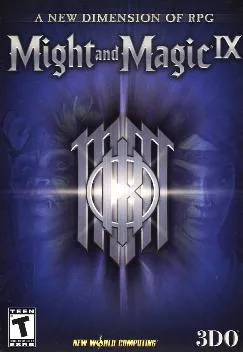
Might and Magic IX
 55
★ /10
55
★ /10
 PC
PC
 New World Computing
 Buka,
Buka,  The 3DO Company
Where to buy

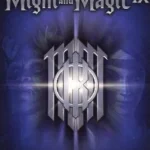
Might and Magic IX (officially sub-titled Writ of Fate) was released on March 28, 2002, and stands as one of the most historically significant, tragic, and bittersweet entries in the entire franchise.
Developed by New World Computing and published by The 3DO Company, it was the final mainline RPG ever produced by the original creators before 3DO collapsed into bankruptcy. Tasked with modernizing the series to compete with early-2000s 3D RPGs like Wizardry 8 and The Elder Scrolls III: Morrowind, the team abandoned their legacy pseudo-3D engine for a fully polygonal 3D environment using the LithTech engine. Heavily rushed to market by an imploding publisher, the game was left unpolished at retail, yet it introduced a brilliant character progression system that fans still celebrate.
The Narrative: The Ashes of Axeoth
The storyline acts as a direct, apocalyptic continuation of the franchise lore. Following the catastrophic planetary destruction of Enroth and Erathia during an event known as “The Reckoning” (depicted in Heroes of Might and Magic IV), survivors escaped through mysterious portals to emerge on a rugged new world called Axeoth.
The game unfolds on the untamed, Norse-inspired continent of Chedian. Players control a fresh band of four customizable raiders from the town of Ravensford who find themselves shipwrecked on the mystical Isle of Ashes. There, a troll hermit reveals a divine prophecy—the Writ of Fate.
A brutal, bloodthirsty warlord named Tamur Leng is marching the Beldonian Horde across the borders to conquer the land. To survive the invasion, your party is tasked with navigating local political assassinations and dangerous dungeons to forcefully unite Chedian’s six fiercely independent, warring jarl clans under a single banner before the horde burns the realm to the ground.
The Career Path Matrix: Might vs. Magic
In previous entries, players meticulously chose from nine separate, static classes at the initial character creation screen. Might and Magic IX completely threw that loop out, replacing it with a fluid branching tree career progression system.
When building your initial four-character squad, you choose from only two base classes: the physical Fighter or the spell-weaving Initiate. As your characters complete specific, major faction quests throughout Chedian, they undergo two distinct tiers of class promotions:
                     /--- Crusader ---> Paladin OR Ranger
         /-- Fighter
        /            \--- Mercenary --> Gladiator OR Assassin
Party --
        \            /--- Healer -----> Priest OR Druid
         \-- Initiate
                     \--- Scholar ----> Mage OR Lich
The Tier 2 Class Identities
Depending on your path, your characters eventually lock into highly specialized final archetypes:
| Final Class Final Class | Base Path Base Path | Grandmaster Specialization Cap | Tactical Identity in Combat |
| Paladin | Fighter / Crusader | Light Magic, Shield | The classic holy vanguard; shields the frontline while slinging support buffs. |
| Ranger | Fighter / Crusader | Bow, Perception, Identify | The ultimate long-range sniper; capable of firing three arrows simultaneously at peak tier. |
| Gladiator | Fighter / Mercenary | Spear, Blade, Armsmaster, Bodybuilding | The ultimate frontline tank; possesses the highest raw physical damage output in close-quarters combat. |
| Assassin | Fighter / Mercenary | Dagger, Disarm Trap, Throwing | The critical toolkit rogue; can dual-wield daggers to execute up to four lightning-fast attacks per round. |
| Priest | Initiate / Healer | Divine Magic, Meditation | The premier defensive support caster; completely required to safely heal catastrophic late-game ailments. |
| Druid | Initiate / Healer | Unarmed Combat, Dodge | A highly unusual hybrid; transforms into a lethal martial artist with extreme base armor classes when fighting unarmed. |
| Mage | Initiate / Scholar | Elemental Magic, Item Identification | The classic glass-cannon wizard; dominates whole screens of monsters with area-of-effect spells. |
| Lich | Initiate / Scholar | Dark Magic, Learning | The ultimate high-tier forbidden caster; unlocks devastating destructive spells that bypass enemy resistances. |
The Tragedy of Development Crunch
Might and Magic IX is often looked back on as a textbook example of corporate publisher interference ruining a legendary studio’s output. 3DO was rapidly running out of money, forcing New World Computing to ship the game half-baked.
- The LithTech Bottleneck: Because the team was completely unfamiliar with the licensed LithTech engine, they struggled to optimize the transition to full 3D. The resulting landscapes were notoriously flat and boxy, city hubs felt eerily empty, and character animations were stiff and robotic compared to contemporaries of 2002.
- The Bug Infestation: At launch, the retail code was deeply unstable. Items routinely vanished from character inventories, quest progression trackers frequently broke if areas were visited out of order, and geometry clips regularly trapped the player’s party inside walls.
- The High Note: Despite the broken technical wrapper, the iconic musical duo of Paul Romero and Rob King returned to deliver a sweeping, highly atmospheric orchestral soundtrack that remains one of the best-produced elements of the package.
Release History & Modern Salvation
- PC (Microsoft Windows): March 28, 2002
- Modern Availability: The title is preserved digitally on GOG as a standalone release or inside the complete Might & Magic Bundle.
The Community Restoration
While the original 2002 retail version was a broken mess, Might and Magic IX has enjoyed a major renaissance thanks to dedicated fans. Long-time players should never run the game entirely vanilla.
By installing community-run restorations like the TELP (The Enrothian Liberation Project) Patches alongside GrayFace’s MM9 engine fixes, the game is completely transformed. These community patches systematically repair the game-breaking script errors, eliminate desktop crashes, restore cut dialogue, adjust AI navigation, and scale the engine layout cleanly up to modern 1080p and 4K widescreen resolutions. With the bugs cleared away, the game’s excellent branching class tree and sandbox exploration shine through, making it a highly rewarding experience for franchise historians.