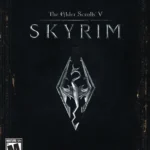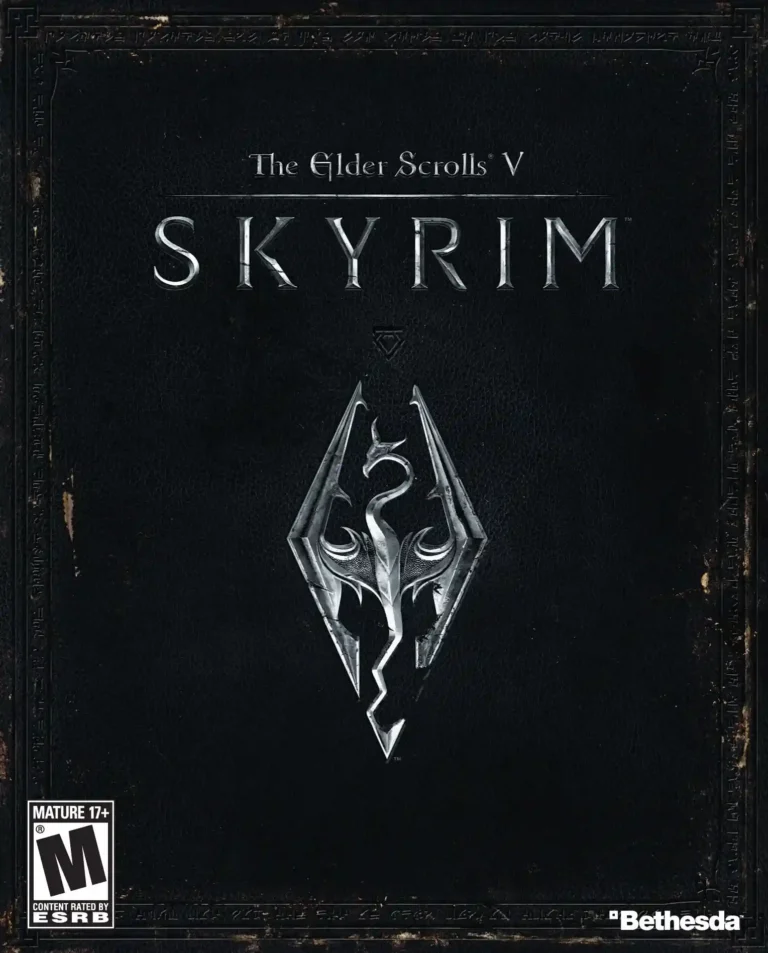
The Elder Scrolls V: Skyrim
 96
★ /10
96
★ /10
 Nintendo Switch,
  Nintendo Switch 2,
  PC,
PC,  PS 3,
PS 3,  PS4,
PS4,  PS5,
PS5,  Xbox 360,
  Xbox One,
  Xbox Series X/S
 1C-SoftClub,
  Bethesda Softworks
Where to buy





The Elder Scrolls V: Skyrim is a 2011 open-world action role-playing game developed by Bethesda Game Studios and published by Bethesda Softworks. Released on November 11, 2011 — a date chosen deliberately for its symmetry: 11/11/11 — it is the fifth mainline entry in The Elder Scrolls series, set in the northern province of Tamriel two hundred years after the events of Oblivion, and the first to cast the player as a Dragonborn.
It received a Metacritic score of 96 on Xbox 360 — among the highest for any game on that platform — and 94 on PC. It shipped 3.4 million physical copies in its first 48 hours and 7 million in its first week. As of June 2023, it has sold over 60 million copies, making it the seventh best-selling video game in history. It has been re-released on more platforms than any other single-player RPG. It is still being purchased, modded, and played in 2026.
Technical Specifications
| Attribute | Details |
|---|---|
| Developer | Bethesda Game Studios |
| Publisher | Bethesda Softworks |
| Director | Todd Howard |
| Lead Designer | Bruce Nesmith |
| Lead Writer | Emil Pagliarulo |
| Composer | Jeremy Soule |
| Engine | Creation Engine |
| Original Platforms | Xbox 360 · PS3 · PC |
| Release Date | November 11, 2011 |
| Genre | Action role-playing, Open world |
| Mode | Single-player |
Skyrim: The Nordic Province
The province of Skyrim sits at the northern edge of Tamriel, below the Arctic ice shelf and above the tree line in its highest reaches. It is mountainous, cold, and culturally defined by the Nords — a people whose values centre on honour, martial ability, and an ancient religious tradition that has recently become politically charged. Its capital is Solitude, seat of the Imperial presence. Its great cities include Whiterun, Windhelm, Riften, and Markarth, each distinct in architecture and culture.
Skyrim is also in crisis. Ulfric Stormcloak, Jarl of Windhelm, has killed the High King of Skyrim in a duel using the Voice — a shout of such force that it is considered by many an act of murder rather than honourable combat. This act has fractured the country into a civil war: the Imperial Legion, backed by the Cyrodilic Empire and bound by the White-Gold Concordat (a peace treaty with the Aldmeri Dominion that bans worship of the god Talos), against the Stormcloaks, who want Nordic independence and the restoration of Talos as a deity of the Nord pantheon. The player enters this conflict from the worst possible position: captured and minutes from execution at an Imperial camp.
Then the dragons arrive.
Story: Civil War, Dragon Return, and the Dovahkiin
Alduin, the World-Eater, is the largest and most powerful dragon in Tamriel’s history — a being prophesied to devour the world at the end of time — and he has returned. Dragons across Skyrim are resurrecting from their burial mounds, attacking towns and travellers. The ancient order tasked with dealing with dragons, the Blades, has been largely disbanded. The one remaining institutional resource is the Greybeards, an order of monks living in silence at the peak of the Throat of the World, Skyrim’s highest mountain, who study the Thu’um — the Voice.
The player survives the execution because a dragon attacks the town before the axe falls. They subsequently discover they are Dovahkiin — a Dragonborn — a person born with the soul of a dragon, capable of absorbing a slain dragon’s soul and using its power. This is the ability that can kill Alduin permanently, rather than merely defeating him until he regenerates. The main quest involves learning the Way of the Voice from the Greybeards, gathering the pieces of an ancient Nordic prophecy, and pursuing Alduin to Sovngarde — the Nord afterlife — for a final confrontation.
The civil war runs in parallel, independently completable, and thematically connected: Skyrim’s division and the return of dragons are both symptoms of the same fracture in the world’s history. The player can support either side, complete neither questline, or complete both.
Dragon Shouts and the Way of the Voice
Skyrim‘s defining mechanical addition to the series is the Thu’um, or Dragon Shout system. Words of Power exist throughout Skyrim, carved on ancient stone walls by the Greybeards’ ancestors. Finding a word unlocks it; absorbing a dragon’s soul grants the ability to use it. Three words combine into a shout with a specific effect: Fus Ro Dah (Force Balance Push) throws enemies backwards with concussive force; Laas Yah Nir (Life Seek Hunt) reveals nearby living creatures through walls; Tiid Klo Ul (Time Sand Eternal) slows time around the player.
There are twenty distinct shouts, each with three words to find and unlock, some hidden deep in dungeons or held by dragons, some acquired through the main quest. The system functions as an ability layer separate from the character’s skill-based progression, rewarding exploration specifically rather than combat or crafting investment.
No Class, No Ceiling: Design Philosophy
Skyrim completed a shift Bethesda began with Oblivion: the removal of the character class from the game’s initial setup. Where Morrowind built characters around a chosen class affecting skill growth rates, and Oblivion retained a class selection without the depth to support it meaningfully, Skyrim abandoned the category entirely. All skills are available to everyone; they improve by use. A character who fights with swords becomes better with swords. A character who sneaks past everything becomes a better thief. The game follows what you do rather than what you declared at the start.
Perk trees replaced the stat-heavy skill investment of earlier games: each skill has a branching tree of specific unlockable abilities, purchased with perk points earned on level-up, that change how that skill functions in qualitative rather than quantitative ways. A One-Handed perk lets attacks stagger enemies; a Sneak perk makes backstabs do fifteen times damage; an Enchanting perk lets enchantments last twice as long. The system made character specialisation feel purposeful without restricting it.
The Radiant Quest system generated procedural missions from faction NPCs — kill a randomly selected bandit leader at a randomly selected dungeon, retrieve a randomly selected item — providing an infinite supply of lower-stakes content for players who wanted more of the game’s activity after the authored quests were exhausted.
The Civil War: Both Sides, No Answer
The conflict between the Imperial Legion and the Stormcloaks is Skyrim‘s most debated unresolved element and has remained so for fifteen years. Bethesda designed both sides to have legitimate claims and genuine flaws.
The Imperials argue that the Empire is the only institution capable of opposing the Aldmeri Dominion (the Elven alliance that defeated the Empire militarily and imposed the White-Gold Concordat); that independence for Skyrim weakens the only remaining check on Elven expansionism; and that the ban on Talos worship, while painful, is a strategic concession rather than a theological statement.
The Stormcloaks argue that the Concordat is a humiliation that surrenders Nordic religious identity; that Ulfric’s cause is one of self-determination for a people whose heritage is being suppressed by an empire that no longer deserves their loyalty; and that Talos — a man who became a god through his own will — represents something specifically Nordic that should not be subject to Imperial political negotiation.
Neither side is vindicated by the game’s narrative. Ulfric has personal political ambitions that complicate the independence framing. The Empire is genuinely compromised by its Aldmeri accommodations. Both questlines resolve the immediate military conflict without addressing the structural problem. The debate about which side is “right” has filled forum threads across the entire lifespan of the game, and Bethesda has never resolved it in supplementary material.
“Dragonborn”: Jeremy Soule’s Theme
Skyrim‘s score was composed by Jeremy Soule, returning from Morrowind and Oblivion for his third Elder Scrolls game. The aesthetic direction had changed significantly: Todd Howard asked for something more aggressive and epic than the melodic, atmospheric scores Soule had written for the previous two games. The result was built around a large choral foundation and the Dragon Language (Dovahzul) — a constructed language Bethesda developed for the game in which the Dragonborn’s lyrics are sung.
The main theme, titled “Dragonborn”, opens with its famous choral statement: “Dovahkiin, Dovahkiin, naal ok zin los vahriin…” (Dovahkiin, Dovahkiin, your fate is to bear the burden of the world). The piece became immediately iconic at the game’s 2010 announcement, where the first trailer — released almost exactly one year before the game — ended on the music’s first statement. It has since been performed by the London Philharmonic Orchestra and numerous other ensembles, and remains one of the most recognised video game compositions of its era.
Modding: Bethesda Creations and Skyrim Together
Skyrim is among the most extensively modded games in history. Bethesda released the Creation Kit — their internal editor — publicly shortly after launch, and Nexus Mods’ Skyrim library has grown to encompass tens of thousands of individual mods spanning graphical overhauls, quest additions, combat revisions, and complete total conversions.
Bethesda Creations (formerly Creation Club, now the official mod platform integrated into all recent versions of Skyrim) hosts curated content from both Bethesda and community creators, free and paid, distributed through the game launcher. The Bethesda Creations page currently draws approximately 14,855 monthly searches — more traffic than the game’s Metacritic page — indicating that modding remains the primary active engagement with Skyrim for a substantial portion of its current player base.
Skyrim Together Reborn (skyrim-together.com) is an unofficial multiplayer co-op mod that enables multiple players to share the same game world and play through the campaign together. It is a community project rather than an official product, has been in development for years, and attracts approximately 2,454 monthly searches — more than most of the game’s contemporary reviews. The game was built for single-player; Skyrim Together runs against its architecture, which produces known limitations and instability. It remains the primary way people attempt co-op Skyrim and the subject of ongoing development.
Skyrim on Everything: The Re-Release History
No single-player RPG has been released on as many distinct platforms as Skyrim. The release history:
- 2011 — Xbox 360, PlayStation 3, PC
- 2013 — Legendary Edition: all three expansions bundled with the base game; PC
- 2016 — Special Edition: 64-bit remaster with improved lighting, volumetric effects, and for the first time, official mod support on console (PS4, Xbox One, PC)
- 2017 — Nintendo Switch; PlayStation VR and PC VR editions
- 2021 — Anniversary Edition: Special Edition plus all Creation Club content (26 add-ons, 500+ items, new quests); PS4, Xbox One, PS5, Xbox Series X/S, PC
The Nintendo Switch version is notable for its commercial performance: the Nintendo.com product page currently draws more search traffic than any other storefront page for the game, suggesting the Switch remains an active entry point into Skyrim for players who didn’t encounter it elsewhere.
Todd Howard, asked in 2018 about the volume of re-releases, said the team keeps doing it because “there’s an audience for it.” In 2021, he joked that Skyrim was going to come to Alexa. The joke landed because it was barely distinguishable from the truth.
Reception and Longevity
Skyrim received universal critical acclaim at launch: 96 on Metacritic for Xbox 360, 94 for PC, 92 for PS3, with Game of the Year awards from essentially every major publication for 2011. The game’s arrival in the same year as The Witcher 2, Portal 2, Dark Souls, and Batman: Arkham City makes 2011 one of the most competitive years in gaming history, and Skyrim‘s dominance of the awards season in that context remains impressive.
Its longevity is the more remarkable story. Todd Howard confirmed in 2023 that the game has passed 60 million copies sold — making it the seventh best-selling video game of all time — and noted that people are still playing it, not just buying it. The game sold 30 million copies between 2011 and 2016, then another 30 million in the following seven years. The patient gamers thread asking “how good is Skyrim really?” in the current search results reflects a real pattern: the game’s reputation is large enough that new players approach it with calibrated skepticism rather than enthusiasm, and most of them end up staying longer than they intended.
Editions Note
This page covers the base game. Separate entries exist for the three expansions: Dawnguard, Hearthfire, and Dragonborn. All three are included in the Legendary Edition, Special Edition, and Anniversary Edition.