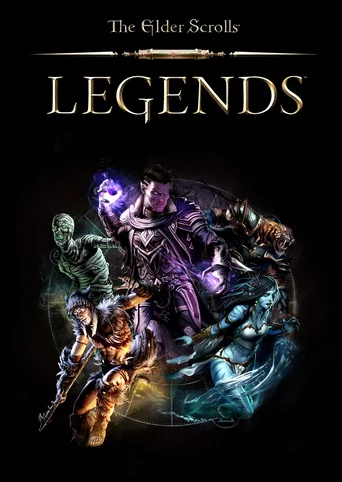
The Elder Scrolls: Legends
 80
★ /10
80
★ /10
 Android,
  iOS (iPhone/iPad),
  PC
PC
 Bethesda Softworks
The Elder Scrolls: Legends was a free-to-play digital collectible card game published by Bethesda Softworks, originally developed by Dire Wolf Digital and later maintained by Sparkypants Studios, available on PC, Mac, iOS, and Android. It officially launched on PC in March 2017, ran for nearly eight years, and shut down permanently on January 30, 2025.
The shutdown was announced not through a press release or social media post, but via an in-game message that players discovered upon launching the game. Bethesda offered no public explanation for the closure. Multiple articles covering the announcement described the game as having been largely forgotten for years before it finally went dark.
Technical Specifications
| Attribute | Details |
|---|---|
| Developer | Dire Wolf Digital (2016–2018) · Sparkypants Studios (2018–2025) |
| Publisher | Bethesda Softworks |
| Designer | Brady Dommermuth |
| Composer | Bradley Derrick |
| Engine | Unity |
| Platform(s) | Microsoft Windows · macOS · iOS · Android |
| Launch | PC: March 9, 2017 · iOS/Android: July 27, 2017 |
| Server Shutdown | January 30, 2025 |
| Genre | Digital collectible card game |
| Monetisation | Free-to-play with card packs and microtransactions |
A Card Game in Tamriel
Legends was Bethesda’s entry into the digital CCG market — a genre that, by 2016, was dominated by Blizzard’s Hearthstone and the digital versions of Magic: The Gathering. Cards depicted creatures, characters, items, and abilities drawn from across the Elder Scrolls franchise: Daedric Princes, Draugr, Dwemer constructs, Shouts from Skyrim, factions from Morrowind, political intrigue from Oblivion. Matches were turn-based one-on-one contests played against other players or against an AI opponent.
The story mode cast the player character against Naarifin, a High Elf general who had invaded Cyrodiil and planned to use the conflict to open the gates of Oblivion and flood Tamriel with Daedra. Eight expansion sets were released between 2017 and 2018, each drawing on a different part of the Elder Scrolls setting: Houses of Morrowind, The Fall of the Dark Brotherhood, Clockwork City, Isle of Madness, and several others, each bringing new cards and limited story content.
The Two-Lane System
The mechanical innovation that distinguished Legends from every other major digital CCG was its two-lane board. Instead of a single contested battlefield, players fought across two parallel zones:
The Field Lane functioned like a standard CCG board — creatures played here were available to attack and be attacked immediately. The Shadow Lane gave any creature played into it a single turn of Cover: it could not be attacked until its next turn. Cover allowed for protected setup, guaranteed survival of fragile high-value cards for one rotation, and created strategic decisions about which lane to commit which creature to on any given turn.
The two-lane system received consistent praise from CCG players as a genuine contribution to the genre’s design vocabulary. Reviews from CCG-focused publications noted that it elevated the tactical ceiling above what comparable games offered without adding complexity that would alienate casual players. It remains the most-cited feature by the community in retrospective discussions of the game.
Development: Dire Wolf, Sparkypants, and the Console Announcement
Legends spent most of 2016 in beta, officially launching on Bethesda.net in March 2017 and on Steam in June that year. Dire Wolf Digital, the Colorado studio behind the card game Eternal, handled the initial build. The first two years saw eight expansions at a pace comparable to Hearthstone‘s early output. Peak concurrent player counts on launch were approximately 9,000 — low relative to the established competition, but a functional community.
On May 31, 2018, Bethesda announced that Dire Wolf Digital’s involvement was ending and that Sparkypants Studios would rebuild the client from scratch. The rebuilt version launched on September 26, 2018. Reaction from the existing player base was mixed-to-negative: many players found the new client inferior to the original in interface and performance, and the transition disrupted the community’s momentum.
At E3 2018, Bethesda announced that Legends was coming to PlayStation 4, Xbox One, and Nintendo Switch. Those versions were never released.
The Forgotten Years (2019–2025)
On December 6, 2019, Bethesda announced that all ongoing content development for Legends would be “put on hold” indefinitely, with only maintenance support continuing. No reason was given. No timeline for resumption was offered. The console versions were silently dropped.
For five years, the game ran in this maintenance state — no new cards, no new story content, no new expansions. The player base shrank steadily, with concurrent player counts on Steam declining from thousands to hundreds in the months before the final shutdown. The competitive scene, which had supported multiple community-run tournaments in 2017 and 2018, contracted and eventually dissolved.
An Asian version of the game, Legends Asia, operated separately under GAEA Mobile: it launched in November 2019, closed in December 2020 due to low player counts, briefly relaunched in China in April 2023, and closed again in December 2024 — a month before the global shutdown.
The Quiet Shutdown
On November 1, 2024, players opening Legends were greeted by an in-game message: “The Elder Scrolls Legends servers will permanently shut down on January 30, 2025. From now until January 30, 2025, all items in the store and entry into in-game events will be available for 1 gold each.”
There was no announcement on Bethesda’s social media. No blog post. No press release. The game’s Steam listing was removed without comment. Several outlets covering the story described the approach as “quiet” — consistent with the game’s general treatment since 2019. Industry observers noted that Microsoft’s significant layoffs at Bethesda’s parent studios in early 2024 had likely contributed to the decision to wind down remaining live-service operations that were not commercially viable.
On January 30, 2025, the servers went offline. No offline mode was made available. The Elder Scrolls: Legends became permanently inaccessible.
Reception
Legends received generally positive reviews at launch, with critics noting the two-lane system as a meaningful innovation and the TES setting as effective window dressing for CCG mechanics. IGN scored it 7.4/10; TouchArcade described it as “pretty legendary.” The Metacritic aggregate for the PC version sits in the mid-70s — meaningfully better than many of Bethesda’s other mobile and spin-off efforts of the era.
The commercial failure was not about product quality so much as market positioning: the game launched two years after Hearthstone had become the defining product of the digital CCG space, competing also against Magic: The Gathering Arena (which entered beta in 2017) and later Gwent, Legends of Runeterra, and Marvel Snap. Without a sufficiently large initial player base to sustain the feedback loop that competitive CCGs require — more players means more competition means longer player retention — the game could not achieve the momentum it needed.
Fan Legacy
teslegends.pro, a fan-maintained card database, remains active as of mid-2026, cataloguing all cards and expansions from the game’s eight-year run. Players who documented the game’s complete card pool before shutdown have preserved it at the database level even if the game itself is unplayable.
A small community of fans explored the possibility of a private server revival in the months following the shutdown — referenced in a TheGamer article shortly after closure — though no functional fan-run version of the game has launched publicly. The subreddit r/elderscrollslegends remains one of the more active communities in the SERP for the game, primarily serving as a space for retrospective discussion.
Legends was the first of two consecutive Elder Scrolls spin-off titles to shut down in this period, preceding The Elder Scrolls: Blades by seventeen months.