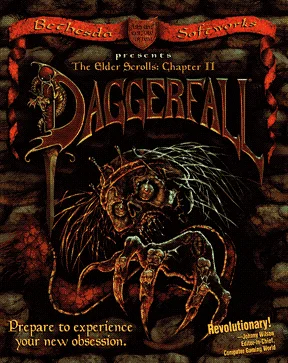
The Elder Scrolls II: Daggerfall
 PC
PC
 Bethesda Softworks


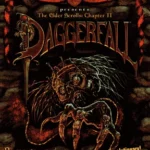
The Elder Scrolls II: Daggerfall is a 1996 action role-playing game developed and published by Bethesda Softworks for MS-DOS. Released on September 20, 1996 in North America, it is the second entry in The Elder Scrolls series and the game most responsible for establishing the systems, lore, and scale ambitions that define the franchise. Bethesda claimed the game world was the size of Great Britain. The actual measured map — roughly 62,394 square miles — is still the largest open-world in RPG history by landmass.
The most prominent question in Daggerfall’s current search landscape is “what is the appeal of Daggerfall?” — a Reddit thread that consistently outranks Bethesda’s own official page in traffic. The question is fair, and the answer is not simple.
Technical Specifications
| Attribute | Details |
|---|---|
| Developer | Bethesda Softworks |
| Publisher | Bethesda Softworks |
| Director | Julian LeFay |
| Designers | Julian LeFay, Bruce Nesmith, Ted Peterson |
| Composers | Eric Heberling, Andy Warr |
| Engine | XnGine |
| Platform | MS-DOS |
| Release Date | NA: Sep 20, 1996 · UK: Nov 1, 1996 |
| Genre | Action role-playing |
| Mode | Single-player |
High Rock, Hammerfell, and the Scale of the Thing
Where Arena placed the player on an entire continent, Daggerfall zoomed in — but only marginally. The game is set in two provinces of Tamriel: High Rock and Hammerfell, the lands bordering the Iliac Bay. Within this space sit over 15,000 towns, cities, villages, and dungeons, populated by more than 750,000 individual NPCs. Bethesda’s marketing put the playable land area at the size of Great Britain; independent measurement puts it closer to 62,394 square miles. Either figure dwarfs every other game on the list.
The comparison that most usefully contextualises this: Skyrim‘s map is approximately 14.8 square miles. Daggerfall‘s is 62,394. A YouTuber has confirmed that walking across the game world in real time, without fast travel, takes approximately 70 hours. Morrowind, the next entry in the series and a game celebrated for its density and depth, is by Todd Howard’s own estimation 0.01% the size of Daggerfall.
Almost all of this space is procedurally generated. The wilderness between settlements is terrain variation without authored content. The dungeons — thousands of them — are assembled from modular tile sets rather than designed by hand. The named, hand-crafted locations number in the dozens; everything else is the machine filling in space.
This distinction matters because it shapes almost everything about how the game is experienced, both as an achievement and as a frustration.
Story: Lysandus’s Ghost and the Numidium
Daggerfall‘s story is set five years after the events of Arena. Emperor Uriel Septim VII — the same emperor the player rescued in the previous game — has sent the player character on a double-mission to the Iliac Bay region.
The first task: the ghost of King Lysandus of Daggerfall has been haunting his own capital city, unable to rest because he was murdered rather than dying in battle, and his killer has never been named. Uriel wants the ghost laid to rest, and the conspiracy surrounding Lysandus’s death unravelled.
The second task: Uriel has written a private letter to Queen Mynisera, Lysandus’s widow. He wants it delivered without going through official channels.
Both missions are simpler than they appear. The investigation into Lysandus’s death leads outward into a much larger conspiracy centred on the Numidium — an enormous brass golem originally built by the Dwemer and used by Tiber Septim (the founder of the Empire) to conquer Tamriel centuries earlier. The Numidium was then disassembled. Its components — specifically a power source called the Mantella — have been hidden since, and every significant power in the Iliac Bay wants them.
The factions competing for the Numidium include the Emperor’s own agents (the Blades), a cadre of necromancers led by the King of Worms, the Underking (an ancient undead sorcerer with his own ancient claim), the various royal houses of High Rock, a faction of Orcs, and the Mages Guild. The player can align with any of them. The game has six distinct endings, each corresponding to a different faction gaining control of the Numidium and using it.
In the lore established by subsequent games, all six endings are simultaneously canonical — an event called the Warp in the West, a paradox caused by the Numidium’s power over time, in which every faction achieved its goal in a moment that resolved the contradiction by restructuring the political map of High Rock. Daggerfall‘s approach to its own endings became one of the most discussed pieces of Elder Scrolls lore.
What Daggerfall Introduced
Daggerfall established or substantially expanded nearly every system the franchise would use for the next decade. Among its introductions:
The Dark Brotherhood — the assassination guild that appears in every subsequent Elder Scrolls game — made its first appearance in Daggerfall. So did the Thieves Guild as a joinable faction with its own questline. Vampirism was implemented as a full character state with multiple bloodlines, each providing different abilities and weaknesses. Lycanthropy allowed players to contract and play as werewolves or wereboars. The climbing and swimming mechanics that became series staples debuted here. So did the spell creation and item enchantment systems in their complex forms, and a reputation system that tracked standing with individual factions, cities, and social groups independently. Daggerfall was also the first entry in the series to receive an M rating, and the first to include optional full nudity.
The Khajiit — a cat-like humanoid race — were given tails for the first time, retroactively changing the series’ visual representation of the species. And in background lore and loading-screen text, dragons were mentioned as creatures of Tamriel’s past roughly twenty years before Skyrim made them the centrepiece of a game.
The Procedural Paradox: What the Scale Costs
The “appeal of Daggerfall” question that dominates its search results points at a genuine tension. The game’s scale is real and extraordinary for its era. The procedural generation that made that scale possible also produced an experience that many players find alienating — identical-looking dungeon rooms extending for hours, wilderness traversals that are literally empty, cities that are navigable only with an automap because every building looks the same.
The hand-crafted content — the main quest dungeons, the faction questlines, the story encounters — is genuinely distinctive. The authored sections of Daggerfall contain some of the most ambitious writing Bethesda had produced at that point, including the entire structure of the Numidium conspiracy. The problem is reaching them. New players trying Daggerfall for the first time frequently describe losing hours in a procedurally generated dungeon before finding the exit, or fast-travelling to a city and being unable to find the relevant NPC because the building index is confusing. The game was designed for a player willing to invest significant time in learning its systems.
The systems themselves, once learned, are extensive. Character creation allows fully custom class construction from hundreds of skill combinations. The reputation network means the same action can have different consequences depending on what factions witnessed it. The political simulation running beneath the surface — marriages, wars, alliances between noble houses — generates events in the background that affect what contracts are available and what NPC dialogue says.
Bugs, Freeware, and Ars Technica’s Question
Daggerfall launched in a significantly buggy state. Critical quest items could become inaccessible, certain quest triggers failed to fire, and some bugs introduced by patches were worse than the problems they fixed. Bethesda released successive patches through 1996 and 1997, bringing the game to a stable-enough state to complete the main quest, though community documentation of remaining bugs continued for years.
In September 2009 — on the occasion of Bethesda’s 25th anniversary — Daggerfall was made available as freeware, available for free download from Bethesda’s website. It is now also free on Steam and GOG, though it requires DOSBox to run on modern hardware (both storefronts bundle it).
In August 2025, Ars Technica published a piece titled “A question for the ages: is The Elder Scrolls II: Daggerfall a good game?” — an article that currently ranks in the top ten search results for the game and reflects an ongoing critical reassessment. The piece doesn’t resolve the question cleanly, which is accurate: the answer depends on what the player brings to it.
Daggerfall Unity: The Recommended Way to Play
The most significant development in Daggerfall‘s recent history is not from Bethesda. It is Daggerfall Unity, a complete recreation of the game in the Unity engine led by Australian developer Gavin “Interkarma” Clayton, who began exploring the original game’s file formats in 2001 and launched the full remake project in 2015.
Version 1.0.0 was released on December 30, 2023, with the project declared complete after more than eight years of active development. The current release is version 1.1.1 (October 2025). The project is open source under an MIT license, available at dfworkshop.net and on GitHub.
Daggerfall Unity runs natively on Windows, Linux, and macOS without DOSBox. It supports high resolutions and modern display ratios, implements improved lighting and visual effects, modernises the control scheme and interface, and has restored unused content from the original game’s files — including elevation data that gives the terrain the rolling hills the original was apparently designed to have before technical constraints flattened it. A GOG Cut of Daggerfall Unity, pre-packaged and ready to run, is available free of charge directly from GOG.
The project has a robust mod community. dfworkshop.net currently draws more search traffic than Bethesda’s own official Daggerfall page — a practical endorsement of Daggerfall Unity as the de facto way most players engage with the game in 2026.