Starfield
 83
★ /10
83
★ /10
 PC,
PC,  PS5,
PS5,  Xbox Series X/S
 Bethesda Softworks,
  Xbox Game Studios


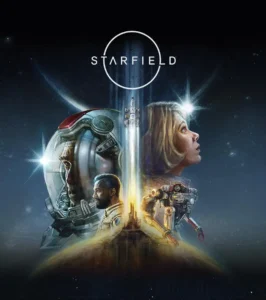
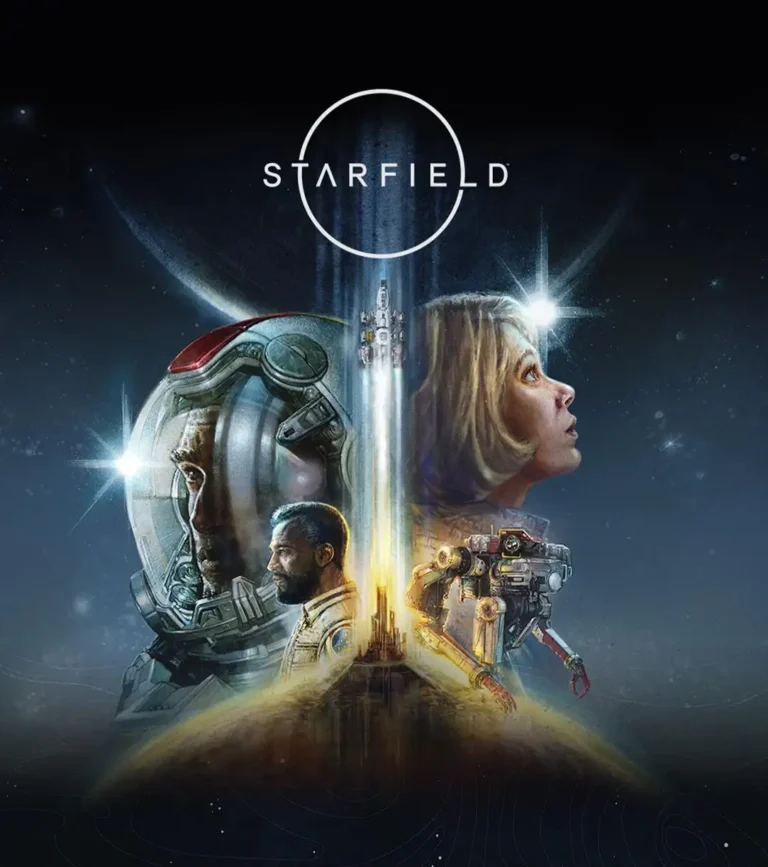
Starfield is a 2023 action role-playing game developed by Bethesda Game Studios and published by Bethesda Softworks. Originally released for PC and Xbox Series X/S on September 6, 2023 — with early access from September 1 for Premium Edition purchasers — it arrived on PlayStation 5 on April 7, 2026, alongside the largest post-launch update in the game’s history.
Bethesda described Starfield as its first new intellectual property in twenty-five years: the studio had shipped only The Elder Scrolls and Fallout sequels since the mid-1990s. Directed by Todd Howard, it was in development for roughly eight years by the time it shipped, and it was the first major title built entirely on Creation Engine 2. The game received a Metacritic score of 87–88 at launch and sold to more than twelve million players within its first month, primarily through Xbox Game Pass, though player reception was considerably more divided than the critical scores suggested.
Technical Specifications
| Attribute | Details |
|---|---|
| Developer | Bethesda Game Studios |
| Publisher | Bethesda Softworks / Xbox Game Studios |
| Director | Todd Howard |
| Lead Writer | Will Shen |
| Composer | Inon Zur |
| Engine | Creation Engine 2 |
| Platform(s) | PC · Xbox Series X/S · PlayStation 5 (April 7, 2026) |
| Release Date | Sep 6, 2023 (PC/Xbox) · Apr 7, 2026 (PS5) |
| Genre | Action role-playing, Space exploration |
| Mode | Single-player |
The Settled Systems: Setting and Story
Starfield is set approximately 330 years in the future, in a region of space humanity has colonised called the Settled Systems — roughly twenty light-years from Earth, spanning about 1,000 star systems. Earth itself was depopulated after an unexplained catastrophe stripped away its atmosphere; Bethesda described it as the moment that forced humanity to finally commit to reaching the stars.
The dominant powers are the United Colonies, a large republic based in New Atlantis (the game’s central city), and the Freestar Collective, a loose frontier confederation, between whom a major war ended about twenty-five years before the game’s events. The player character joins Constellation, an organisation of explorers investigating mysterious alien artefacts that have appeared across the Settled Systems. The main quest follows the investigation of these artefacts — known as Powers — and their connection to something called The Unity: a metaphysical threshold whose implications reshape the game’s relationship between player and character in ways most open-world games don’t attempt.
The factions running parallel to the main quest — including the United Colonies military questline and the Freestar Rangers storyline — were generally considered the game’s narrative highlights, providing extended stories with distinct political perspectives on life in the Settled Systems.
NASA-punk: Design Philosophy
“NASA-punk” was the term Todd Howard coined for Starfield‘s visual identity — a sci-fi aesthetic rooted in the textures, materials, and ergonomic logic of real mid-twentieth century space exploration rather than the chrome-and-neon conventions of science fiction entertainment. Ship interiors reference Apollo-era control panels. Equipment and clothing have the worn, functional look of workwear in a frontier environment. Cities are built with a mix of institutional architecture and improvised settlement, rather than the gleaming megastructures of comparable games.
The aesthetic was one of the game’s most consistently praised elements. Critics who were otherwise ambivalent about the experience noted that the environments, character designs, and spacecraft had a coherent, distinctive visual character that distinguished Starfield from both the retrofuturism of Fallout and the fantasy palette of The Elder Scrolls. The NASA-punk framing became the shorthand by which the game’s visual identity was discussed across most coverage of the release.
Exploration: 1,000 Planets and What That Actually Means
Starfield features over 1,000 explorable planets across approximately 100 star systems, reachable through a galaxy map rather than seamless real-time travel. Landing on a planet triggers a brief loading sequence and places the player on a procedurally generated surface; these surfaces contain handcrafted points of interest (abandoned facilities, settlements, resource deposits, roaming enemies) distributed within an otherwise terrain-only landscape.
The scale and the execution of this system became the game’s central controversy. Players expecting the handcrafted density of Skyrim‘s world — where every few minutes of walking reveals something deliberate — found most planetary surfaces to be largely empty between points of interest, with long walks across featureless terrain required to reach the next destination. The absence of seamless space-to-planet-surface transition (a loading screen separates each step of travel) compounded the sense of disconnection from the world.
Bethesda’s position was that the game’s intended mode of play was slower and more contemplative than prior entries — more like a space simulation than an action-adventure — and that a galaxy with 1,000 meaningfully dense planets was technically and narratively impossible. This framing satisfied some players and frustrated others. The empty-planet complaint became the primary critical fault line around which discussion of the game organised itself and has largely remained so.
Ship Building and Combat
The most enthusiastically received element of Starfield by a significant margin was its ship building system. Players can construct custom ships from modular components — cockpits, hab modules, landing gear, weapons, engines, fuel tanks — with the arrangement affecting both the ship’s appearance and its flight characteristics. Ships built in the workshop are fully flyable and fully integrated into the narrative: Constellation members react to what you show up in.
Ship-to-ship combat takes place in real time in space, with the player managing power allocation between weapons, shields, and engines while targeting individual enemy ship components to disable specific systems before boarding. The system received substantial praise for its tactical depth and for how cleanly it connected to the building side: a ship you designed yourself is one you understand the capabilities and weaknesses of in combat.
The Character and Skill System
Character creation in Starfield is the most detailed Bethesda has shipped: a full body type, facial feature, and background selection process that is deeper than any prior entry in the studio’s library. The Background system selects three starting skills based on a narrative origin (Soldier, Xenobiologist, Pilgrim, and fifteen others), framing who the player character was before joining Constellation.
Skills operate on a tier system: purchasing a skill in the skill tree unlocks it at rank 1, and advancing through four ranks requires completing challenges specific to that skill (killing a number of enemies in a particular way, crafting a certain number of items, etc.). The 82-skill tree covers combat, social, science, tech, and exploration specialisations and was designed to support multiple distinct playstyle archetypes across replays.
New Game Plus: An Unusual Design Choice
Starfield‘s most structurally unusual feature is its New Game Plus system. At the conclusion of the main quest, players are offered the option to pass through The Unity — beginning the game again from the starting location, but with all Powers and levels retained, and with the universe subtly altered in ways that reflect the player’s choices. This is not a simple difficulty-modifier NG+ but a deliberate narrative device: the game acknowledges you have been through this before and begins constructing a different version of the experience.
The system supports multiple successive playthroughs, with each pass revealing additional layers of the story and modified NPC dialogue. It was one of the more discussed aspects of the game’s late-stage narrative design, praised by players who engaged with it and largely invisible to those who did not reach it. Starfield is, by Bethesda’s own description, a game designed to be played more than once.
Post-Launch: From REV-8 to PS5
Following launch, Bethesda issued a sustained series of updates across nearly three years:
December 2023 saw the release of the Creation Kit, enabling full mod support and launching the Creations marketplace — a mix of free and paid modifications from Bethesda and verified community creators. Over 1,000 Creations were available by April 2026.
March 2024 added the REV-8, a driveable land vehicle (the game’s first ground transport), addressing the complaint about traversal on planetary surfaces — though it divided players on whether it improved or merely accelerated the experience of empty-planet exploration.
September 30, 2024: Shattered Space, the first major story expansion, released. Set on Va’ruun’kai, the homeworld of the House of Va’ruun faction, it received a Metacritic score of 65 — significantly weaker than the base game — with reviewers criticising the quest design, the limited scope of the setting, and the failure to meaningfully expand the characters introduced in the main campaign.
April 7, 2026: Starfield came to PlayStation 5, simultaneously with two content releases. The Free Lanes update (free for all players) introduced a cruise mode allowing in-system planet-to-planet travel while remaining aboard the ship and interacting with crew — directly addressing the disconnected travel criticism. It also added new encounters, two crew members, a new land vehicle variant, and substantial quality-of-life improvements. The Terran Armada DLC ($10, included in the Premium Edition) added a galaxy-spanning faction questline, new weapons with a distinct modular aesthetic, and a new robot companion. At the same time, Bethesda reduced the base game price from $70 to $50 across all platforms.
May 14, 2026: Patch 1.16.242 released — Bethesda’s most recent update as of June 2026, confirming the game remains in active maintenance more than two and a half years after launch.
Reception and the Discourse
Starfield earned 87 on Metacritic for Xbox Series X and 88 on PC — the highest scores Bethesda Game Studios had received since Fallout 4 in 2015, and above the Oblivion Remastered launch. IGN’s 7/10 was one of the more prominent dissents from a largely positive critical consensus; Destructoid awarded a 10/10 at the other end. The Player Score on Metacritic and Steam’s user reviews told a different story: initial Steam ratings settled around 60-65% positive, stabilising at “Mostly Positive” over time after the initial wave of disappointed players.
The critical-player reception gap was the most discussed aspect of Starfield‘s launch. The game’s defenders cited its writing, ship building, faction content, NASA-punk visual identity, and the depth of its RPG systems; its critics cited the empty-planet problem, the loading-screen-gated exploration, and the sense that Bethesda’s design philosophy had become formulaic in ways the setting should have disrupted. Neither position resolved convincingly against the other, and the game has occupied an unusual space in public perception ever since — genuinely acclaimed in some dimensions, genuinely disappointing in others, and impossible to reduce to either verdict cleanly.
Did Starfield Fail?
“Why did Starfield fail?” is one of the most common follow-up searches for the game in 2026, and the question requires a distinction the discourse around it rarely makes.
Commercially: no. Twelve million players in the first month, primarily via Xbox Game Pass, is the largest launch audience Bethesda Game Studios has ever had. The game sold through Xbox, PC, and — two years later — brought enough demand on PS5 to justify a port. Todd Howard described the Creations modding ecosystem in March 2026 as “healthy,” and the game continues to receive updates. By the numbers, Starfield is among the most successful games Bethesda has ever released.
As a cultural moment: differently. The question of why Skyrim felt more alive — a world of 300 square kilometres compared to Starfield‘s 1,000 planets — is the one that has followed the game most persistently. “Why does Starfield feel smaller than Skyrim?” is another PAA question that Google associates with this title, and it identifies the actual issue: not the quantity of space but the density of intentional design within it. Skyrim’s world was handcrafted at a scale the team could control; Starfield‘s scale required procedural generation that could not replicate that density, and the loading screen between each step of travel prevented the seamless discovery loop that made Bethesda’s earlier worlds feel coherent.
The expectation mismatch was real. Starfield arrived as the studio’s most ambitious project in twenty-five years and the flagship exclusive of the Xbox Game Studios era. It was measured against Skyrim, one of the most beloved games ever made, and against Baldur’s Gate 3, which launched two weeks earlier to universal acclaim. Relative to those comparators, an 87 Metacritic and mixed player scores read as disappointment even if, measured against most games, they are not.
By mid-2026, the more accurate description is that Starfield is a game whose best version — with Free Lanes, three years of patches, the PS5 DualSense integration, and both story expansions — is meaningfully better than the one that launched in September 2023. Whether that constitutes vindication is still being debated in r/Starfield, which as of this writing draws more organic search traffic than the game’s Steam page.