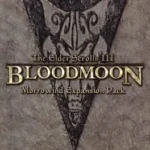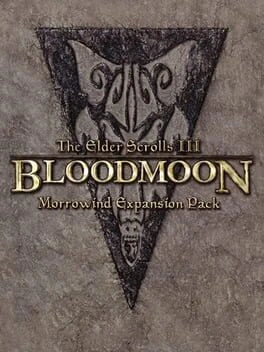
The Elder Scrolls III: Bloodmoon
Expansion of The Elder Scrolls III: Morrowind 85
★ /10
85
★ /10
 PC
PC
 1C Company,
  Bethesda Softworks



The Elder Scrolls III: Bloodmoon is the second and final expansion pack for The Elder Scrolls III: Morrowind, developed by Bethesda Game Studios and published by Bethesda Softworks. Released for Windows on June 3, 2003, it was developed in six months with an explicit design mandate: make something structurally opposite to Tribunal. Where Tribunal was urban, sealed, and interior-heavy, Bloodmoon would be an open island with outdoor exploration, split quest paths, and werewolves.
It holds a Metacritic score of 85 on PC — two points above Tribunal — and is consistently rated the stronger of the two expansions. It is also the expansion that introduced Solstheim, an island Bethesda would return to in Skyrim’s Dragonborn DLC nine years later.
Technical Specifications
| Attribute | Details |
|---|---|
| Developer | Bethesda Game Studios |
| Publisher | Bethesda Softworks |
| Producer | Ashley Cheng |
| Lead Designer | Ken Rolston |
| Engine | Gamebryo |
| Platform(s) | Microsoft Windows (standalone) · Xbox (GOTY Edition only) |
| Release Date | Windows: Jun 3, 2003 · GOTY Edition: Nov 3, 2003 |
| Genre | Action role-playing |
| Mode | Single-player |
Solstheim: Cold, Forested, Norse
Solstheim is an island northwest of Vvardenfell, sitting between Morrowind and Skyrim in the Sea of Ghosts. Its climate is Skyrim’s — snow-covered, glacier-scarred, subject to blizzards that the expansion’s new weather shader system makes genuinely atmospheric — and its culture is correspondingly Nordic. The island is inhabited by the Skaal, an indigenous tribe of Nords with their own traditions, sacred standing stones, and mead hall; the rival mead hall of Thirsk houses a separate contingent with different customs.
At the time of Bloodmoon, the island is mostly wilderness. The only significant Imperial presence is Fort Frostmoth, a garrison on the southern coast. Most of Solstheim is old-growth forest, ash tundra, frozen caves, and the barrows of ancient Nord dead — visually, culturally, and atmospherically unlike anything on Vvardenfell. The contrast with the alien mushroom-and-ashland landscape of the base game is immediate and total.
Two Questlines: Colony and Prophecy
Bloodmoon runs two largely parallel questlines that converge at the expansion’s culmination.
The East Empire Company questline begins at Fort Frostmoth, where the Empire’s trading arm is attempting to establish a mining colony at Raven Rock on the island’s southern coast, to extract the rich ebony ore deposits there. The player takes on a series of contracts: surveying land, finding a missing miner, dealing with supply problems, defending the site, and watching Raven Rock grow from a surveying stake into a recognisable settlement over the course of the quests. The colony’s visible development across the questline — buildings appearing, population arriving, the operation becoming functional — is one of Bloodmoon‘s quieter achievements; it gives the secondary questline a satisfying sense of accumulation unusual for the era.
The Bloodmoon Prophecy questline concerns a ritual event that the Skaal call the Bloodmoon — the reddening of the moons that signals the Daedric Prince Hircine is preparing his Hunt. At the end of every era, Hircine arrives on Solstheim to conduct a literal hunt: his werewolves pursue mortal prey through the island’s wilderness. The Skaal revere certain warriors as potential champions against the Hunt. Strange and violent things are happening on Solstheim that the Skaal interpret as omens, and the Nerevarine arrives in time to be drawn into them.
Hircine’s Hunt: Predator or Prey
The Bloodmoon questline’s central branch comes when the player contracts lycanthropy — the werewolf disease — from an infected Skaal warrior. The disease progresses in stages, producing harrowing dreams and physical changes, and the player is presented with a genuine choice.
Cure the disease and align with the Skaal: become one of the mortal champions defending against Hircine’s Hunt, help survivors reach safety, and eventually confront one of Hircine’s aspects in combat as a mortal.
Embrace the disease and become a werewolf: join the Hunt as predator rather than prey, pursuing the island’s inhabitants through the wilderness as one of Hircine’s chosen and eventually facing the Prince as one of his own servants.
Both paths lead to Hircine. The confrontation differs. The expansion’s final sequence plays differently depending on which choice was made, and the character the player built determines how equipped they are for either outcome. It is a more consequential branch than most RPGs of 2003 were offering, and it is embedded in mechanics rather than just dialogue.
Werewolf Mechanics
Becoming a werewolf in Bloodmoon is the expansion’s most distinctive gameplay addition — and the first time lycanthropy in The Elder Scrolls was implemented as a fully mechanised character state rather than a plot device.
In beast form, the character loses access to all weapons, armour, and spells. Combat is physical: powerful claw attacks and a bite with high base damage. The werewolf is faster and stronger than the base character but can neither equip items nor cast magic. Transformations occur at night, initially outside the player’s control.
Managing the state requires feeding: the werewolf must consume kills regularly to sustain health and suppress the condition’s effects. A series of dreams — experienced when sleeping while infected — push the player toward the werewolf questline, providing quests that reward the transformed character specifically. Hircine’s Ring, which allows voluntary transformation control, is obtainable through the questline.
The werewolf’s visual presentation — hunched, four-limbed sprint animation, fur texture over the character model — was a significant graphical undertaking for the engine, and influenced how Bethesda implemented lycanthropy in Skyrim eight years later.
Raven Rock and the Long Shadow to Dragonborn
The East Empire Company settlement of Raven Rock that the player helps construct in Bloodmoon is a small, newly established mining colony by the time the expansion ends: a handful of buildings, a few dozen inhabitants, the beginnings of an operation in ebony.
In The Elder Scrolls V: Skyrim‘s Dragonborn DLC (2012), the player travels to Solstheim and finds Raven Rock as a major settlement. The Empire has long since withdrawn from the island and ceded it to House Redoran; Raven Rock is now a Dunmer city, considerably larger than its Bloodmoon foundation, with its own economy, factions, and history. Fort Frostmoth, the military installation that serves as Bloodmoon‘s starting point, is a ruin by the time of Dragonborn, its garrison long dead.
The continuity between the two games — same island, same settlement, 200 years of in-world time — is one of the more satisfying pieces of long-form world-building in the franchise. Players who complete Bloodmoon before playing Dragonborn arrive on Solstheim with prior knowledge of where everything began.
Bloodmoon as Proto-Skyrim
Several reviewers and players who experienced Bloodmoon after Skyrim have described it as a prototype for that game’s sensibility: Nordic culture, snow and glacier environments, ancient barrows, werewolves, standing stones, the Daedric Prince Hircine (who reappears in Skyrim). One Metacritic user review describes it as feeling “like a Skyrim betatest,” and the observation is not without basis — Bethesda clearly found the aesthetic compelling enough to build an entire main-series game around it.
For players who come to Bloodmoon from Skyrim, the reversal is equally interesting: the island Bethesda used to test this territory in 2003 looks, understandably, rougher than the version they shipped in 2011, but the underlying design instincts — the wilderness, the mythology, the mortal-versus-divine confrontation — are continuous.
Reception
Bloodmoon received a Metacritic score of 85 on PC, two points above Tribunal, with critics praising the outdoor exploration, the branching Hunt questline, the werewolf implementation, and the visual variety of Solstheim’s environments. Criticisms focused on some quests feeling abbreviated and on the island’s total size being smaller than the ambition of its premise suggested.
The consensus among players who complete both expansions remains stable: Bloodmoon is the more essential experience, and more representative of what Morrowind‘s open-ended design philosophy produces at its best. The Reddit thread about it in the current search results — framed as “let’s talk about the Bloodmoon DLC” rather than Tribunal’s “is it just not very good?” — reflects the difference in how each expansion has been remembered.
Both are included in the Morrowind Game of the Year Edition on Steam and GOG.