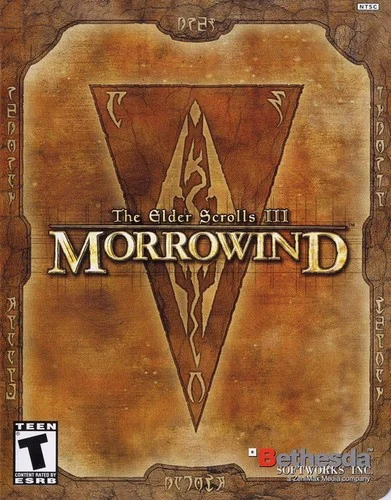
The Elder Scrolls III: Morrowind
 87
★ /10
87
★ /10
 PC
PC Xbox
Xbox 1C Company
 Bethesda Softworks


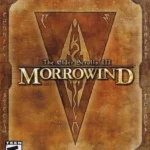
The Elder Scrolls III: Morrowind is a 2002 action role-playing game developed by Bethesda Game Studios and published by Bethesda Softworks. Released for Windows on May 1, 2002 and Xbox on June 7, 2002, it is the third entry in The Elder Scrolls series and the first to be built on a fully three-dimensional engine — a transition that required Bethesda to put the project on hold for three years while technology caught up to the design.
The game sold over four million copies, won more than sixty awards including multiple Game of the Year citations, and holds a Metacritic score of 89 across both platforms. It is also, depending on who you ask, either the best RPG ever made or the one most likely to drive a first-time player out within two hours.
Technical Specifications
| Attribute | Details |
|---|---|
| Developer | Bethesda Game Studios |
| Publisher | Bethesda Softworks |
| Director | Todd Howard |
| Lead Designer | Ken Rolston |
| Writers | Ken Rolston, Douglas Goodall, Mark Nelson |
| Composer | Jeremy Soule |
| Engine | NetImmerse |
| Platform(s) | Microsoft Windows · Xbox |
| Release Date | PC: May 1, 2002 (NA) · Xbox: Jun 7, 2002 (NA) |
| Genre | Action role-playing |
| Mode | Single-player |
Vvardenfell: The Setting That Isn’t Anywhere Else
The most immediately striking thing about Morrowind is that it doesn’t look like a fantasy game. The island of Vvardenfell — the playable region, a province of the broader Morrowind territory — is dominated by a volcanic caldera at its centre, surrounded by ashlands that erupt into blight storms capable of infecting travellers with disease. The forests are not oak and pine but enormous mushrooms, some the size of buildings, their caps used as platforms for Dunmer architecture. The landscape ranges from marshland in the south to tundra plateaus in the west to the fungal grottos of the Grazelands, and none of it resembles the medieval European template that defines most fantasy world-building.
This is the result of deliberate artistic choices rooted in the culture of the Dunmer — the Dark Elves who have inhabited Vvardenfell for millennia. Their architecture, religion, cuisine, political structure, and social hierarchy are all distinct from the Imperial culture that governs the rest of Tamriel and that the player arrives from. The three god-kings who rule Morrowind — Vivec, Almalexia, and Sotha Sil, collectively the Tribunal — are mortal beings who achieved divinity through an act that the game’s main quest eventually reveals to have been a profound betrayal. The political structure is divided between five Great Houses with competing territorial and philosophical interests, and the indigenous Ashlanders who reject both the Great Houses and the Tribunal as corrupt.
Vvardenfell is six square miles. Against Daggerfall‘s 62,394, this is a rounding error. Everything within those six miles is hand-crafted, authored, and specific.
The Nerevarine: Story and Prophecy
The player character arrives in Morrowind the same way they arrived in Arena and Daggerfall: as an anonymous prisoner released by Imperial decree. This time, Uriel Septim’s letter instructs them to travel to the town of Balmora and find Caius Cosades, a Blades operative working undercover as a skooma addict. He enlists the player in an investigation into an old Dunmer prophecy.
The Nerevarine Prophecy holds that the ancient hero Nerevar — the Hortator who united the Dunmer and led them against the Dwemer and a Daedric invasion centuries ago — will be reincarnated to free Morrowind from a threat emerging from Red Mountain. That threat is Dagoth Ur, a former ally of Nerevar who was driven to madness and became a god-like entity after contact with the Heart of Lorkhan — the literal divine heart of a dead god buried beneath Red Mountain. Dagoth Ur has spent a century spreading the Corprus disease through his Sixth House cultists and is constructing a weapon called the Akulakhan, a brass golem in the tradition of the Dwemer Numidium.
The complication: the Tribunal — Morrowind’s god-kings — were also present at the moment of Nerevar’s death, used the same divine artefact to make themselves gods, and did so in violation of an oath they made to Nerevar. The prophecy of the Nerevarine is, from their perspective, also a prophecy of their own undoing. Whether you are the actual reincarnation of Nerevar or simply someone who fulfils the conditions of a prophecy is a question the game raises and declines to definitively answer.
The main quest asks the player to be recognised as the Nerevarine by all major Ashlander tribes and two Great Houses, receive the reluctant blessing of the Tribunal, and descend into Red Mountain to confront Dagoth Ur directly.
No Markers, No Hand-Holding: Navigation by Journal
The single design decision that most defines the Morrowind experience for modern players is the absence of quest markers. When an NPC gives you a task, they give you directions — written in your journal. Not an arrow on a compass. Directions.
“Head north from Seyda Neen along the road. Take the left fork past the Customs office. Arvo’s house is at the end of the north street.” If you follow those directions accurately, you find the house. If you misread them or confuse which left fork they meant, you don’t. This is not a bug and not an oversight. It is how Morrowind was designed to work.
The system produces an experience of navigation that differs qualitatively from anything in Oblivion or Skyrim. Learning the geography of Vvardenfell through repeated travel, through missed turns and unexpected detours, through arriving somewhere and realising you’ve been here before from the other direction — this is a process that Bethesda’s subsequent games replaced with an arrow. Critics of the later approach argue that the arrow removed the world from the game; that once you’re following a marker, you stop seeing what’s between you and it.
The same principle applies to information. NPCs in Morrowind have individual dialogue topics — hyperlinked terms that expand into additional responses. Asking enough NPCs about the right terms, in the right order, assembles a picture of the world that feels genuinely explored rather than delivered. The written dialogue is extensive and, in large parts, authored by Ken Rolston with a sensibility shaped by tabletop RPG design: dense, cross-referential, world-building through specificity.
Dice-Roll Combat: What Nobody Tells You First
The other major barrier to Morrowind for players coming from Oblivion, Skyrim, or any action game made after 2006 is its combat system. Morrowind uses a hybrid system in which the game calculates a probability-based hit chance for each attack, derived from the attacker’s weapon skill, agility, and fatigue against the defender’s equivalent stats.
The consequence: swinging a sword at an enemy at point-blank range can produce the message “miss” — even when the animation shows the weapon making contact — because your Short Blade skill of 20 produces insufficient hit probability against the enemy’s agility. The sword appears to connect. The game says it didn’t.
This is not a design failure. It is a system from tabletop RPG tradition (the same tradition that produced KOTOR‘s combat) that rewards character-building and skill investment — a character with Short Blade 70 will almost never miss — and that becomes invisible once your stats are at appropriate levels. The first hour of Morrowind, before your skills have developed, is the most dangerous period for player retention. Players who understood they were building a character, not playing an action game, stayed. Players who expected to swing and hit left.
Several major mods and the OpenMW engine reimplementation address the presentation of the miss system without removing it, making the mechanic clearer to new players through UI changes.
The Construction Set and Mod Community
Morrowind shipped with its own level editor — the Morrowind Construction Set — as a publicly available tool, allowing players to create, modify, and extend essentially everything in the game. In 2002, this was unusual. Most games with modding communities required reverse-engineering the file formats from the outside; Bethesda handed players the same tool used to build the game itself.
The Construction Set produced one of the most prolific modding ecosystems in PC gaming. The Morrowind Modding History archive currently catalogs over 11,000 individual mods, ranging from graphical updates and bug fixes to total conversions and continent-scale expansions. Tamriel Rebuilt — an ongoing community project to construct the rest of the Morrowind province (the mainland, beyond Vvardenfell) to the same standard as the base game — has been in development since 2001, has released substantial landmass already, and remains active in 2026. The scale of that single community project, pursued for over two decades by volunteers, indicates something about the hold the setting has on its audience.
OpenMW and Skywind: The Modern Ways to Play
OpenMW is a free, open-source reimplementation of the Morrowind engine, developed since 2008 and currently in stable release. It runs natively on Windows, Linux, and macOS, supports modern resolutions and display ratios, significantly improves stability and performance relative to the original executable, and is fully compatible with virtually the entire mod library. Players with a legitimate copy of Morrowind can point OpenMW at their data files and play through it instead of the original engine. It is increasingly the recommended option for new PC playthroughs.
Skywind (tesrskywind.com) is a separate, larger ambition: a total conversion of Morrowind’s content into the Skyrim Special Edition engine, built by a volunteer team that has been working on the project since 2012. The goal is to render Vvardenfell — its geography, locations, quests, and NPCs — with Skyrim’s 2011 graphics and control scheme, playable without owning the original Morrowind files. Skywind has no release date, remains in active development, and currently draws 1,463 monthly search visits — more than Metacritic’s Morrowind page — which accurately reflects the scope of interest in the project relative to formal critical assessment.
Does It Stand the Test of Time?
This question is in Morrowind‘s People Also Ask results because a former Skyrim lead designer made a public comment suggesting the answer is no — that the game’s design choices belong to an era that contemporary players can’t comfortably inhabit.
The debate is real and not resolved by dismissing it. Morrowind‘s dice-roll combat, its navigation system, its lack of voice acting for most NPCs, and its 2002 engine all represent genuine friction for players formed by later conventions. The game does not accommodate unfamiliarity with itself. New players frequently describe abandoning it in confusion or frustration, returning later, and then not being able to stop.
The patient gamers thread about Morrowind at #6 in the search results — written by someone who came to the game decades after release — describes it as “one of the best games ever made” after working through the initial friction. The two responses are not contradictory: Morrowind both doesn’t stand the test of time by one metric (frictionless playability) and absolutely does by another (depth, density, and the irreplaceability of its world). OpenMW, modding, and potentially Skywind eventually make the question partly moot by separating the content from the 2002 executable.
Editions Note
The Game of the Year Edition — the version sold on Steam, GOG, and the Epic Games Store — bundles the base game with both expansion packs: Tribunal and Bloodmoon. This page covers the base game only; both expansions have their own entries. The GOTY Edition is available on Xbox through backward compatibility.