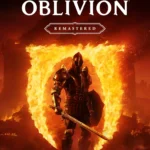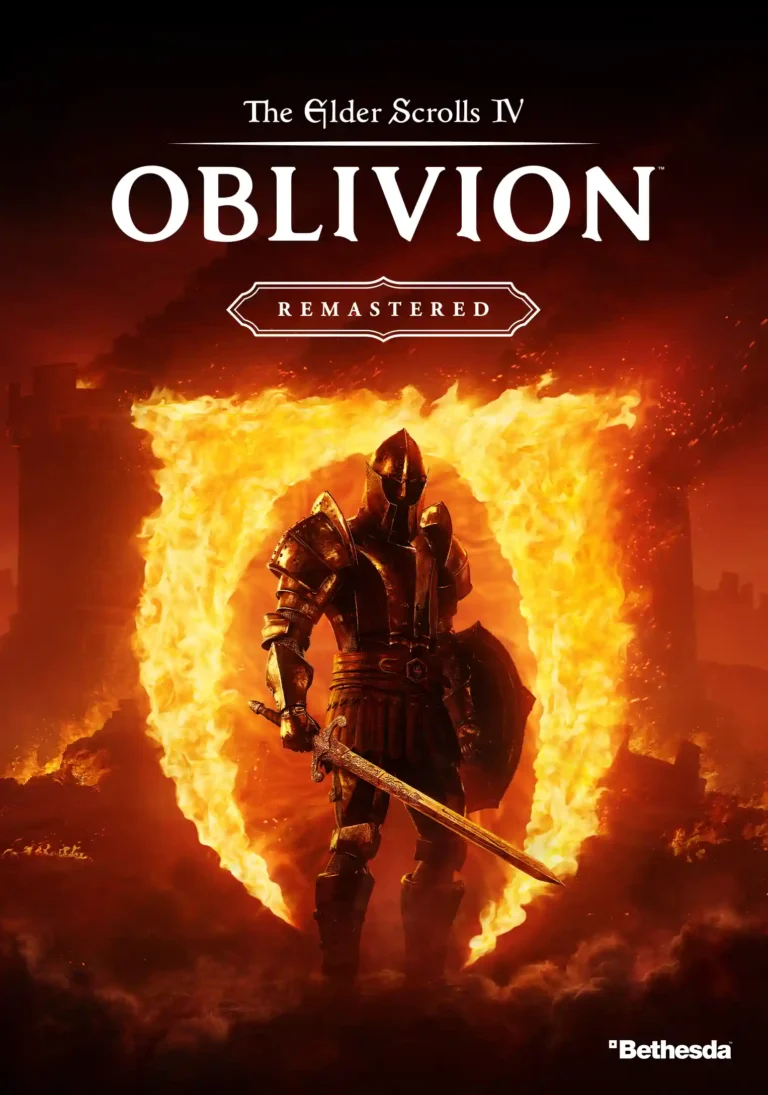
The Elder Scrolls IV: Oblivion Remastered
Remake of The Elder Scrolls IV: Oblivion 80
★ /10
80
★ /10
 Nintendo Switch 2,
  PC,
PC,  PS5,
PS5,  Xbox Series X/S
 Bethesda Softworks
Where to buy



The Elder Scrolls IV: Oblivion Remastered is a 2025 action role-playing game developed by Virtuos in collaboration with Bethesda Game Studios and published by Bethesda Softworks. It was announced and released on the same day — April 22, 2025 — for PlayStation 5, Xbox Series X/S, and PC, and became available immediately on Xbox Game Pass. A Nintendo Switch 2 version is scheduled for release in 2026.
It is a comprehensive visual and mechanical overhaul of The Elder Scrolls IV: Oblivion (2006), built on a dual-engine system pairing Unreal Engine 5 for graphics with Bethesda’s original Gamebryo engine for all gameplay logic. The world map, story, quests, characters, and dialogue are identical to the original. Nearly everything else has been rebuilt.
Technical Specifications
| Attribute | Details |
|---|---|
| Developer | Virtuos · Bethesda Game Studios |
| Publisher | Bethesda Softworks |
| Directors | Theo Gallego · Tom Mustaine |
| Engine | Unreal Engine 5 (graphics) · Gamebryo (gameplay) |
| Platform(s) | PlayStation 5 · Xbox Series X/S · Windows · Nintendo Switch 2 (2026) |
| Release Date | April 22, 2025 (PS5, Xbox Series X/S, PC) · Oct 13, 2025 (physical) |
| Price | $49.99 (standard) · included on Xbox Game Pass |
| Genre | Action role-playing, Open world |
| Mode | Single-player |
What Is Oblivion?
The Elder Scrolls IV: Oblivion was released by Bethesda Game Studios in March 2006 and became one of the most influential open-world RPGs ever made. Set in the province of Cyrodiil — the Imperial heartland of Tamriel — it followed a customisable protagonist tasked with stopping the Daedric Prince Mehrunes Dagon from invading the mortal world through a network of ruptures called Oblivion Gates. It introduced the series’ real-time combat to a wide audience, popularised radiant AI (NPCs with daily schedules and reactive behaviour), and featured a sprawling faction questline structure that Skyrim and later Bethesda games would build on.
The 2006 original also had problems that became legendary: an extreme level-scaling system that rewarded players who obsessively min-maxed their skill choices and punished those who played naturally; potato-shaped NPC faces that aged poorly even at launch; and a deeply janky quality to much of its incidental content that made the game simultaneously endearing and frustrating. These things are part of what people mean when they say they love Oblivion. The remaster does not erase them.
The Shadow Drop and the Leaks
For a release of this scale, Oblivion Remastered had one of the most unusual launch timelines in recent memory. Bethesda never officially acknowledged the project’s existence — but the industry knew it was coming. Internal Microsoft documents revealed during the FTC v. Microsoft antitrust proceedings in 2023 referenced an Oblivion remaster planned for 2022. Rumours of Virtuos’s involvement circulated from July 2023. On April 15, 2025 — one week before launch — screenshots and promotional assets were discovered accessible on the Virtuos website’s WordPress repository. References to the game were found in Bethesda.net’s source code. Retailer pre-order listings appeared.
Then, on April 22, 2025, Bethesda held a brief video presentation, revealed the game, and released it the same day. No pre-orders, no release-date countdown. It landed on Xbox Game Pass, Steam, and PlayStation stores simultaneously. The approach — known as a shadow drop — is typically reserved for smaller titles and indie games; for a remaster of this size and profile, it was unprecedented.
The Dual-Engine Architecture
Oblivion Remastered runs on two engines simultaneously. Unreal Engine 5 handles all rendering: lighting, shadows, textures, character models, animations, particle effects, and the volumetric weather system. Gamebryo — the original 2006 engine — handles everything else: AI behaviour, quest scripting, physics, inventory systems, dialogue triggers, and the radiant AI schedules that define how NPCs move through the world.
This architecture is the reason the game can credibly call itself a remaster rather than a remake. The underlying simulation — every quest trigger, every NPC’s daily routine, every piece of dialogue, every exploitable mechanic — is the original 2006 code. UE5 renders new geometry over the top of it. The result is that the game looks like a 2025 title and plays like a 2006 one, with everything that implies.
It also has performance consequences. Two engines running simultaneously is an unusual load for modern hardware, and the game shipped with the shader compilation stutters common to UE5 releases. Performance, particularly on PC, was a consistent complaint in launch-window reviews.
What Changed: Visual Transformation and QoL
The visual overhaul is total. Every texture, character model, environmental asset, spell effect, and weapon was rebuilt from scratch. The file size is approximately twenty times that of the original release. Cyrodiil’s forests, which in 2006 were sparse arrangements of trees on flat terrain, are dense and lit with Lumen global illumination. Character faces — the most notorious graphical element of the original — have been redesigned: still recognisably Cyrodiilean in their expressiveness, still capable of the jarring stare that defines Oblivion’s NPC culture, but no longer the haunted clay masks of 2006.
Combat received a meaningful mechanical update. Melee weapons now have combo attacks. Sprinting and dodging were added. Archery was made more responsive. The stealth indicator shifted from a binary open/closed eye to a graduated system similar to Skyrim‘s, giving players real-time feedback on detection status rather than a binary alarm trigger.
The levelling system — the most mechanically controversial element of the original — was substantially revised. The 2006 system rewarded players who deliberately limited which skills they levelled to maximise attribute bonuses at level-up, and punished those who played naturally by scaling enemies so aggressively that an under-optimised character could find Cyrodiil’s enemies outpacing them by mid-game. The remaster replaces this with a straightforward XP system: any skill use contributes to levelling, and each level-up grants twelve freely assignable “Virtue” points to distribute across attributes. Enemy scaling was toned down but not removed. The result is a game that can be played intuitively without a spreadsheet.
Additional changes include: numerical values on character creation sliders (independent rather than interdependent), a Clairvoyance spell to guide players toward objectives (borrowed from Skyrim), over-encumbrance allowing walking but not sprinting, new voice actors for several races that reused voice lines in the original, and fixes for hundreds of bugs including the infamous floating paintbrush stacking exploit.
What Stayed: The Same Wonderful Mess
Bethesda and Virtuos made a deliberate decision to preserve the original game’s personality. The dialogue — every line, every reading, every memorable absurdity — is unchanged. The quests and their structures are identical. The map of Cyrodiil is the same. The NPC schedules, the guards’ famous utterances, the NPCs who walk directly into walls, the comedic tonal incongruities of Oblivion‘s writing — all preserved.
This is the central argument about what Oblivion Remastered is. A game rebuilt in UE5 to the highest modern visual standard that still has an NPC deliver “STOP. You violated the law” while wearing Daedric armour in front of a raytraced waterfall is not a sanitised product. It is, as one widely-cited review described it, a beautiful, wonderful mess. Critics and players have largely concluded that this is the correct interpretation: that Oblivion‘s strangeness is inseparable from its appeal, and that a version cleaned of it would not be Oblivion at all.
What’s Included
Oblivion Remastered bundles both of the original game’s major expansions:
The Shivering Isles — the larger and more celebrated of the two — sends the player character into the realm of the Daedric Prince Sheogorath, a shifting land divided between mania and dementia, ruled by a god of madness who is both funniest and most affecting character in the franchise’s history. It is widely considered one of the best pieces of Elder Scrolls content ever produced, sometimes cited as better than the main game it accompanies.
Knights of the Nine — a shorter questline involving the restoration of a sacred order of Paladins and a confrontation with an apostate. Less celebrated than Shivering Isles but a coherent addition to the main game’s faction content.
A Deluxe Edition adds further new quests and content beyond what either original expansion provided.
Reception
Oblivion Remastered launched to an OpenCritic aggregate of 82, rated “Strong,” with an 87% recommendation rate across more than 100 reviews — one of the strongest critical showings for any release in spring 2025. Critics consistently praised the visual transformation, the QoL levelling revisions, and the faithfulness of the preservation approach. The most recurring criticism was UE5’s performance burden, particularly on PC.
The game was described in multiple reviews as a restoration of confidence in Bethesda after Starfield (2023) had disappointed a portion of the studio’s audience. One Metacritic reviewer wrote that it “won back fans who were drifting away after Starfield” — a sentiment that surfaced in several adjacent discussions. Whether by intention or circumstance, Oblivion Remastered arrived at a moment when the studio needed it.
Steam traffic for the game is consistently among the highest of any title on the platform nine months after launch — a sustained engagement profile more typical of live-service games than single-player RPG remasters, and one that reflects a playerbase finding the game rather than just rediscovering it. The Reddit thread titled “Nearly out for 9 months, what is your opinion on Oblivion Remastered?” draws nearly 25,000 visits per month, suggesting the conversation about the game has not settled.