The Elder Scrolls: Castles
 56
★ /10
56
★ /10
 Android,
  iOS (iPhone/iPad)
 Bethesda Softworks
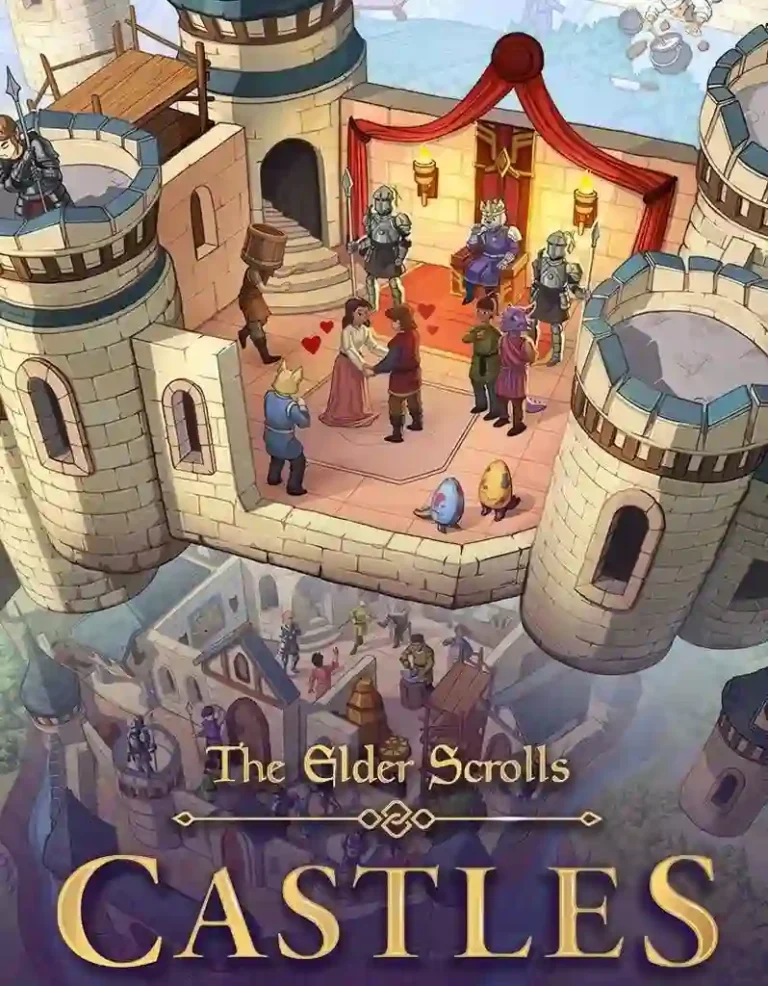
The Elder Scrolls: Castles is a 2024 free-to-play mobile management simulation game developed by Bethesda Game Studios and published by Bethesda Softworks, available for iOS and Android. It launched in early access for a limited US audience on September 27, 2023, soft-launched in the Philippines in January 2024, and released globally on September 10, 2024.
Bethesda has explicitly positioned the game as the spiritual successor to Fallout Shelter (2015) — the studio’s landmark mobile title — transplanting that game’s base-management loop into the Elder Scrolls universe, and extending it with a dynasty succession system and a real-time calendar in which each day in the real world corresponds to one year inside the game.
Technical Specifications
| Attribute | Details |
|---|---|
| Developer | Bethesda Game Studios |
| Publisher | Bethesda Softworks |
| Platform(s) | iOS, Android |
| Release Date | Global: September 10, 2024 |
| Genre | Construction and management simulation |
| Monetisation | Free-to-play with microtransactions |
| Mode | Single-player |
Setting: After the Fourth Era
Castles is set in the Fourth Era of Tamriel — after the events of The Elder Scrolls V: Skyrim — in an unnamed kingdom neighbouring Rivercrest and the Bloodfall Kingdom, ruled at the outset by a queen known as the Bloodfall Queen. The location is not a major canonical Elder Scrolls site but sits within the established Elder Scrolls timeline, making it lore-adjacent rather than lore-central. The game does not tie into the narrative of any specific numbered Elder Scrolls entry and can be understood without prior knowledge of the series.
Gameplay: Castle, Dynasty, Rulings
Castles gives the player control of a castle and the dynasty that rules it. The core gameplay unfolds across three interconnected systems:
Castle management works along lines familiar from Fallout Shelter: rooms are built and expanded to house subjects, train workers, craft equipment, and generate resources. Each room and decoration has both a visual effect and a numerical one — rearranging the layout, adding furnishings, and unlocking new workstations are ongoing activities rather than one-time setup decisions. Unlike Fallout Shelter, the castle’s layout can be edited freely at any time.
The dynasty system tracks the lineage of rulers over time. The current ruler ages, names an heir, and eventually dies, passing the throne to their successor — who may have different traits, relationships, and strengths. Managing who marries whom, which children are educated in which disciplines, and which family members are assigned to which roles within the castle determines the character of each successive reign. The system has been compared to a simplified version of the dynastic mechanics in Crusader Kings.
Rulings are decisions the player makes in response to events that arise in the kingdom — disputes between subjects, resource dilemmas, requests from factions, moral judgments. Each ruling has an immediate effect and may have longer-term consequences for happiness, loyalty, or resource levels. The mechanic is the game’s primary differentiator from Fallout Shelter, which had no equivalent decision layer, and it gives the simulation a light political texture that references the TES universe’s familiar factions, creatures, and conflicts.
The Real-Time Calendar
One of Castles‘ most distinctive design choices is its time scale: each real-world day equals one year in the game. This means a dynasty that spans thirty rulers would take roughly thirty real-world days to reach its natural end — and a character born this morning will be elderly by the time the player returns tomorrow. The mechanic encourages daily engagement without demanding the kind of session lengths a traditional management game might, and it gives the passing of rulers a natural rhythm that ties the dynasty system to actual time rather than an arbitrary in-game counter.
The Fallout Shelter Line
Fallout Shelter, released by Bethesda in 2015 as a same-day surprise alongside the Fallout 4 announcement at E3, became one of the most commercially successful mobile games from a traditional development studio. Its base-building, resident-management, and resource-balancing loop attracted an audience that had little overlap with the mainline Fallout franchise, and it remained in active development for years after launch.
Castles draws on that framework deliberately. Bethesda’s promotional materials used the Fallout Shelter comparison as a primary selling point, and the DNA is visible throughout: the 2.5D side-view presentation, the room-based construction system, the character management layer, and the free-to-play monetisation structure are all inherited. What Bethesda added for Castles — the dynasty system, the rulings, the time-based calendar, and deeper decoration mechanics — is positioned as a generational improvement over the 2015 template rather than a departure from it.
For context within Bethesda’s mobile output: The Elder Scrolls: Blades, the studio’s previous mobile Elder Scrolls title (launched 2019 as a first-person dungeon crawler), had its servers shut down in early 2026. Castles is currently Bethesda’s sole active mobile Elder Scrolls product.
Reception
Castles received a divided critical response. Pocket Gamer awarded it 4/5, praising the dynasty system and the improvements over Fallout Shelter. GamesRadar gave it 2.5/5, describing it as “a retooled Fallout Shelter with more options and the same problems” — specifically the gap between the initial appeal of the simulation loop and the diminishing returns of repeating it. Multiplayer.it scored it 7.5/10, noting the TES setting as an effective frame for the core mechanics.
Player response has been more consistent: the subreddit r/ESCastles is active, and the game’s Google Play listing draws more organic search traffic than its Wikipedia page or official Bethesda site, indicating a playerbase that is finding it through the storefronts rather than through franchise coverage. The free-to-play monetisation — timers and premium currency tied to accelerating progression — has drawn the expected complaints, though reviews have generally characterised it as less aggressive than the worst examples of the genre.