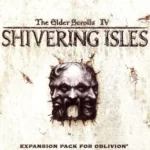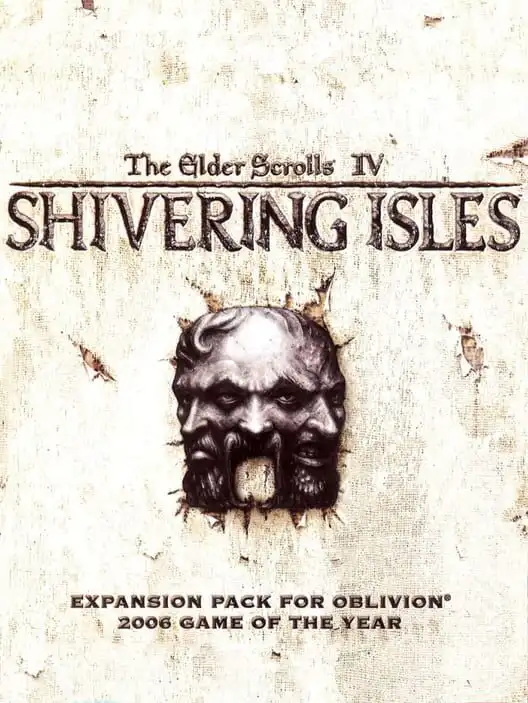
The Elder Scrolls IV: Shivering Isles
Expansion of The Elder Scrolls IV: Oblivion 86
★ /10
86
★ /10
 PC
PC PS 3
PS 3 Xbox 360
 1C-SoftClub,
  2K Games,
  Bethesda Softworks,
  Ubisoft



The Elder Scrolls IV: Shivering Isles is a 2007 expansion for The Elder Scrolls IV: Oblivion, developed and published by Bethesda Game Studios. Released on March 27, 2007 for PC and Xbox 360 at $30 — three times the price of Knights of the Nine — it takes the player out of Cyrodiil entirely and into the personal realm of Sheogorath, the Daedric Prince of Madness.
It received a Metacritic score of 90 on PC and 88 on Xbox 360. It is consistently cited as one of the finest pieces of DLC in RPG history, frequently described as better than the base game, and the expansion that established Sheogorath as one of the most beloved characters in the franchise. Its ending involves the player character becoming a Daedric Prince. The consequences of that ending are still being discussed in Skyrim lore threads in 2026.
Technical Specifications
| Attribute | Details |
|---|---|
| Developer | Bethesda Game Studios |
| Publisher | Bethesda Softworks |
| Engine | Gamebryo |
| Platform(s) | Microsoft Windows · Xbox 360 (later GOTY Edition and Oblivion Remastered) |
| Release Date | March 27, 2007 |
| Genre | Action role-playing |
| Mode | Single-player |
The Strange Door
Entry into the Shivering Isles is through the Strange Door — a glowing Daedric gate that appears on a small island in Niben Bay, southeast of the Imperial City. It appears without explanation or journal prompt. Its discovery is one of the more commonly searched questions about the expansion, both in 2007 and again following Oblivion Remastered in 2025, as the door has no marker and new players have to find it.
Inside the door is a small threshold zone called the Fringe, populated by people who have come through the gate and are waiting, or have gone mad from waiting, or have simply settled into the strangeness. At the Fringe’s end is the Gatekeeper: an enormous creature that serves as the expansion’s first major combat challenge and the boundary between the ordinary Oblivion exterior and the Shivering Isles proper.
Mania and Dementia: The Two Halves of Madness
The Shivering Isles are divided into two halves, separated by the central capital New Sheoth and reflecting the two poles of madness that Sheogorath embodies.
Mania is the bright half: over-saturated colour, dense and strange vegetation, mushrooms in unnatural purples and greens, populated by eccentrics, artists, and those whose madness takes expansive and creative forms. Its ruler — the Duke of Mania — is Thadon, a hedonist addicted to a substance called Felldew that keeps him in a state of elevated, deteriorating pleasure. The city of Bliss is Mania’s urban expression: colourful, chaotic, thrumming with barely-suppressed energy.
Dementia is the dark half: gothic, decaying, overgrown with poisonous plants in greys and deep purples, populated by paranoids, killers, and those whose madness takes contracting and violent forms. Its ruler — the Duchess of Dementia — is Syl, a woman so certain of betrayal around every corner that she has made betrayal the defining fact of her politics. The city of Crucible is Dementia’s counterpart: cramped, hostile, beautiful in a rotten way.
Both halves share architectural and cultural elements unique to the Isles — a self-consistent society built around Sheogorath’s nature, with its own faction (the Order of the Golden Saint representing Mania, the Order of the Dark Seducer representing Dementia), its own weapons and armour sets, its own religion, and its own calendar. The expansion is large enough — easily fifteen to twenty-five hours — that the world has room to feel inhabited.
Sheogorath: The Mad God
Sheogorath is voiced by Wes Johnson — the same actor who provided the voice for all male Imperial NPCs in the base game, delivering a performance so completely unlike those characters that many players didn’t recognise the connection. Sheogorath is theatrical, digressive, genuinely frightening beneath the comedy, prone to non-sequiturs that become coherent only in retrospect, and capable of switching from warmth to menace without transition. He greets the player with interest and assignments and something that might be affection, while making clear that his interest in their survival is contingent on their usefulness.
Haskill, Sheogorath’s Chamberlain, is his perfect foil: dry, immovable, operating with complete clarity of thought in a realm built on its absence. He is, in many ways, the most lucid and useful character in the expansion, and his exchanges with the player — and with Sheogorath — provide much of the expansion’s ambient comedy.
The characterisation of Sheogorath is Shivering Isles‘ most praised achievement. Every critical review of the expansion mentions it. It is also entirely consistent: nothing Sheogorath says or does is arbitrary, because his madness is a specific thing with its own logic, and the expansion’s narrative reveals what that logic is.
Story: The Greymarch Approaches
Sheogorath has summoned the Strange Door because the Greymarch is coming. The Greymarch is a periodic event at the end of each era: a march of the Forces of Order — crystalline, emotionless soldiers serving the Daedric Prince Jyggalag — that destroys the Shivering Isles, reduces its inhabitants to blank order, and erases everything Sheogorath has built. After the Greymarch, Sheogorath “wakes up” and begins again, with no memory of what was lost.
Sheogorath wants a champion who might break the cycle. The player enters, survives the Fringe, reaches New Sheoth, and is tasked with earning the trust of both halves of the realm — completing the questlines of both the Mania and Dementia political hierarchies, each involving schemes, tests, and revelations about the people who live under those conditions. The Forces of Order begin advancing as the player progresses, and Obelisks of Order — strange crystalline structures that empower Jyggalag’s soldiers — appear across the landscape.
The player must repair the Throne of Madness, construct a Staff of Sheogorath from components sourced from the Isles’ most dangerous corners, and eventually face the Greymarch’s arrival directly.
The Twist: Order Behind Madness
The revelation at the centre of Shivering Isles is one of the better-executed twists in RPG narrative: Sheogorath and Jyggalag are the same Daedric Prince.
Jyggalag was, in ancient times, the most powerful of all Daedric Princes — the embodiment of Perfect Order, whose power had grown so great that the other Princes feared him. Their solution: a collective curse transforming Jyggalag into Sheogorath, his perfect opposite, the embodiment of Madness. He retained no memory of what he was. The Greymarch is the one moment per era when the curse partially lifts, allowing Jyggalag’s true form to emerge and destroy the realm his cursed self built — before transforming back into Sheogorath again, beginning the cycle anew.
Sheogorath has always known this, in some sense, and has always been searching for someone who could stop it. The Greymarch arrives at the expansion’s climax; Sheogorath disappears, transforming into Jyggalag. The player must defeat Jyggalag — in his full, original Daedric Prince form — at the gates of his own palace.
Becoming the New Prince of Madness
Defeating Jyggalag breaks the curse permanently. He thanks the player, briefly and coherently, for doing what no one has managed across countless eras. He departs to roam Oblivion freely as himself, for the first time in ages. The Shivering Isles has no ruler.
Haskill informs the player that they have undergone mantling — taking on the role, identity, and power of a Daedric Prince. They are, from this moment, Sheogorath. He tells them they will “grow into the God they need to be.”
The expansion ends there. The player returns to the Isles as its Prince of Madness, with Haskill addressing them accordingly and the realm’s citizens acknowledging the change. The implications are not explained further.
The Skyrim Connection
In The Elder Scrolls V: Skyrim, the Daedric questline “The Mind of Madness” takes the Dragonborn into the fractured mind of the mad Emperor Pelagius, where Sheogorath is already present. This Sheogorath speaks in references to events that only the Hero of Kvatch could know: he mentions the Oblivion gates, the Grey Fox, specific details of the Oblivion Crisis. He says things like “Been a long time since someone’s called me that” in response to hearing the name Sheogorath.
The consensus in the broader TES community, reinforced by writer confirmation, is that the Sheogorath encountered in Skyrim is the Hero of Kvatch — the player character from Oblivion — who has spent the two centuries between games occupying the role they assumed at Shivering Isles‘ conclusion. The discussion of what this means for the Hero’s identity and consciousness (are they still a mortal? did they remain themselves?) is one of the more actively debated lore topics in the franchise, visible in the Reddit thread currently at #3 in the expansion’s search results.
Reception
Shivering Isles received critical scores significantly above the base game’s expansion average and is still routinely cited as a benchmark for what large-scale DLC can accomplish. The Metacritic aggregate of 90 on PC placed it among the highest-rated content releases of 2007. Critics uniformly praised the world design, the faction structure, and above all Sheogorath’s characterisation. The ending — becoming a Daedric Prince — was considered a surprising and earned conclusion to a full-length campaign.
The UESP wiki page for the expansion attracts 7,058 monthly searches — more than the Wikipedia articles for most of the smaller Oblivion DLC. MapGenie hosts a dedicated map. Multiple walkthrough pages remain actively visited. The practical question “how do I get to the Shivering Isles” is searched more often than the Metacritic score.
Both the GOTY Edition and Oblivion Remastered include Shivering Isles bundled with the base game and Knights of the Nine.