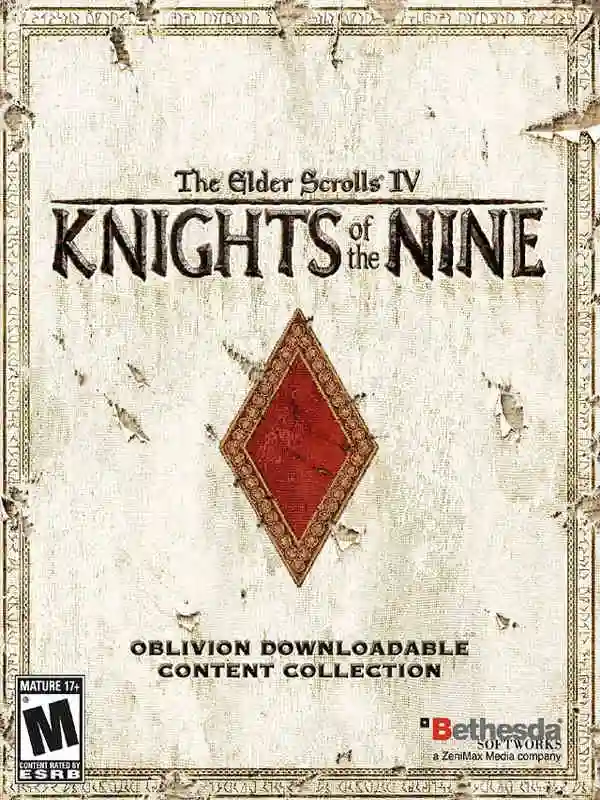
The Elder Scrolls IV: Knights of the Nine
Expansion of The Elder Scrolls IV: Oblivion 81
★ /10
81
★ /10
 PC
PC PS 3
PS 3 Xbox 360
 1C-SoftClub,
  Bethesda Softworks,
  Ubisoft



The Elder Scrolls IV: Knights of the Nine is a 2006 downloadable expansion for The Elder Scrolls IV: Oblivion, developed and published by Bethesda Game Studios. Released on November 21, 2006 for PC and Xbox 360 — originally at 800 Microsoft Points, approximately $10 — it is the largest and most narratively substantial piece of DLC Bethesda released for Oblivion before Shivering Isles, and the one most concerned with the religion and divinity of the setting.
It is included in the Oblivion Game of the Year Edition (2009) and in Oblivion Remastered (2025). Its armor set — the Relics of the Crusader — is the most-searched element of the expansion in 2026, generating more search traffic than the expansion’s main quest.
Technical Specifications
| Attribute | Details |
|---|---|
| Developer | Bethesda Game Studios |
| Publisher | Bethesda Softworks (NA) · Ubisoft (EU co-publisher) |
| Engine | Gamebryo |
| Platform(s) | Microsoft Windows · Xbox 360 (later GOTY Edition and Oblivion Remastered) |
| Release Date | November 21, 2006 |
| Genre | Action role-playing |
| Mode | Single-player |
Premise: Desecrated Chapels, an Ancient Sorcerer-King
The expansion triggers organically, without a quest marker or journal prompt. When the player approaches the Chapel of Dibella in the coastal city of Anvil, they find it recently attacked: the clergy slaughtered, the altar defiled with Ayleid symbols carved in blood. Outside, a Prophet is addressing a small crowd. He identifies the attacker as Umaril the Unfeathered — an ancient Ayleid sorcerer-king who has returned from Oblivion to destroy the chapels of the Nine Divines.
The backstory: Umaril was originally killed by Pelinal Whitestrake, the legendary Divine Crusader, in the First Era. But Umaril made a pact with a Daedric Prince that preserved his soul in Oblivion rather than letting it dissipate at death. He has spent centuries waiting, and now the Divines’ power over Cyrodiil has weakened enough for him to return. He wants revenge — specifically on the institutions that venerate the gods who opposed him.
The Prophet tells the player that Umaril cannot be permanently destroyed by ordinary means. He can only be killed by a Crusader favoured by the Nine Divines and bearing the Relics of Pelinal Whitestrake — the holy armour and weapons carried by the man who first defeated him.
Pelinal Whitestrake
Pelinal Whitestrake is one of the odder figures in The Elder Scrolls‘ lore, and Knights of the Nine is the primary place his story is told in playable form. He was a warrior of the First Era who fought alongside Saint Alessia — the slave-queen who led humanity’s revolt against their Ayleid masters — and is credited with killing Umaril during that uprising. He was himself subsequently killed by the combined Ayleid host.
In the desecrated chapel, the player finds in-game books — The Song of Pelinal and The Adabal-a — that describe him: a near-berserk holy warrior, prone to fits of violent fury, who fought with divine purpose but personal chaos. His character in TES lore is deliberately strange and suggested to be more than a simply mortal: later lore implies he may have been a divine instrument or a time-displaced entity, and that his understanding of what he was fighting for differed from everyone around him. Knights of the Nine presents the accessible version of his story; the full portrait is assembled from texts distributed across several games.
The expansion’s plot involves receiving visions of Pelinal — encountering his spirit during the pilgrimage across Cyrodiil — and eventually visiting his tomb to begin recovering his equipment.
The Pilgrimage: A Walk Across Cyrodiil
To be considered worthy of the Relics, the player must complete a pilgrimage to the wayshrines of all Nine Divines. Each divine — Akatosh, Dibella, Arkay, Zenithar, Mara, Stendarr, Kynareth, Julianos, and Talos — has at least one outdoor wayshrine somewhere in the game world. The player must find and pray at one shrine per deity.
This pilgrimage functions as more than a gatekeeping mechanic. It is the expansion’s most distinctive sequence: a lengthy traversal of Cyrodiil without a specific combat objective, during which the player receives visions of Pelinal at each shrine, gradually assembling the context of the story. Several critics noted that the pilgrimage — riding or walking between shrines across the game’s autumn landscapes — produced a meditative quality uncommon in action RPGs of 2006.
The pilgrimage also resets the player’s Infamy to zero. This matters considerably.
The Infamy Restriction
Knights of the Nine‘s most debated mechanic is the condition placed on the Relics of the Crusader: the complete armor set can only be equipped if the player’s Infamy is 1 or lower. Infamy accumulates through crimes, morally compromised faction choices, and certain Dark Brotherhood quest completions.
The practical consequence: players who have completed the Dark Brotherhood questline — which is among the most acclaimed content in the base game but involves committing significant crimes and murders — will arrive at Knights of the Nine unable to equip the relics until they redo the full pilgrimage to clear their infamy. After equipping the armor, the restriction persists: any future crime that raises Infamy to 2 or above immediately disables the relics mid-combat or mid-exploration, until the pilgrimage is repeated again.
The game notifies the player with the message: “You are unable to equip the holy armor. Walk the Pilgrim’s Way to repent of your sins and once again seek the favor of the gods.”
The mechanic is either the expansion’s most thematically coherent design decision — the armour belongs to a holy crusader, and a criminal cannot wield it — or its most frustrating, depending on when and how the player encountered the Dark Brotherhood. It does not block completion of the expansion; it only blocks use of the equipment the expansion is built around.
The Relics of the Crusader
The items gathered across the expansion are collectively the most-searched element of Knights of the Nine in current search data. The Relics of the Crusader form a complete matched set with a distinctive visual identity — white and silver with ornate religious iconography — that stands apart from most of Oblivion’s equipment.
The set comprises the Crusader’s Helm, Cuirass, Gauntlets, Greaves, and Boots (armour), plus the Mace of the Crusader, the Sword of the Crusader, the Shield of the Crusader, and the Boots of the Crusader. Each piece is obtained through a separate quest leading to a different dungeon or location.
Wearing the full armour set grants Holy Aura — a passive defensive bonus — and activates Umaril’s Bane, an effect that significantly reduces Umaril’s combat attributes in the expansion’s final battle, making the set mechanically useful as well as cosmetically distinctive. The pieces auto-repair when placed on the designated armor rack at the Priory of the Nine, bypassing the normal repair system.
The Priory and the Final Battle
After completing the pilgrimage and beginning to recover relics, the player discovers and restores the Priory of the Nine — an abandoned order’s base in the southern part of Cyrodiil. The priory becomes a headquarters: it includes stabling, a chapel, and the armor rack where the relics self-repair. Companion characters can be recruited as the quest progresses, filling out the reformed order.
The final confrontation takes place at Garlas Malatar, an Ayleid ruin. Umaril is defeated in direct combat. Because of his Daedric pact, however, this alone cannot kill him permanently — his spirit flees to his plane of Oblivion. The player must immediately pursue it, fighting Umaril’s spirit form before it can reconstitute, to destroy him entirely. The sequence concludes with a divine intervention that returns the player to the mortal world.
Reception
Knights of the Nine received mixed-to-positive reviews, with most coverage noting that it offered more substance than Oblivion‘s smaller DLC releases while falling short of the Morrowind expansions it was inevitably compared to. Metacritic aggregated scores in the mid-70s. Critics acknowledged the pilgrimage sequence as inventive, the armor set as well-realised, and the overall pacing as tighter than the base game’s side quests. The infamy restriction attracted criticism for penalising players who had engaged with the game’s most acclaimed content before attempting this expansion.
The consensus positioning — more engaging than “Horse Armour” and the smaller content packs, but not in the same category as Shivering Isles — has remained stable. The Reddit discussion thread about it in the current search results frames it as a “thoughts on…” evaluation rather than a “is it good?” question, suggesting an audience that has played it and is processing what it is rather than deciding whether to try it.
Both the GOTY Edition and Oblivion Remastered include it bundled with the base game and Shivering Isles.