The Elder Scrolls: Arena
 PC
PC Bethesda Softworks

The Elder Scrolls: Arena is a 1994 action role-playing game developed and published by Bethesda Softworks for MS-DOS. Released on March 25, 1994, it is the first entry in The Elder Scrolls series and the game that established both the continent of Tamriel and the lore framework that would define the franchise for the next three decades.
The game shipped in one of the more inauspicious launches in the history of a subsequently beloved franchise: three months late, in what developers describe as the “doldrums” of March, with an initial distribution of 3,000 units, a boxart that confused distributors, and bugs that made the main quest difficult or impossible to complete without patches. It became a cult classic anyway, spreading through word of mouth, and secured Bethesda’s place in the RPG industry. It is available for free in 2026.
Technical Specifications
| Attribute | Details |
|---|---|
| Developer | Bethesda Softworks |
| Publisher | Bethesda Softworks (NA) · US Gold (UK) |
| Director | Vijay Lakshman |
| Designers | Vijay Lakshman, Ted Peterson |
| Lead Programmer | Julian LeFay |
| Composer | Eric Heberling |
| Platform | MS-DOS |
| Release Date | March 25, 1994 (NA) |
| Genre | Action role-playing |
| Mode | Single-player |
The Game That Wasn’t: From Gladiators to Tamriel
Arena did not begin as an RPG. The original concept, developed internally at Bethesda starting around 1992, was for a gladiatorial action game: the player would lead a team of fighters competing against teams from different cities across a fantasy world, completing increasingly difficult tournaments until achieving the title of Grand Champion in the Imperial City. Think of it as a fantasy sports management game with direct combat.
As development progressed, the designers found the tournament framework limiting. Side quests were added between bouts. Cities outside the arenas were built. Dungeons were added beyond the cities. The role-playing elements grew more complex and more interesting than the combat tournaments, and one by one the tournament bouts were deprioritised in favour of open exploration. Eventually the gladiatorial competition was dropped from the design entirely — by then, it hadn’t yet reached the coding stage, so little trace of it remained.
The name Arena was kept regardless. A late decision was made to call the game The Elder Scrolls: Arena, establishing both the series title and its subtitle convention. Bethesda’s course, which had run almost entirely through sports simulations and licensed adaptations in the six years since the studio’s founding, changed abruptly and permanently. It was during Arena’s late development, while the CD-ROM version was being tested, that Todd Howard joined Bethesda and received his first assignment: quality assurance on Arena. He would remain with the studio and eventually direct Morrowind, Oblivion, Skyrim, and Starfield.
Story: The Imperial Simulacrum
The Elder Scrolls: Arena is set during a ten-year period in Tamriel’s Third Era known as the Imperial Simulacrum — a crisis that begins before the game opens and ends at its conclusion.
Jagar Tharn, the Imperial Battlemage and personal advisor to Emperor Uriel Septim VII, has spent months plotting a betrayal. Using a powerful artifact called the Staff of Chaos, Tharn traps Uriel in Oblivion — a parallel dimension — and uses Illusion magic to impersonate the Emperor on the throne. To prevent the Emperor’s return, he shatters the Staff of Chaos into eight pieces and hides each piece in a dungeon in one of Tamriel’s eight provinces.
The player character — an unnamed agent with some connection to the court — discovers Tharn’s treachery alongside Ria Silmane, Tharn’s former apprentice. Tharn kills Ria and throws the player character into the Imperial dungeons. Ria’s ghost escapes death enough to periodically contact the player in dreams, providing guidance throughout the quest, and engineers the player’s escape from prison.
From there the game opens onto the whole of Tamriel. The objective: locate all eight pieces of the Staff of Chaos, scattered across eight provinces from Skyrim to Valenwood to Morrowind, then return to the Imperial City and confront Tharn in the depths of the Imperial Palace. The player character who completes this journey is declared the Eternal Champion by the restored Emperor — a title that recurs in the franchise’s lore as one of its foundational heroic identities.
Tamriel in 1994: Scale and Scope
Arena was described at release as one of the largest games ever made — a claim that reflects the technological ambitions of a studio determined to put an entire continent into a single product. The shipped game included:
Over 400 cities, towns, and villages — most of them procedurally generated, but all of them visitable and named. Hundreds, if not thousands, of dungeons, crypts, and tombs, similarly generated with variation in layout and content. An outdoor wilderness stretching across all eight provinces, traversable by foot with a day-night cycle and dynamic weather. 18 character classes, from Mage and Warrior to Healer and Bard. Over 2,500 magical items. A spell creation system allowing players to mix effects and create custom spells. More than 150,000 words of dialogue and text.
The eight main quest dungeons — the locations of each Staff of Chaos fragment — are hand-crafted and distinct. Everything else is generated, which is what made the claimed scale achievable. The approach would define how Bethesda built open worlds for the next decade.
The CD-ROM version of the game — one of two editions available at launch, the other being 3.5″ floppy disk — added voice acting for key characters and an enhanced CGI cutscene for the ending. A Deluxe Edition released in late 1994 added a printed Tamriel map on a mousepad, a manual, and an in-depth hint book.
Launch, Bugs, and Recovery by Word of Mouth
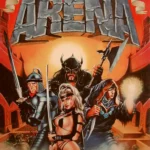
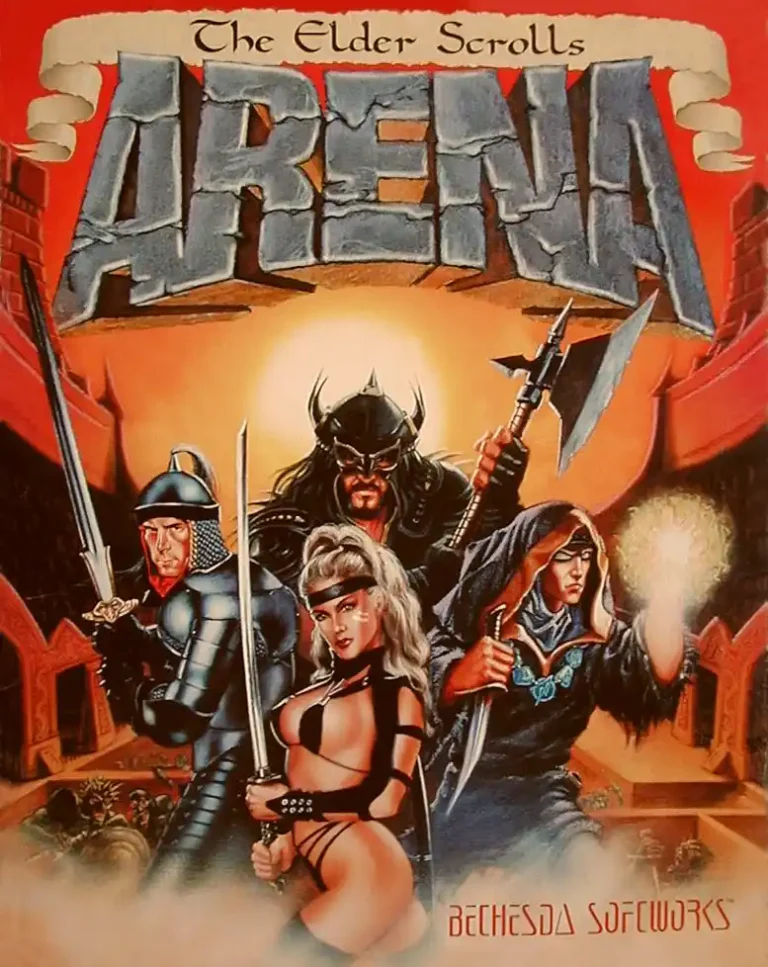
The road to release was rough by any measure. Bethesda missed their Christmas 1993 deadline and shipped in March — a period industry insiders then considered a poor window for small developers. The boxart, which leaned into the gladiatorial aesthetic of the original design concept, confused retailers and distributors about what kind of game they were selling. Initial shipment was 3,000 units.
The game that reached players was also substantially broken. The main quest was difficult or impossible to complete without patches due to bugs affecting key quest triggers; Bethesda released successive updates that progressively stabilised the experience. System requirements were steep for 1994 hardware, limiting the potential audience further.
What saved Arena was the behaviour of the players who did manage to get it working. The combination of procedurally generated scale, first-person exploration, and RPG depth was unlike anything widely available in 1994, and players who found their way into it shared that enthusiasm directly. Critical reception had been mixed-to-negative, focused on the technical shortcomings. Player reception, communicated through Usenet groups and word of mouth, was substantially warmer. The game sold enough copies to justify Daggerfall, which was already in early planning and would go on to introduce most of the systems and lore conventions that still define the series.
Free to Play: Where to Find It in 2026
Arena was made available as a free download by Bethesda in 2004, on the occasion of The Elder Scrolls‘ tenth anniversary — the floppy disk version, requiring DOSBox to run on modern hardware. In 2021 the game was added to Steam (app ID 1812290) and later to GOG, both free, both with DOSBox bundled. The game is available on Xbox through Microsoft’s platforms as well. The Bethesda.net page for the game (elderscrolls.bethesda.net/en/arena) remains the official source.
An unofficial open-source reimplementation called OpenTESArena is in active development on GitHub, aiming to recreate the game’s engine in a form that runs natively on modern operating systems without DOSBox, with improved rendering and performance. For players interested in the historical record, the Steam and GOG versions with bundled DOSBox are the most accessible entry point; OpenTESArena is the option for those willing to engage with an ongoing community project.