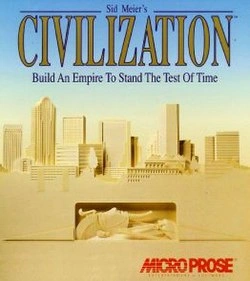
Sid Meier’s Civilization
 Amiga
Amiga Atari ST
 PC
PC PS 1
PS 1 Sega Saturn
 SNES
SNESSid Meier’s Civilization is a landmark 1991 turn-based strategy 4X video game designed by Sid Meier and Bruce Shelley, and developed and published by MicroProse. Originally released for MS-DOS, the game was subsequently ported to the Amiga, Atari ST, Macintosh, Super Nintendo, and PlayStation, cementing its legacy as one of the most important and influential computer games ever created.
Civilization single-handedly established the structural vocabulary for the 4X genre—codifying the cycle of eXplore, eXpand, eXploit, and eXterminate.
Tasking the player with guiding a lone nomadic tribe from the dawn of agriculture in 4000 BC into the Space Age and the near future, the game synthesized elements of city management, technological research, empire expansion, and global diplomacy into a unified, deeply addictive loop.
Technical Specifications
| Attribute | Details |
| Developer | MicroProse |
| Publisher | MicroProse (Japan port: Koei) |
| Designers | Sid Meier, Bruce Shelley |
| Composer | Jeff Briggs |
| Engine | Proprietary 2D Top-Down Orthogonal Grid Engine |
| Platform(s) | DOS, Amiga, Atari ST, Classic Mac OS, Windows 3.1, SNES, Sega Saturn, PlayStation |
| Release Date | September 1991 |
| Genre(s) | Turn-based strategy, 4X |
| Mode(s) | Single-player (Multiplayer introduced via 1995’s CivNet) |
The Spatial Blueprint: The Top-Down Orthogonal Grid
Before the franchise adopted detailed pseudo-3D isometric tiles in Civilization II or the modern hexagonal grids of late-stage entries, the original 1991 client rendered the planet as a flat, strictly top-down orthogonal square grid.
Despite the technical simplicity of its EGA and VGA pixel graphics, the game engine mapped out an elaborate geographic ecosystem. The map was divided into a variety of terrains—such as grasslands, plains, deserts, mountains, swamps, and oceans—with each individual square yielding a distinct matrix of baseline resources:
- Food (Wheat): Directly sustained city population growth.
- Production (Shields): Leveraged to build municipal improvements, world wonders, and military units.
- Commerce (Trade Arrows): Distributed via sliders to fund the state treasury, produce luxury entertainment happiness, or accelerate scientific breakthroughs.
Civilizations expanded by training Settlers, the absolute lifeblood of the early game. Settlers were manually routed across tiles to clear dense jungles, irrigate dry deserts, build basic road networks, and found new cities, permanently pushing back the pitch-black shroud of the game’s pioneer fog of war.
Binary Combat & The Stack Death Penalty
The combat engine of the 1991 original was notoriously brutal, operating on unyielding binary mathematical parameters. Unlike later sequels, units in the first Civilization did not possess independent hit point pools or firepower stats. Combat was resolved as a sudden, randomized calculation of a unit’s raw Attack value pitted directly against the defender’s structural Defense value, heavily modified by terrain parameters (like fortifying on a mountain or behind city walls).
If a unit lost a combat encounter, it was instantly deleted from the map. There was no retreating, no partial damage, and no survival.
This unforgiving math birthed one of the most famous and agonizing tropes in strategy history: the legendary anomaly where an ancient, primitive Phalanx unit fortified inside a city could occasionally defeat an advanced, modern Battleship or Armor tank division simply due to an exceptionally lucky, randomized roll of the game’s internal dice.
Furthermore, out in the open field, the game enforced a strict Stack Death Penalty. While players could group an infinite number of military units onto a single square tile to move them as a massive army, catching a stack outside the protective confines of a city center or a manual fortress was an extreme risk. If an enemy unit successfully attacked and defeated the top-most defending unit in an open-ground stack, the entire stack was instantly destroyed and wiped from existence, vaporizing hours of production in a single turn.
Systemic Pillars: The First Tech Tree & Advisors
The game seamlessly blended its macroeconomics through two innovative user-interface systems that became foundational to the genre:
The Definitive Tech Tree
Civilization popularized the concept of a non-linear, branching Technology Tree. Civilizations pooled their trade commerce into research, selecting from primitive ancient concepts like The Wheel, Pottery, and The Alphabet.
Discovering a technology served as a hard prerequisite that organically unlocked subsequent historical eras. Researching Alphabet unlocked Writing, which eventually paved the way toward modern physics, Nuclear Fission, and Spaceflight. This progression completely altered the gameplay mid-match, transitioning your empire from simple club-wielding militias into advanced mechanized infantries and nuclear-armed superpowers.
The Pixelated Advisory Council
To help players manage the complex interplay of tax rates, public unrest, and international treaties, the game introduced a dedicated panel of Advisors.
Presented as charming, pixelated text boxes, your Military, Science, Foreign, and Domestic advisors would pop up to yell warning alerts if your cities were slipping into violent civilian riots, if foreign empires were out-pacing your academic growth, or if an AI leader was actively massing troops near your borders to execute a surprise invasion.
The 14 Playable Factions
Before the launch of a match, players selected from a cosmetic roster of 14 historical civilizations, split into matching color pairs that shared initial starting slots on real-world earth maps:
- Romans and Russians (White)
- Zulus and French (Green)
- Aztecs and Germans (Yellow)
- Babylonians and Americans (Light Blue)
- Greeks and English (Purple)
- Indians and Mongols (Light Gray)
- Chinese and Egyptians (Light Green)
While civilizational choices in 1991 were largely cosmetic for the human player—affecting your starting city names, palace architectural styles, and musical herald flags—the choice heavily altered the AI behavior profiles of your computer opponents. MicroProse hardcoded distinct personalities for the AI sovereigns; for example, Shaka of the Zulus was programmed to be relentlessly aggressive and expansionist, while Mahatma Gandhi of India favored peaceful, scientific democracy.
The “Nuclear Gandhi” Urban Legend
No retrospective of the 1991 original is complete without addressing the industry’s most famous programming myth: Nuclear Gandhi.
For decades, gaming culture widely maintained that the original game suffered from an integer underflow bug. The lore stated that Gandhi’s baseline aggression rating was set to 1 out of 10. If India transitioned into a Democracy, the government style automatically subtracted 2 points of aggression from the leader. The math ($1 – 2$) allegedly looped backward into an unsigned integer underflow, spiking Gandhi’s aggression rating to a maximum cap of 255 and causing him to aggressively blanket the globe in catastrophic nuclear missile strikes the moment he discovered uranium.
However, in his 2020 autobiography, Sid Meier’s Memoir!, Sid Meier officially debunked this historic legend. He revealed that no such underflow bug ever existed in the 1991 code. Gandhi’s sudden late-game nuclear aggression was simply a natural byproduct of the game’s mechanics: India frequently prioritized high science spending, meaning they were simply the first AI civilization to discover nuclear fission, and since all AI leaders were programmed to act aggressively during late-game space race standoffs, Gandhi utilized his nuclear arsenal just like any other sovereign.
The internet myth became so deeply entrenched in gaming culture that Firaxis formally leaned into the joke, intentionally coding Gandhi to be a hyper-nuclear zealot in subsequent games like Civilization V and VI.
Modern Preservation Status (2026)
As of May 2026, the 1991 original stands preserved as a foundational holy text of digital game design. While its visual presentation is ancient compared to the sweeping landscapes of modern iterations, the mechanical clarity of Sid Meier’s source code remains brilliantly playable.
Because the original game is an MS-DOS application, it cannot execute natively on modern 64-bit Windows 11 or contemporary macOS systems. To run the classic client today, strategy historians rely on open-source emulation tools like DOSBox or DOSBox-Staging.
The game is widely hosted on classic digital preservation archives and abandonware repositories. When executed inside a DOSBox container, players can safely apply scaling filters and lock aspect ratios, allowing the foundational pixelated palaces, branching tech trees, and unforgiving unit stacks of the original Civilization to run smoothly in modern monitor environments for pure preservation.