 79
79  Android,
  iOS (iPhone/iPad),
  Nintendo Switch,
  PC,
PC,  PS4,
PS4,  Xbox One
 Firaxis Games
 2K Games
Where to buy




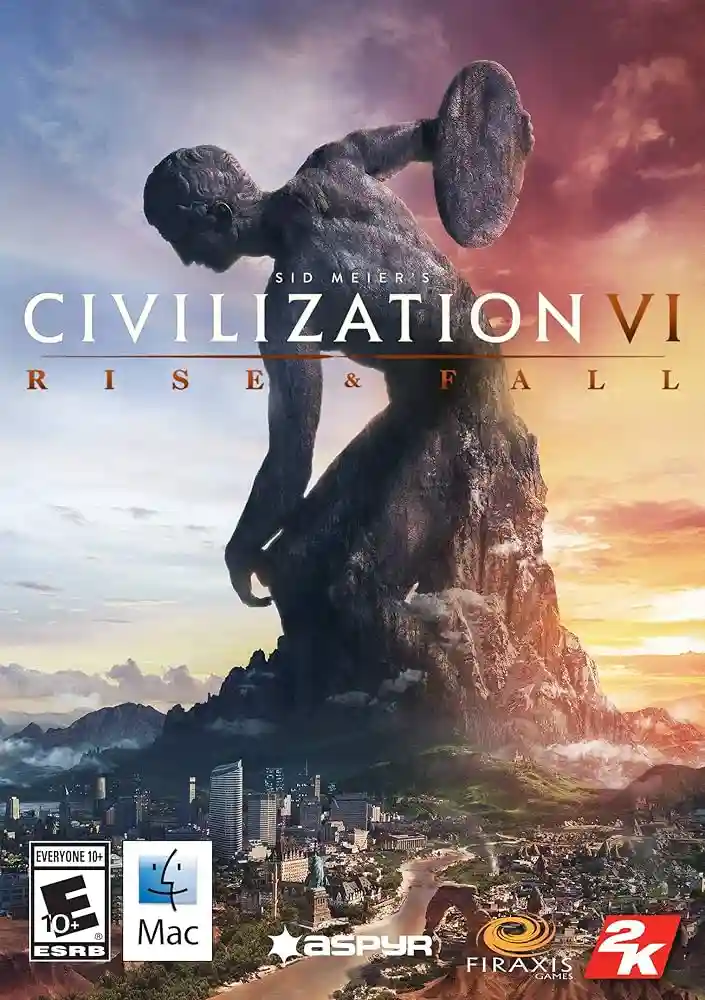
Sid Meier’s Civilization VI: Rise and Fall is the first official expansion pack for the turn-based strategy 4X video game Civilization VI. Developed by Firaxis Games and published by 2K Games, the expansion launched on February 8, 2018, for Microsoft Windows and macOS, before eventually expanding across Linux, mobile, and home consoles.
Designed by Lead Designer Anton Strenger, the expansion focuses heavily on adding dynamic instability and narrative progression to long-term empires. By shifting away from static, linear growth curves, Rise and Fall ensures that borders ebb and flow organically through history.
The expansion introduces a cyclical Great Ages mechanics loop, localized city Loyalty, hireable Governors, a global Emergency matrix, and an account-wide historical timeline tracker.
Technical Specifications
| Attribute | Details |
| Developer | Firaxis Games |
| Publisher | 2K Games (Mobile/Console ports: Aspyr Media) |
| Lead Designer | Anton Strenger |
| Platform(s) | Windows, macOS, Linux, iOS, Android, Nintendo Switch, PlayStation 4, Xbox One |
| Release Date | February 8, 2018 |
| Genre(s) | Turn-based strategy, 4X |
| Mode(s) | Single-player, Multiplayer |
Great Ages: The Rise and Fall of Empires
The core gameplay engine overhauls the transition between historical eras by introducing Great Ages. Instead of every civilization automatically moving into the next era uniformly, a player’s historical actions dictate their society’s structural stability.
Era Score & Historic Moments
Throughout each era, players accumulate Era Score by achieving unique milestones called Historic Moments. These moments represent the dynamic story of your empire—such as clearing a nearby barbarian outpost, founding a religion, launching a unique unit, or completing a World Wonder next to a mountain range.
Upon crossing an era boundary, your cumulative score determines your destination age:
- Dark Age: Triggered if a civilization falls short of the minimum score threshold. A Dark Age severely handicaps your cities’ internal stability and border loyalty. However, it unlocks powerful, high-risk Dark Age Policy Cards (such as Monasticism or Twilight Valor) that grant extreme bonuses at the expense of civil liberties or economic generation.
- Golden Age: Achieved by exceeding the high-tier score threshold. Entering a Golden Age vastly accelerates your cities’ internal loyalty metrics and allows you to choose powerful Dedications—specialized modifiers that multiply your scientific, cultural, or religious yields for the duration of the era.
- Heroic Age: The ultimate comeback mechanic. If a player successfully navigates the hardships of a Dark Age and manages to secure enough Era Score to trigger a Golden Age in the subsequent era, their civilization ascends into a Heroic Age. A Heroic Age grants the player three independent Dedication bonuses simultaneously instead of one, fast-tracking an immediate macro-economic resurgence.
The Loyalty Matrix & Free Cities
To restrict brainless border expansion and punish backward civilization management, Rise and Fall implements a spatial Loyalty System. Every individual city tracks a dynamic Loyalty gauge ranging from 0 to 100.
Population Pressure
Loyalty is exerted as a physical, geographic pressure emanating from the population sizes of nearby cities.
- Cities sitting in a Golden Age project 1.5 times their standard pressure metrics outward, aggressively bleeding into neighboring territories.
- Conversely, cities trapped in a Dark Age project only 0.5 times their normal pressure, leaving their own border outposts highly vulnerable to ideological subversion.
The Rise of Free Cities
If a city’s local Loyalty pool drops to 0, the citizens forcefully revolt against your leadership. The city immediately secedes from your empire, transforming into an independent Free City complete with its own localized defensive garrison and automated military units.
Free Cities are highly aggressive to their former owners but remain systemically open to cultural absorption. If a neighboring civilization continues to project dominant, positive Loyalty pressure over the rebellious hexes, the Free City will eventually offer to voluntarily flip its borders to join that competitor’s empire completely without a single shot being fired.
Specialized Municipal Governors
To help players anchor shifting loyalty lines and deeply customize individual city outputs, the expansion introduces Governors. Players earn Governor Titles along the Civics tree or by completing specific milestones, which can be spent to recruit or promote up to seven unique characters:
- Reyna (The Financier): Maximizes commercial hub outputs, accelerates border tile acquisition velocities, and eventually permits buying entire districts directly with gold.
- Magnus (The Steward): Drastically multiplies the immediate production yields harvested from clearing local forest or rainforest tiles, and enables training Settler units without consuming city population points.
- Amani (The Diplomat): The only governor who can be physically dispatched outside your empire. Placing her inside a neutral independent City-State instantly injects bonus Envoys to safely flip its suzerainty to your favor.
- Victor (The Castellan): Built strictly for military defense. He establishes highly accelerated unit combat defense strengths and locks down city walls against enemy sieges.
- Pingala (The Educator): Optimizes urban academic infrastructure, multiplying the baseline Science and Culture outputs generated per citizen living in the city.
- Liang (The Surveyor): A master builder who grants an extra build action charge to all newly trained Builders while insulating infrastructure from tile pillaging.
- Moksha (The Cardinal): A religious zealot who accelerates local Faith generation metrics, speeds up religious unit healing, and permits purchasing districts cleanly with Faith.
Placing any Governor inside a city instantly projects a flat, unyielding +8 Loyalty bonus to the city center, acting as a crucial defensive barrier to stop border regions from flipping to independent status.
Enhanced Alliances & Global Emergencies
Diplomatic networks are heavily expanded to level out the late-game playing field when a single civilization runs away with the match:
Dynamic Alliance Tracks
Traditional flat alliances are replaced by five targeted Alliance Categories: Scientific, Cultural, Economic, Military, and Religious. Maintaining an alliance continuously causes the relationship to level up across three operational tiers.
For instance, a Level 1 Research Alliance grants extra Science to trade routes, while leveling it up to Tier 3 automatically triggers a shared Eureka breakthrough effect between both partners every fixed number of turns.
The Emergency Matrix
When an empire acts with absolute aggression—such as converting a holy city, launching a nuclear warhead, or capturing a player’s capital—the engine triggers a global Emergency Pact.
The surrounding world leaders receive an immediate request to assemble a temporary international coalition against the threatening civilization. Joining the coalition outlines a strict, time-gated tactical target condition (such as liberating the captured capital within 30 turns). If the coalition succeeds, the members receive massive economic and diplomatic favor rewards; if they fail, the aggressive target civilization inherits permanent, game-defining empire-wide buffs.
New Civilizations and Leaders
The expansion injects eight original civilizations and nine unique leaders into the match pools, heavily altering strategic team metrics:
- The Cree (Poundmaker): An economic powerhouse specialized in establishing early-game shared trade networks and securing map tiles cleanly via roaming caravans.
- Korea (Seondeok): An elite scientific juggernaut that constructs the Seowon unique district to outpace rivals along the technology tree.
- Mongolia (Genghis Khan): A hyper-aggressive, mobile war machine designed to forcefully capture enemy cavalry units and weaponize trade networks for combat visibility.
- Scotland (Robert the Bruce): Prioritizes ecstatic city happiness metrics, multiplying Science and Great Scientist production points when cities are ecstatically content.
- The Zulus (Shaka): A dominant military faction capable of forming advanced Corps and Armies far earlier than standard eras, overwhelming frontlines via cheap Impi units.
- The Netherlands (Wilhelmina): Harnesses maritime river trade systems and constructs beautiful, tile-forging coastal Polders to maximize agricultural growth.
- Georgia (Tamar): Excels at wall fortification lines, projecting high religious influence across independent city-states while farming Era Score easily.
- The Mapuche (Lautaro): Specifically engineered to counter Golden Age empires, gaining massive active combat strength multipliers when attacking units belonging to a civilization currently experiencing a Golden Age.
- Chandragupta (Alternate India Leader): Discards Gandhi’s peaceful diplomacy to utilize the aggressive Casus Belli framework, launching rapid territorial wars that grant massive movement and combat bonuses to his frontline war elephants.
Modern Preservation Status (2026)
As of May 2026, Rise and Fall is universally maintained as a foundational expansion pack built natively into the baseline architecture of the Civilization VI: Platinum Edition and definitive Anthology Bundle. The client operates flawlessly across modern Windows 11 architectures, Apple Silicon configurations, and home console systems, running at native 4K resolutions with fluid performance benchmarks.
While its systems are expanded further by the subsequent Gathering Storm environmental layer, the structural pacing of managing Great Ages, placing governors, and stabilizing city loyalty grids stands as the primary framework that modern Civ 6 purists prefer for competitive multiplayer matches.