Civilization VI
 88
★ /10
88
★ /10
 Android,
  iOS (iPhone/iPad),
  Nintendo Switch,
  PC,
PC,  PS4,
PS4,  Xbox One
 Firaxis Games
 2K Games,
  Aspyr Media
Where to buy




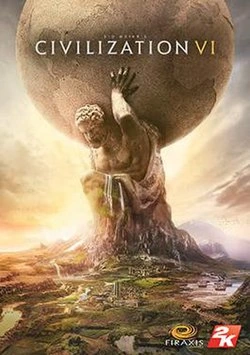
Sid Meier’s Civilization VI (commonly abbreviated as Civ 6) is a turn-based strategy 4X video game developed by Firaxis Games and published by 2K Games. Released in October 2016 for Microsoft Windows and macOS, the game was subsequently ported to Linux, iOS, Android, PlayStation 4, Xbox One, and the Nintendo Switch, establishing itself as one of the most accessible and commercially successful installments in the historic franchise.
Directed by Ed Beach, Civilization VI sought to fundamentally rewrite how players interact with their map. Moving away from the static city hubs of previous games, the title introduced the concept of “city unstacking,” forcing structural improvements and specialized infrastructure out onto the surrounding hex tiles via localized Districts.
Supported by two massive expansion packs (Rise and Fall and Gathering Storm) and multiple seasonal content passes, the game evolved into a deeply complex strategy simulation that remains a benchmark for the 4X genre.
Technical Specifications
| Attribute | Details |
| Developer | Firaxis Games |
| Publisher(s) | 2K Games, Aspyr Media (Mobile/Switch ports) |
| Lead Designer | Ed Beach |
| Composer | Geoff Knorr |
| Engine | Proprietary Firaxis Engine (Built specifically for advanced multi-core processing and DirectX 12) |
| Platform(s) | Windows, macOS, Linux, iOS, Android, Nintendo Switch, PlayStation 4, Xbox One |
| Release Date | October 21, 2016 (PC/Mac initialization) |
| Genre(s) | Turn-based strategy, 4X |
| Mode(s) | Single-player, Multiplayer |
Gameplay Architecture: “Unstacking” Cities & Districts
The defining mechanical innovation of Civilization VI is the dismantling of the single-hex city model. In previous entries, a player could construct an infinite number of specialized wonders, scientific libraries, and military barracks entirely inside a single city center tile.
The District Engine
Civ 6 forces players to physically layout their cities across the map grid by constructing Districts. Each district occupies a full, dedicated hex tile outside the city center and acts as a specialized hub for related structures:
- Campus: The scientific core of the empire, housing libraries, universities, and research labs. It reaps massive passive adjacency bonuses if placed next to mountain ranges, geothermal fissures, or rainforest tiles.
- Theater Square: The cultural capital, housing amphitheaters, museums, and broadcast centers. It relies on proximity to World Wonders and entertainment zones to optimize culture generation.
- Commercial Hub / Harbor: The financial nodes of the city, generating gold streams and increasing trade route capacities based on adjacent rivers, coastlines, or luxury resources.
- Industrial Zone: The manufacturing heart, grouping workshops and factories cleanly. It maximizes production parameters when placed near iron, coal, mines, or aqueducts.
- Holy Site: Dedicated to the generation of Faith, unlocking shrine and temple structures to fund religious missionaries and apostles.
This spatial system transformed the game into a highly tactical geographic puzzle. Constructing a World Wonder (such as the Pyramids or Eiffel Tower) now requires a specific, un-pillaged hex tile meeting explicit terrain parameters (e.g., deserts, flat land adjacent to rivers), forcing players to make crucial risk-reward trade-offs between agricultural space and civic development.
Mechanics: The Civic Evolution & Policy Cards
To mirror the separate advancement of societal thought alongside mechanical technology, Civilization VI bifurcated progression into two independent, scrolling advancement tracks: The Technology Tree and the Civics Tree.
Dual Progression
While Science continues to drive structural weaponry and engineering options on the Tech Tree, Culture is spent to research philosophical developments along the Civics Tree. Completing a Civic node unlocks dynamic government styles and specialized Policy Cards.
The Policy
Governments (ranging from early Chiefdoms to late-game Digital Democracies) provide a rigid template composed of physical card slots categorized across four colored ideological paths:
- Military (Red): Focuses on lowering troop production costs, boosting unit combat strength, or reducing unit resource maintenance fees.
- Economic (Yellow): Tailored to multiplying city gold yields, accelerating settler development, or boosting district adjacency outputs.
- Diplomatic (Green): Modifies relationships with independent City-States, boosting spy operations, or compounding trade route yields.
- Wildcard (Purple): Accommodates any policy classification or accommodates exclusive cards designed to fast-track Great Person generation points.
Players can freely swap policy cards in and out of their active government chassis whenever a Civic research node completes, allowing empires to instantly shift their entire structural focus from an aggressive military expansion to a peaceful economic trade boom with zero infrastructural downtime.
Comprehensive Expansions: Rise and Fall & Gathering Storm
Firaxis heavily supplemented the core game via two definitive, large-scale expansions that drastically complicated the mechanical ecosystem:
1. Rise and Fall (2018)
This expansion introduced systems to emulate the natural, cyclical instability of long-term empires.
- Loyalty Matrix: Individual cities now track an internal Loyalty rating. Exerting low religious or cultural pressure on border regions risks a city declaring itself a “Free City”, defecting away from your rule entirely to join a competitor’s empire.
- Golden and Dark Ages: Based on the accumulation of “Era Score” milestones (such as circumnavigating the globe or training a unique unit), players transition into specialized ages. Entering a Golden Age spikes global city loyalty and opens powerful dedication bonuses. Conversely, slipping into a Dark Age cripples border loyalty but unlocks powerful, high-risk policy cards to engineer a subsequent Heroic Age comeback.
- Governors: Players can hire and promote up to seven unique Governors, embedding them within specific cities to lock down shifting loyalty parameters and inject tailored industrial or military buffs.
2. Gathering Storm (2019)
The second major expansion introduced an active environmental and ecological simulation engine.
- Natural Disasters: Maps become dynamic fields prone to river floods, volcanic eruptions, hurricanes, blizzards, and severe droughts. While these events can instantly pillage or shatter standing improvements, they leave behind incredibly fertile soil matrices that multiply food yields upon restoration.
- Climate Change and Power: The industrial era introduces a Power grid mechanic. Late-game buildings demand electricity to operate at maximum efficiency. Generating electricity via coal or oil refineries spews $CO_2$ into the global atmosphere, driving up a global climate index that melts polar ice caps and permanently submerges low-lying coastal hex tiles under rising sea levels. Players must transition to green alternatives (solar, wind, nuclear) to mitigate environmental fallout.
- World Congress & Diplomatic Victory: Restores the international voting house. Empires spend a currency called Diplomatic Favor to force global resolutions or accumulate Diplomatic Victory Points to win via absolute international consensus.
Current Status & Modern Retention (2026)
Following the 2025 launch of its highly experimental successor, Sid Meier’s Civilization VII, Civilization VI has transitioned into a highly celebrated, fully mature legacy era.
As of May 2026, the game maintains an incredibly robust and fiercely loyal player base. Daily tracking data reveals that Civilization VI regularly hosts a remarkably stable 30,000 to 50,000 concurrent active users on Steam alone.
For many strategy purists, Civ 6 remains the preferred modern 4X ecosystem, retaining large chunks of its audience due to its deeply entrenched district planning and its status as a complete, fully ironed-out package with no active feature gates.
The game functions flawlessly on modern multi-core Windows 11 architectures, Apple Silicon Macs, and current console generations, scaling cleanly into sharp 4K desktop resolutions.
Supported by an immense creative footprint on the Steam Workshop—where community total-conversion mods, AI adjustments, and custom civilizations continue to be updated daily—the game is firmly preserved as an absolute high-water mark of modern turn-based strategy design.