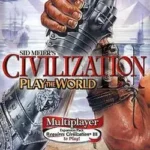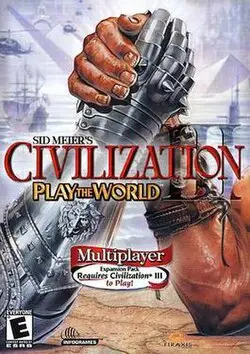
Sid Meier’s Civilization III: Play the World
Expansion of Sid Meier’s Civilization III 61
★ /10
61
★ /10
 PC
PC Firaxis Games

Sid Meier’s Civilization III: Play the World (commonly abbreviated as Civ 3: PtW or Play the World) is the first official expansion pack for the turn-based strategy 4X video game Civilization III. Developed by Firaxis Games and published by Infogrames Interactive (later under the Atari banner), the expansion was released on October 29, 2002, for Microsoft Windows.
The primary focus of Play the World was addressing the single most controversial omission of the 2001 vanilla release: a complete lack of multiplayer capabilities. In addition to introducing network architecture to support worldwide online matches, the expansion infused the traditional 4X sandbox with arcade-style competitive modes, expanded the historical roster with eight civilizations, introduced technology-bridging neutral units, and incorporated advanced overworld tile mechanics.
Technical Specifications
| Attribute | Details |
| Developer | Firaxis Games |
| Publisher | Infogrames Interactive / Atari |
| Engine | Proprietary Custom 2D Isometric Engine |
| Platform | Microsoft Windows |
| Release Date | October 29, 2002 |
| Genre(s) | Turn-based strategy, 4X |
| System Requirement | Requires the base Civilization III client to execute |
| Mode(s) | Single-player, Multiplayer |
The Multiplayer Infrastructure & “Turnless” Mechanics
When Civilization III debuted in 2001, it was widely praised for its innovative cultural borders and strategic resource networks, but it was heavily criticized for being a strictly solitary, single-player application. Play the World served as the official structural remedy, implementing various multiplayer connectivity options—including Local Area Network (LAN), traditional local Hotseat, Play-by-Email (PBEM) configurations, and global online matchmaking via the GameSpy network.
To solve the historic pacing issues of turn-based strategy games in multiplayer—where a player could be forced to sit idle while a competitor managed individual worker paths across giant maps—Firaxis engineered three distinct turn styles:
- Classic Mode: Traditional alternating turns, identical to the pacing of the single-player game.
- Simultaneous Mode: All players execute their actions at the same time. Once everyone clicks the “End Turn” button (or the optional turn clock expires), the game engine processes the moves together, resolving unit production and building development concurrently.
- Turnless Game Mode: The expansion’s most radical concept, which attempted a total mixture of turn-based and real-time gameplay. Under turnless parameters, the game entirely removes the concept of an alternating turn queue. Every active player moves their units, adjusts economic tax sliders, and logs city production scripts continuously in real-time. A highly visible master timer continuously ticks down at the top of the screen. When it hits zero, unit movement points and resource pools automatically refresh without interrupting player commands.
Arcade-Style Competitive Game Modes
To accommodate fast-paced multiplayer sessions that could be concluded in a single evening, Play the World introduced four arcade-inspired victory tracks:
- Regicide & Mass Regicide: Every civilization initializes the match with a physical, weak King or Queen unit spawned on their starting tile. Monarchs cannot participate in heavy frontline combat phases but act as exceptional scouts due to their high sightline metrics. If an opposing military force successfully assassinates your Monarch, your entire empire instantly suffers an automatic defeat, regardless of your remaining cities or standing army strength.
- Elimination: Enforces a zero-tolerance military margin. If a competing player captures or razes a single city center belonging to your empire, you are instantly eliminated from the match.
- Capture the Flag: Spawns a physical, high-value Flag asset inside every player’s capital. Conquering an enemy capital allows a player’s land units to physically seize and carry the flag back to their own palace coordinates to score immediate victory point infusions.
- Victory Point Locations: The world map generator seeds highly specialized, glowing target tiles across neutral terrain. Empires must march their forces to physically occupy and fortify these hot spots, accumulating a continuous stream of Victory Points turn-by-turn to win the scenario.
Civilizational Roster Expansion
The expansion injected eight original civilizations into the configuration pools. This rollout introduced several defining franchise traits and legendary Unique Units (UUs) that became staple tropes across subsequent mainline generations:
- The Arabs (Abu Bakr): Religious and Expansionist attributes, fielding the high-mobility Ansar Warrior (a specialized, low-cost replacement for the Knight that sacrifices defensive plate armor for extreme battlefield speed).
- Carthage (Hannibal): Commercial and Industrious attributes, anchoring early-game frontlines using the heavy Numidian Mercenary (replacing the standard Spearman with massively boosted baseline attack statistics).
- The Celts (Brennus): Religious and Militaristic attributes, launching rapid early-game territory invasions via the Gallic Swordsman (capable of traversing mountainous and hill terrain with high speed metrics).
- Korea (Wang Kon): Commercial and Scientific attributes, specializing in absolute defensive artillery bombardment via the Hwacha siege engine.
- The Mongols (Genghis Khan): Militaristic and Expansionist attributes, swarming open plains via the Keshik horse archer division, which bypasses movement penalties when traversing rough mountain ranges.
- The Ottoman Empire (Osman I): Industrious and Scientific attributes, fielding the devastating Sipahi cavalry unit, an elite modern horse division that can effortlessly shatter fortified musket walls.
- Spain (Isabella): Religious and Commercial attributes, executing rapid trans-oceanic colonization via the Conquistador unique exploration unit.
- The Vikings (Ragnar): Militaristic and Commercial attributes, fielding the fan-favorite Berserk shock troop, which possesses the exclusive ability to execute amphibious coastal raids directly from transport ships.
New Global Units & Tile Infrastructure
To resolve severe gaps along the vanilla technology tree—where players occasionally felt trapped utilizing outdated ancient infantries deep into late historical eras—the expansion introduced four neutral, civilization-agnostic units:
Filling the Tactical Gaps
- Medieval Infantry: Enabled by researching Feudalism, this unit provides a highly competitive, affordable melee option to bridge the massive gap between early-game Swordsmen and late-game Musketmen.
- Guerrilla: An industrial-era infantry unit requiring zero strategic resource nodes to manufacture. It ensures that resourceless, impoverished empires can still field a viable defensive frontline if they are entirely cut off from iron, rubber, or oil deposits.
- Flak & Mobile SAM: Crucial anti-aircraft support units added to counter the vanilla game’s heavily overpowered bomber aircraft sweeps, automatically shooting down hostile planes trying to pillage city infrastructure.
Advanced Overworld Engineering
Workers gain access to specialized Tile Improvements designed to maximize macro-scale strategic logistics across continents:
- Airfields: Built on neutral or domestic flat tiles outside city boundaries, airfields act as secondary functional runways, letting players airlift massive regiments of military units directly across continents to reinforce an active war front.
- Radar Towers: Advanced military outposts that project a permanent, invisible protective aura over a 2-tile radius. Any friendly unit fighting within the radar’s catchment zone receives an automatic +25% combat strength multiplier.
- Civil Defense: Constructed directly inside city centers to heavily upgrade the baseline defensive shielding metrics of the urban civilian populace.
The expansion also introduces The Internet as a late-game Great Wonder of the World. Completing this massive technological project automatically awards the constructing empire with a free Research Laboratory building inside every single city operating on the same continent, dramatically accelerating late-game space race science velocities.
Critical Reception & Legacy
Despite high conceptual anticipation, Play the World was notoriously poorly received by critics and players at launch. The primary feature, its online multiplayer, was riddled with extreme bugs, netcode instability, and severe latency issues. In Turnless mode, players frequently suffered catastrophic “Out of Sync” (OOS) errors that routinely crashed active matches.
“The main feature, its online multiplayer, was extremely buggy and slow. Computer Gaming World labeled the game as a ‘train wreck,’ giving it one out of five stars. GameSpot named it the most disappointing computer game of 2002.” — Wikipedia Historical Archive
Because of these pervasive architectural problems, the Turnless game mode was entirely abandoned and never returned in subsequent iterations like Civilization IV. However, Firaxis quickly remedied the content expansion itself by completely rewriting the netcode and bundling the entirety of Play the World’s assets into the critically acclaimed 2003 expansion, Civilization III: Conquests.
Modern Digital Preservation (2026 Status)
As of May 2026, Play the World is fully preserved and widely active within retro strategy communities under the consolidated digital compilation title Sid Meier’s Civilization III Complete, distributed via major storefronts like Steam and GOG.com for a standard price of $4.99. During the Firaxis 30th Anniversary Sale in May 2026, the complete collection was discounted by 80% to celebrate three decades of studio history.
The compiled application functions perfectly out-of-the-box on modern 64-bit multi-core Windows 10 and Windows 11 operating systems. While the original GameSpy matchmaking master servers were permanently shut down over a decade ago, retro strategy purists actively organize multiplayer matches in 2026 utilizing direct IP connections, virtual local area networks (such as Hamachi), and the robust Play-by-Email engine.
To ensure visual stability and flawless display scaling on modern high-resolution monitors, players apply community-tested configuration overrides (such as appending the text line KeepRes=1 directly to the local game initialization file, conquests.ini), allowing the isometric visual charm and high-speed simultaneous battles of Play the World to run with smooth performance.