 80
80  Android,
  iOS (iPhone/iPad),
  Nintendo Switch,
  PC,
PC,  PS4,
PS4,  Xbox One
 Firaxis Games
 2K Games
Where to buy




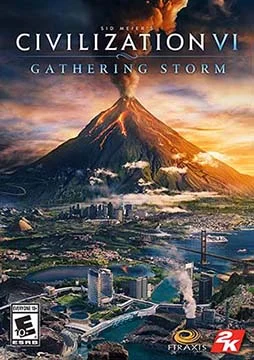
Sid Meier’s Civilization VI: Gathering Storm is the second official major expansion pack for the turn-based strategy 4X video game Civilization VI. Developed by Firaxis Games and published by 2K Games, the expansion launched on February 14, 2019, for Microsoft Windows and macOS, subsequently arriving on Linux, iOS, Android, Nintendo Switch, PlayStation 4, and Xbox One.
Directed by Franchise Lead Designer Ed Beach, Gathering Storm introduces a dynamic, living planet ecosystem where geology and climatology serve as both catastrophic hazards and immense opportunities. The expansion permanently overhauls the late-game experience by integrating global climate change, active power grids, macro-engineering projects, and the fan-favorite World Congress diplomacy matrix.
Technical Specifications
| Attribute | Details |
| Developer | Firaxis Games |
| Publisher | 2K Games (Mobile/Console ports: Aspyr Media) |
| Lead Designer | Ed Beach |
| Composer | Geoff Knorr |
| Platform(s) | Windows, macOS, Linux, iOS, Android, Nintendo Switch, PlayStation 4, Xbox One |
| Release Date | February 14, 2019 |
| Genre(s) | Turn-based strategy, 4X |
| Mode(s) | Single-player, Multiplayer |
Environmental Effects & Climate Change
The foundational upgrade of Gathering Storm is the transition from a static world map to a reactive global ecosystem. World generation clusters terrain across realistic geological boundaries, placing volcanoes along continental fault lines and spawning deep floodplains exclusively along winding river systems.
Natural Disasters
The map is frequently struck by unpredictable, dynamic environmental emergencies categorized as Natural Disasters. These include volcanic eruptions, river floods, severe droughts, and localized storms like blizzards, sandstorms, tornadoes, and hurricanes.
While a flash flood or eruption can instantly pillage local tile improvements, wipe out defensive city walls, or kill military units, disasters possess a vital silver lining: they permanently enrich the affected soil hexes with volcanic ash or river silt, drastically multiplying food and manufacturing yields once the city reconstructs the tile.
The Global Warming Index
As civilizations march into the Industrial Era and beyond, their choices directly alter the world’s temperature matrix. Burning fossil fuels spews carbon dioxide emissions into the global atmosphere.
This triggers a multi-tiered Climate Change system that permanently accelerates the frequency and intensity of natural disasters across the globe. In its late-stage phases, global warming melts polar ice caps, resulting in rising sea levels that systematically submerge and permanently erase low-lying coastal lowland tiles from the map.
Power Grids & Consumable Resources
To incentivize late-game manufacturing dominance, the expansion introduces a complex municipal Power Grid ecosystem. High-tier modern buildings—such as research labs, factories, and stock exchanges—demand electricity to function at peak efficiency.
Strategic resources no longer act as flat, binary unlocks for unit creation; they accumulate as a numerical stock pool spent continuously. Power plants consume these strategic assets turn-by-turn to generate electricity:
- Carbon-Based Energy: Early grids rely strictly on constructing Coal and Oil power plants. While highly efficient and cheap to manufacture, they spew massive amounts of carbon emissions into the global climate tracker.
- Clean Alternatives: Advancing along the technology tree unlocks eco-friendly, green power alternatives, allowing players to build Geothermal, Wind, and Solar power stations. These green solutions provide clean energy to local cities without contributing to greenhouse gas emissions.
- Nuclear Energy: Uranium-fueled power plants offer absolute maximum electricity outputs with zero carbon footprint. However, they require routine maintenance; failing to continuously service a nuclear plant risks a catastrophic reactor meltdown that radiates surrounding city tiles into an un-farmable wasteland.
Large-Scale Engineering Projects
To protect cities from hostile terrain and environmental fury, players can construct grand Engineering Projects directly onto hex tiles:
- Canals: Carve artificial shipping lanes through land tiles, cleanly linking inland cities to coastal waters and allowing naval fleets to cross continents.
- Dams: Constructed along floodplains to permanently insulate adjacent districts from river flooding while providing clean electricity in the mid-game.
- Mountain Tunnels & Railroads: Erase movement bottlenecks. Railroads facilitate instant cross-country unit movement, while Tunnels allow military regiments to teleport directly through mountain ridges.
- Flood Barriers: The ultimate defensive engineering feat against global warming. Built around coastal city centers and lowland tiles, Flood Barriers safely repel rising sea levels, preserving precious coastal real estate from permanent submersion.
The World Congress & Diplomacy Overhaul
Diplomacy is entirely redesigned via the return of the World Congress and a brand-new victory track.
Diplomatic Favor
Players generate a dedicated political currency known as Diplomatic Favor by maintaining active alliances, influencing independent city-states, and competing in global events like the World Games. Favor acts as a direct voting weight spent during World Congress sessions. Players vote on critical global resolutions—such as banning specific luxury commodities, modifying religious strength, or calling international emergency sessions to penalize a warmonger. Accumulating 20 Diplomatic Victory Points via consensus wins the match.
The Grievances System
Replacing the baseline game’s frustratingly rigid “Warmonger Score,” the engine logs historical context through Grievances. Grievances operate like a localized political ledger balancing two empires. If an AI opponent spends centuries breaking promises, spying on your capitals, and converting your cities, you accumulate a massive pool of Grievances against them. This pool permits you to declare a justified retaliatory war and capture their border outposts without suffering any international diplomatic penalties or denouncements from the global community.
New Civilizations and Leaders
The expansion introduces eight original civilizations and nine unique leaders, heavily diversifying the asymmetric strategy landscape:
- Hungary (Matthias Corvinus): Specializes in levying city-state military units at extreme discounts, transforming rented forces into hyper-fast, high-strength assault armies.
- The Māori (Kupe): Discards standard continental starts. Kupe initializes the match floating in the middle of deep ocean tiles, gathering passive culture and science before settling. Once established, the Māori are heavily penalized for chopping woods, instead reaping massive food and production bonuses for preserving the pristine environment.
- Canada (Wilfrid Laurier): Converts frozen tundra tiles into highly lucrative agricultural farms and camps, completely immune to surprise declarations of war.
- The Inca (Pachacuti): Establishes massive domestic internal trade networks, utilizing specialized Qhapaq Ñan mountain pass networks to cross ridges easily while farming high food yields from terrace mountain tiles.
- Mali (Mansa Musa): Suffers a severe production penalty but generates staggering, unmatched streams of gold and faith from desert trading routes, using raw liquid cash to instantly buy entire districts and military forces out-of-the-box.
- Sweden (Kristina): Optimizes Great Person generation points, organizing Great Works inside themed museums to rapidly fast-track culture tourism.
- The Ottoman Empire (Suleiman): An elite, destructive siege machine. They deploy a unique military governor to easily break foreign city defenses without suffering local city loyalty decay.
- Phoenicia (Dido): Dominates maritime shorelines, utilizing a unique harbor district to build ships at maximum speed while possessing the exclusive ability to move her capital city freely between continents to optimize colonial trade loops.
- Eleanor of Aquitaine (Dual Leader): The first leader in the franchise capable of ruling two entirely separate nations (either England or France). She discards military conflict entirely, weaponizing high-tier Great Works to output devastating cultural pressure over border regions, causing adjacent enemy cities to skip independent status and immediately flip into her empire via pure loyalty subversion.
Modern Preservation & Legacy (2026)
“In Gathering Storm, the late-game transforms from a predictable click-through grind into a desperate, high-stakes battle against an active, angry planet. It complete the structural vision of Civilization VI.” — 4X Strategy Retrospective Archive
As of May 2026, Gathering Storm stands as the definitive, baseline operating standard for Civilization VI. The DLC is natively packaged into the global digital installer for both the Platinum Edition and the definitive Anthology Bundle across Steam, GOG.com, and home consoles.
Following the polarizing launch and subsequent major overhauls of its successor, Civilization VII, Civ 6 has enjoyed a major legacy renaissance. The game continuously pulls in a remarkably stable 30,000 to 50,000 concurrent daily active players on Steam, with the overwhelming majority of the community choosing Gathering Storm rulesets for both single-player challenges and global competitive multiplayer tournaments.
The application scales beautifully into modern native 4K ultra-widescreen resolutions under Windows 11, fully preserved as a masterpiece of modern tactical management.