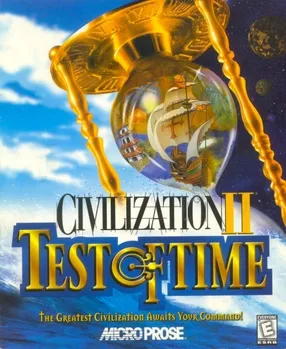
Sid Meier’s Civilization II: Test of Time
Expansion of Sid Meier’s Civilization II PC
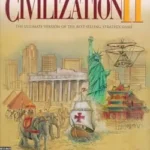
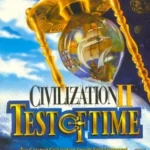
PCCivilization II: Test of Time is a turn-based strategy 4X video game developed by MicroProse’s Hunt Valley studio and published by Hasbro Interactive. Released in August 1999 for Microsoft Windows, the game is a comprehensive, standalone reimagining and mechanical expansion of the legendary 1996 title Civilization II.
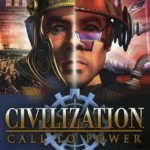
Test of Time was engineered during a highly turbulent period in strategy gaming history. Developed to directly compete with Activision’s clone title Civilization: Call to Power and Firaxis Games’ Sid Meier’s Alpha Centauri, it sought to push the historical boundary of the franchise into speculative fiction.
The game permanently overhauls the series’ mechanical layout by implementing a groundbreaking Multi-Map Engine, replacing static 2D sprites with fully animated unit artwork, and introducing massive, standalone Science-Fiction and Fantasy narrative campaigns.
Technical Specifications
| Attribute | Details |
| Developer | MicroProse (Hunt Valley Studio) |
| Publisher | Hasbro Interactive |
| Lead Designers | John Possidente, Mick Uhl |
| Composer | Roland J. Rizzo |
| Engine | Upgraded 2D Isometric Engine with multi-map layers & 16-bit color mapping |
| Platform | Microsoft Windows |
| Release Date | • NA: August 9, 1999 • UK: August 13, 1999 |
| Genre(s) | Turn-based strategy, 4X |
| Mode(s) | Single-player, Multiplayer |
The Core Innovation: The Multi-Map Engine
The defining technical breakthrough of Test of Time is the abandonment of the single, isolated overworld grid. Instead, the game’s engine accommodates up to four distinct physical map layers running simultaneously within a single match.
This multi-tiered architecture transforms spatial geography into a vertical puzzle. Maps are stacked or linked, and civilizations can move units, establish settlements, and fight wars across completely different environmental realms.
To bridge these environments, units utilize specialized map-transit commands or move onto designated “Teleportation Tiles” (such as portals, spaceports, or mystical stairwells). This design forces a multi-front macro-strategy; for example, a player can launch a surface-level military diversion on Map 1 while quietly marching a stealth strike force through an underground underworld network on Map 2 to emerge directly beneath an enemy’s heavily fortified capital.
The Three Thematic Campaigns
The game discards a uniform setup by packaging three massive, structurally isolated game modes, each running on independent art assets, tech trees, and unit blueprints:
1. The Extended Original Campaign
This mode begins identically to standard Civilization II, tasking players with guiding a historical nation from prehistory to the modern era. However, reaching the classic Space Race victory condition by launching a ship to Alpha Centauri no longer ends the game.
Instead, the match instantly opens Map 2: The Centaurus Star System. The launching player lands their pod on a fresh, alien landscape to begin a secondary colonization loop, fighting native alien lifeforms and managing new high-tech resource nodes while the remaining Earth-bound nations desperately scramble to research advanced propulsion tech to catch up and join the interstellar conflict.
2. The Science-Fiction Campaign (Lalande 21185)
Set within a distant, hostile star system, this campaign splits players across multiple vertical map layers simultaneously: the Orbit, the surface of an alien world, and a subterranean cavern system.
Human colonists and highly asymmetric alien factions (such as the Cyborgs and the energy-based Silhouettes) clash over unique cosmic parameters. The victory condition requires researching hyper-advanced, speculative physics to construct an interstellar gateway back to Earth.
3. The Fantasy Campaign (Midgard)
Loosely based on rich Norse and European mythologies, this campaign completely strips away real-world history, stacking four distinct worlds concurrently: the Sky World, the Surface World, the Undersea World, and the Underworld. Factions are split across seven distinct, highly asymmetric biological cultures:
- The Elves: High cultural growth masters optimized for forest tile navigation.
- The Goblins: Hyper-aggressive, fast-breeding subterranean swarms.
- The Stygians: An Undead legion that utilizes specialized immunities to survive lethal terrain hazards.
- The Buteo: A specialized avian bird-people culture capable of flying freely across Sky maps.
- The Merfolk: Aquatic humanoids engineered to settle and dominate Undersea coordinates.
- The Humans & The Infidels: Divided human kingdoms mimicking early medieval societies and nomadic Eastern European tribes.
Winning the Fantasy campaign requires undertaking a grand narrative matrix of Ten Legendary Quests spread across all four world layers to banish a catastrophic ancient evil.
Aesthetic & Engine Upgrades
Beyond its structural innovations, Test of Time delivered a comprehensive visual overhaul to the Civ II framework. The engine transitioned from legacy 8-bit color rendering to an advanced 16-bit high-color palette.
This allowed designers to introduce Animated Unit Sprites; phalanxes physically march in place, dragons flap their wings on tiles, and modern tanks rotate their turrets.
Furthermore, MicroProse integrated dynamic environment effects, mapping colored lighting shifts and glittering resource nodes directly onto the isometric grids to provide an atmospheric depth that was entirely missing from the sterile sprites of the 1996 original.
Modern Preservation & The 2026 Legacy Horizon
As of May 2026, Civilization II: Test of Time occupies a deeply fascinating dual position within strategy gaming culture. While the original 1999 software package is long out-of-print and highly rare to acquire physically, its technical legacy has witnessed an immense community-driven renaissance.
The Test of Time Patch Project (TOTPP)
Because the original 16-bit installer executable fails to execute natively on contemporary 64-bit multi-core operating systems like Windows 11, the preservation community continuously maintains the Test of Time Patch Project (TOTPP).
Currently operating in its highly stable 2026 iteration, this open-source digital launcher completely rewrites the game’s memory layout:
- It injects native 64-bit multi-core CPU support and DirectX translation frameworks directly into the old
civ2.exeprocess. - It completely removes legacy hardcoded limits, expanding maximum parameters to allow up to 189 distinct unit types, 253 unique technologies, and massive map sizes.
- It overhauls the game’s primitive macro script engine, replacing it with a robust Lua Scripting framework. This has enabled retro modders throughout 2025 and 2026 to launch incredibly complex total-conversion scenarios—such as Atlantis: The Lost Empire and The Holy Roman Empire—keeping the 1999 engine actively played.
The 2026 Franchise Homage
The phrase “Test of Time” holds a monumental dual meaning for 4X fans. In an intentional, high-profile homage to this specific 1999 classic, Firaxis Games officially released the Patch 1.4.0 “Test of Time” Update for Civilization VII on May 19, 2026.
By naming their largest, free game-altering modernization update after the 1999 title—which famously restored single-civilization sandbox continuity and completely overhauled the franchise’s victory tracks—2K and Firaxis permanently cemented Civilization II: Test of Time as the ultimate historical symbol of structural evolution and enduring design within the strategy genre.