Sid Meier’s Civilization II
 94
★ /10
94
★ /10
 PC
PC PS 1
PS 1 Activision
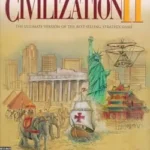
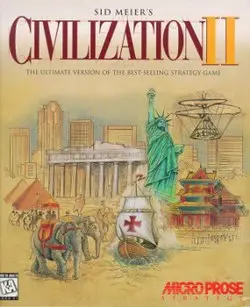
Sid Meier’s Civilization II (commonly abbreviated as Civ 2 or Civ II) is a turn-based strategy 4X video game developed and published by MicroProse. Released in February 1996 for Microsoft Windows, with subsequent ports arriving on Mac OS and the original PlayStation, it is the second mainline entry in the Civilization series.
While the game bears the name of franchise founder Sid Meier, he was not directly involved in its design due to internal corporate restructuring at MicroProse. Instead, the game’s development was helmed by Lead Designer Brian Reynolds alongside Jeff Briggs and Douglas Caspian-Kaufman.
Civilization II is widely considered one of the most critical foundational stepping stones in the history of the 4X genre. It successfully transitioned the series into an isometric perspective, overhauled the mathematical rules governing tactical combat, introduced a live-action interactive advisory council, and pioneered deep, user-accessible scenario modding toolkits.
Technical Specifications
| Attribute | Details |
| Developer | MicroProse |
| Publisher | MicroProse |
| Lead Designer | Brian Reynolds |
| Engine | Proprietary 2D Isometric Engine |
| Platform(s) | Microsoft Windows (Windows 3.1 / Windows 95), Mac OS, PlayStation |
| Release Date | February 29, 1996 |
| Genre(s) | Turn-based strategy, 4X |
| Mode(s) | Single-player, Multiplayer (via later editions) |
The Isometric Pivot & Graphic Realignment
The most immediate upgrade in Civilization II over its 1991 predecessor was a complete visual and structural transformation of the world map. The game discarded the flat, top-down, orthogonal square grid of the original title in favor of a detailed 2D Isometric Perspective.
This graphical shift added pseudo-3D depth to the landscapes. Terrain features like rolling hills, jagged mountain ridges, and lush grasslands were rendered with distinct elevations, significantly enhancing map readability. The change also altered unit navigation, allowing military forces and civilian settlers to traverse the map across eight directional vectors rather than four, which added a layer of spatial logistics to early-game exploration and territorial expansion.
Combat Overhaul: Hit Points and Firepower
To address one of the most infamous and frustrating flaws of the original Civilization—where a primitive militia unit fortified in a city could occasionally, through randomized dice-roll math, defeat an advanced modern battleship or tank—Brian Reynolds completely restructured the underlying combat logic by introducing two discrete mechanics loops:
- Hit Points (HP): Units were no longer bound to a binary “live or die” combat system. Every military division received a specific pool of health points. This allowed units to survive losing skirmishes, retreating into friendly territory with a damaged health bar to heal over subsequent turns.
- Firepower: A separate attribute assigned to advanced military units to simulate their technological destructive capacity. High-tier units (such as Musketeers, Artillery, and Armor) possessed exponentially higher firepower ratings than ancient warriors or phalanxes.
When a modern unit engaged a primitive one, its high firepower status multiplied the actual damage dealt to the defender’s hit point pool per round of combat. This change effectively eliminated the severe statistical anomalies of the first game, ensuring that industrial and modern armies reliably outclassed ancient forces.
The High Council
One of the game’s most memorable and charming features was the introduction of The High Council, an interactive advisory menu utilized to guide your empire’s socioeconomic policies. Leveraging the popular mid-1990s multimedia trend of Full-Motion Video (FMV), the council was composed of five live-action actors who filmed separate video clips to represent different administrative branches of the state:
- The Military Advisor: A brash, aggressive commander who demanded continuous funding for troops and walls.
- The Science Advisor: A cerebral, hyper-focused intellectual who pushed for rapid academic breakthroughs.
- The Economy Advisor: A pragmatic, easily stressed merchant who managed tax rates and deficits.
- The Foreign Affairs Advisor: A smooth, calculating diplomat who monitored international relationships and treaties.
- The Entertainment Advisor: A theatrical coordinator responsible for citizen happiness, who famously dressed as an Elvis Presley impersonator when the empire advanced into the modern era.
The genius of the system lay in its dynamic, reactive script arrays. The advisors did not deliver isolated generic lines; they actively argued with one another face-to-face based on the current state of your empire. If you plunged the nation into a severe financial deficit to fund a sudden war, the Economy Advisor would literally scream in panic while the Military Advisor cheered him down.
Furthermore, the actors changed their physical costumes and sets depending on your current historical era (e.g., wearing tunics in the ancient era, doublets in the renaissance, and modern suits in the 20th century) and your chosen government style. If your empire slipped into absolute Anarchy during a government transition, the advisors would break out into full, unscripted chaotic shouting matches, ignoring your presence entirely.
Expansion History & Alternative Versions
MicroProse heavily capitalized on the success of the base game by deploying targeted content packs and deep engine overhauls:
Scenarios and Fantasy Overhauls
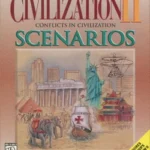
- Conflicts in Civilization (1996): Injected exactly 20 historical scenarios into the game files, featuring pre-made maps for the American Civil War, the conquests of Alexander the Great, and post-apocalyptic survival challenges.
- Fantastic Worlds (1997): A radical thematic expansion that pushed Civilization II far outside the boundaries of real-world history. It introduced fantasy, mythology, and science-fiction scenario layers, allowing players to fight against dragons, commanding magic-casting elves, or repel alien invasions on distant planets. Crucially, it packaged a robust, highly accessible script and event editor, turning the game into an early blueprint for community-driven total conversion mods.
Comprehensive Editions
- Civilization II: Multiplayer Gold Edition (1998): Bundled both the Conflicts and Fantastic Worlds expansions into a singular directory, optimized the computer’s artificial intelligence algorithms to be far more aggressive, and integrated native internet networking code to support multi-user online matches.
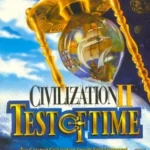
- Civilization II: Test of Time (1999): The final, most ambitious iteration of the franchise’s second generation. It delivered a comprehensive graphical overhaul, replacing the standard static sprites with fully animated units and high-color terrain maps. The title’s definitive feature was its Multi-Map Campaign architecture, allowing a single match to run across separate physical maps concurrently (such as building a terrestrial empire on Earth while simultaneously managing an alien colonization campaign on Alpha Centauri).
Legacy and Modern Preservation
“In Civilization II, the series grew up. It took Sid Meier’s brilliant but rough concept and turned it into an uncompromised, mathematically sound strategy masterpiece that defined the baseline laws of the 4X genre for decades.” — Retro Strategy Review Archive
Within the timeline of interactive media history, Civilization II is routinely preserved as an absolute high-water mark of turn-based design, regularly occupying top slots on industry listings of the greatest video games ever made.
As of May 2026, the game exists primarily as a revered legacy classic. Because MicroProse’s original 1996 codebase was authored strictly within legacy 16-bit Windows 3.1 and early Windows 95 software protocols, attempting to execute the original retail application executable directly on contemporary 64-bit operating systems like Windows 10 or Windows 11 triggers immediate architecture errors.
To safely bypass these technical limitations and preserve the game for modern strategy fans, the community relies on open-source translation layers and software emulation tools. The most popular method utilizes WineVDM (a 16-bit Windows executable emulator for 64-bit Windows systems), which safely interprets the game’s old draw calls and allows the original client to execute smoothly on modern setups.
Concurrently, strategy purists utilize community-developed compatibility patches (such as the Civ2Unlimiter and widescreen GUI fixes) to safely unlock frame rates, remove hardcoded unit caps, and scale the vibrant isometric tiles and classic FMV advisor videos of Civilization II into crisp modern monitor resolutions.