Sid Meier’s Starships
 64
★ /10
64
★ /10
 iOS (iPhone/iPad),
  PC
PC
 Firaxis Games
 2K Games
Where to buy

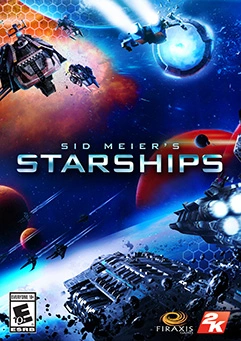
Sid Meier’s Starships is a turn-based science-fiction space strategy video game developed by Firaxis Games and published by 2K Games. Released on March 12, 2015, for Microsoft Windows, OS X, and iOS, the title functions as an official narrative and thematic spin-off to 2014’s Sid Meier’s Civilization: Beyond Earth.
Conceived by legendary game designer Sid Meier himself, the game took a radical detour from traditional, hyper-complex 4X space epics.
Instead of demanding dozens of hours of complex macro-management, Starships was intentionally engineered as a streamlined, “strategy-light” single-session experience. By compressing galactic conquest into swift tactical fleet engagements, modular ship blueprints, and an interconnected resource loop, the title offered an accessible, pocket-sized space opera.
Technical Specifications
| Attribute | Details |
| Developer | Firaxis Games |
| Publisher | 2K Games |
| Lead Designer | Sid Meier |
| Engine | Proprietary 3D Tactical & 2D Planetary Interface Engine |
| Platform(s) | Microsoft Windows, macOS, iOS (iPad) |
| Release Date | March 12, 2015 |
| Genre(s) | Turn-based strategy, Tactical Space Combat |
| Mode | Single-player |
Beyond “Beyond Earth”: The Narrative Setup
The storyline of Sid Meier’s Starships picks up roughly 1,000 years after the events of Civilization: Beyond Earth. The narrative chronicles the fate of the original colony ships sent from a dying Earth to seed humanity across the stars. Over the centuries, these isolated colonies successfully adapted to their host planets, branching into distinct spacefaring civilizations.
Upon initializing a match, players choose from the eight original leaders from Beyond Earth—such as the militaristic Bolivar, the diplomatic Hutama, or the economically minded Suzanne Fielding—with each leader bringing a permanent, game-altering resource multiplier to your civilization.
Furthermore, empires are aligned with one of three ideological Affinities that dictate their societal evolution and aesthetic architecture:
- Purity: Human purists who reject alien adaptation; they start with free starting technology levels.
- Supremacy: A hyper-industrial cybernetic collective; they gain a massive strategic advantage by starting the match with a random completed Wonder.
- Harmony: Gene-crafters who seamlessly integrate alien biology into their DNA; they receive massive discounts when repairing damaged hulls.
One Fleet to Rule Them All
The macroscopic overworld map is structured as a collection of isolated planets connected by space lanes. Unlike traditional grand strategy games where players manage dozens of scattered task forces, Starships simplifies logistics by locking your entire global military presence into a single primary grand armada.
The Influence Quest System
To expand your empire, your single fleet must travel from system to system to make first contact with independent worlds. Upon arrival, the local planetary government issues a specific narrative quest or tactical mission—such as escorting a vulnerable civilian transport, surviving a meteor storm, or neutralizing marauding space pirates.
Successfully completing the mission earns you regional Influence. Amassing 100% influence over a planet forces it to formally join your federation, granting you total access to its resource yields.
The Crew Morale Tracker
Fleet movement is strictly bottlenecked by an active Crew Morale Meter. The fleet starts every turn with 10 morale points. Traveling to a neighboring planet consumes exactly 1 morale point, while initiating a tactical mission devours 2 points.
As your crew fights and travels, the meter drops from green to red, actively degrading your ship attributes. To reset the meter and reap your planetary resource rewards, you must order your fleet to “Shore Leave,” which effectively concludes your strategic turn.
The 4-Resource Economy & Modular Ship Customizer
Federation planets generate a continuous turn-by-turn yield divided across four fundamental domestic resources, which players spend instantly to buy structural upgrades without waiting for construction queues:
- Energy: Spent directly to upgrade hull sizes, buy fresh starships, or repair structural damage.
- Metal: Used to build planetary cities, factory improvements, and local orbital defensive networks.
- Science: Expended to instantly purchase upgrades across a militaristic tech tree (boosting laser range, armor thickness, or stealth shields).
- Food: Consumed to purchase new cities on civilized worlds to multiply overall resource yields.
The Shape-Shifting Assembly Terminal
Upgrading your starships functions like an interactive mechanical workshop. Ships are divided into discrete functional Modules that players can freely purchase, sell, or swap using Energy reserves.
Crucially, the physical 3D model of your ship dynamically morphs its geometry on screen based on the modules you install: bolting down heavy Armor modules adds thick physical plates, upgrading Engines elongates the thruster bays, and purchasing Stealth modules applies a shimmering, cloaked texturing effect.
Directional Armor & Remote Torpedoes
When a mission or a faction battle is initiated, the game transitions to a localized, flat 3D Hexagonal Tactical Arena filled with space anomalies and asteroid fields that function as physical cover. Combat places a heavy emphasis on positioning and physics-based mechanics:
- Directional Shield Vulnerability: Ships are outfitted with directional shields that absorb incoming fire across the front and side arcs. However, starships possess zero rear shield plating. Tactical mastery requires maneuvering fast ships to slip directly behind an enemy’s orientation to blast their exposed engines for an instant, high-damage critical kill.
- Remote Detonation Torpedoes: Torpedoes behave like slow-moving, physical spatial bombs. When fired, they glide across hexes but cannot be exploded on the turn they are launched. On subsequent turns, players choose when to manually hit the detonation prompt, triggering a massive area-of-effect blast radius that forces enemies to continuously scatter their formations to avoid the explosion.
- Deployable Fighters: Capital ships can spend actions to launch fragile, high-velocity Fighter wings. Fighters are exceptional tools for flying straight through dangerous asteroid belts or acting as defensive decoys to draw enemy fire away from your primary flagships.
Reception and Legacy
Sid Meier’s Starships received a highly polarized reception upon its debut. Casual players and mobile reviewers highly praised the game’s intuitive touch controls and swift pace, earning it a perfect 5/5 score from Gamezebo on iOS.
However, PC strategy purists and mainstream outlets like IGN and GameSpot were heavily disappointed. Critiques targeted the game’s simplistic tactical AI, poor explosion effects, and the lack of a deep, thoughtful diplomatic or economic overlay. Because players command only one fleet, losing a single high-stakes battle frequently resulted in an immediate game over, causing matches to swing too fast for their own good.
Modern Preservation Status
As of June 2026, Sid Meier’s Starships is fully preserved and cleanly playable. While the iOS mobile edition has largely become unplayable on modern Apple tablets due to 64-bit iOS architecture shifts, the personal computer original is stably distributed on the Steam platform for a budget baseline price of $14.99.
Because Firaxis natively built the game around modern Windows API frameworks and standard DirectX architectures, the game executes flawlessly out-of-the-box on modern Windows 11 environments without requiring external wrappers or community patches, serving as an interesting, strategy-light artifact of Firaxis’s mid-2010s design era.