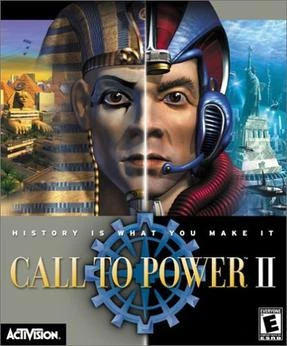
Call to Power II
 72
★ /10
72
★ /10
 PC
PC Activision

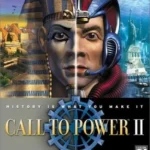
Call to Power II (commonly abbreviated as CtP2) is a turn-based strategy 4X video game developed and published by Activision. Released in November 2000 for Microsoft Windows, the title is the direct sequel to 1999’s Civilization: Call to Power.
Call to Power II holds a unique, historical position in the 4X genre. It is the final entry in Activision’s short-lived sci-fi strategy series, functioning as a direct mechanical bridge between the classic style of Civilization II and the emerging modern tropes of the early 2000s.
While it preserved major gameplay engines from its predecessor—such as the automated Public Works budget and asymmetric shadow units—the sequel underwent an intellectual property rebranding, entirely removed its controversial upper space layer to tighten tactical focus on terrestrial boundaries, and heavily redesigned the franchise’s diplomacy and combined-arms military loops.
Technical Specifications
| Attribute | Details |
| Developer | Activision |
| Publisher | Activision |
| Lead Designers | David White, Tony Evans, Dan Haggerty, Winnie Lee |
| Composer | Carey James Chico |
| Engine | Upgraded 2D Isometric Engine with tabbed interface layouts |
| Platform | Microsoft Windows |
| Release Date | • NA: November 20, 2000 • EU: November 24, 2000 |
| Genre(s) | Turn-based strategy, 4X |
| Mode(s) | Single-player, Multiplayer (TCP/IP, IPX, Hotseat, Play-by-Email) |
The Trademark Fallout & Map Scaling
The most notable shift regarding Call to Power II was the absolute omission of the name “Civilization” from its branding. Following the aggressive multi-studio legal battles surrounding the trademark in the late 1990s, a legal settlement firmly restricted the use of the prefix to MicroProse and Firaxis Games. Activision moved forward with the sequel by establishing Call to Power as an independent standalone brand.
Concurrently, the developers enacted a major design contraction by completely removing the vertical Orbital Space Layer that had defined the endgame of the 1999 original.
Finding that managing simultaneous space battles alongside land and sea campaigns created extreme visual clutter and pacing issues, Activision focused the map scale entirely on Earthbound terrain.
The timeline was restaged to run from 4000 BC to 2300 AD across roughly 500 balanced turns, prioritizing land, sea, and deep submarine future warfare over cosmic travel.
Advanced Diplomacy & Border Visibility
The definitive upgrade in Call to Power II over its predecessor is a highly flexible, deep Diplomacy Interface. Rather than navigating simple binary war-or-peace ultimatums, players could propose intricate, conditional bilateral treaties:
- Scientific & Economic Pacts: Factions could formalize cooperative research ventures or open joint trade networks.
- Disarmament Decrees: Dominant superpowers could open diplomatic channels to actively demand that a rival nation completely halt research on a specific dangerous technology, or forcefully downsize their standing nuclear arsenal to maintain global stability.
- Counter-Proposals: If an AI empire demanded a gold tribute, players could leverage counter-terms, trading map data or strategic resources instead of liquid currency.
Furthermore, national boundaries were visually rendered as explicit colored empire borders directly on the isometric map grid. This system tracked tactical friction; moving military units inside a friendly neighbor’s territory would visibly trigger a deep diplomatic grudge on the intelligence screen, organically escalating cross-border tensions if trespassing continued.
The Combined-Arms Stacked Combat Layer
To eliminate the frustrating, randomized combat outcomes of older 4X engines—where a primitive unit could occasionally defeat a technologically superior division through lucky mathematical rolls—Call to Power II completely overhauled battlefield logistics through a Combined-Arms Army System.
Military units could be grouped into unified, dense armies containing up to 12 individual divisions. When two armies engaged, the engine opened a specialized tactical overlay that automatically partitioned units into active rows based on their specific weapon classifications:
- Front Row (Melee/Armor): Absorbed initial physical impact strikes and formed defensive blockades (e.g., Hoplites, Tanks).
- Second Row (Ranged/Artillery): Provided passive, stacking long-range bombardment support fire from safety behind the melee line.
- Flanking Row (Cavalry/Mobility): Actively skirted the edges of the battlefield to directly attack the enemy’s soft backline support ranged units.
- Rear Row (Special Forces): Stored unconventional assets—such as Slavers who could capture routed enemy units to turn them into domestic city workforce laborers.
The engine rigidly enforced class rules. Primitive spearmen were hardcoded to be entirely incapable of damaging advanced high-tier flying aircraft, successfully enforcing chronological logic across combat encounters.
The Gaia Controller Victory
With the interstellar Space Race completely removed from the technology tree, Activision implemented an original, ecologically focused win condition: The Gaia Controller Victory.
Instead of constructing an alien spaceship, late-game future societies prioritize environmental and territorial mapping. Players build localized Gaia Sensors and Obelisks on map tiles across the planet, linking them back to a massive, centralized World Wonder called The Gaia Controller.
The sensors project a continuous ecological network over the terrain. The first civilization to successfully envelope and stabilize exactly 60% of the entire planetary grid within their Gaia network instantly triggers an immediate victory exception, winning the match through total ecological hegemony.
The 2003 Source Code & Open-Source Legacy
The true legacy of Call to Power II lies in its historic transition to an open-source framework. Upon release, the game suffered from several critical development problems, navigating a weak release AI and severe network multiplayer bugs. Shortly after launch, Activision completely dissolved the core development team to focus strictly on third-party publishing operations.
However, in October 2003, after intense coordination and negotiation with the dedicated fan community at the Apolyton Civilization Site, Activision officially made the historic decision to publicly release the game’s full source code under a flexible end-user license agreement.
“Activision’s release of the Call to Power II source code to Apolyton became a legendary milestone for game preservation, transforming a forgotten commercial title into a community-maintained sandbox.”
This democratization of the codebase allowed community programmers to completely bypass old engine limits. Utilizing the internal SLIC macro scripting language, fan developers spent decades debugging the executable, heavily optimizing the artificial intelligence to be ruthlessly competitive, adding widescreen user interfaces, and continuously distributing the definitive “Apolyton Edition”.
Thanks to this structural open-source preservation, the 2000 title is kept perfectly stable, allowing contemporary strategy purists to purchase the game on platforms like Steam and GOG.com for $5.99 and execute the client flawlessly on modern Windows 11 architectures.