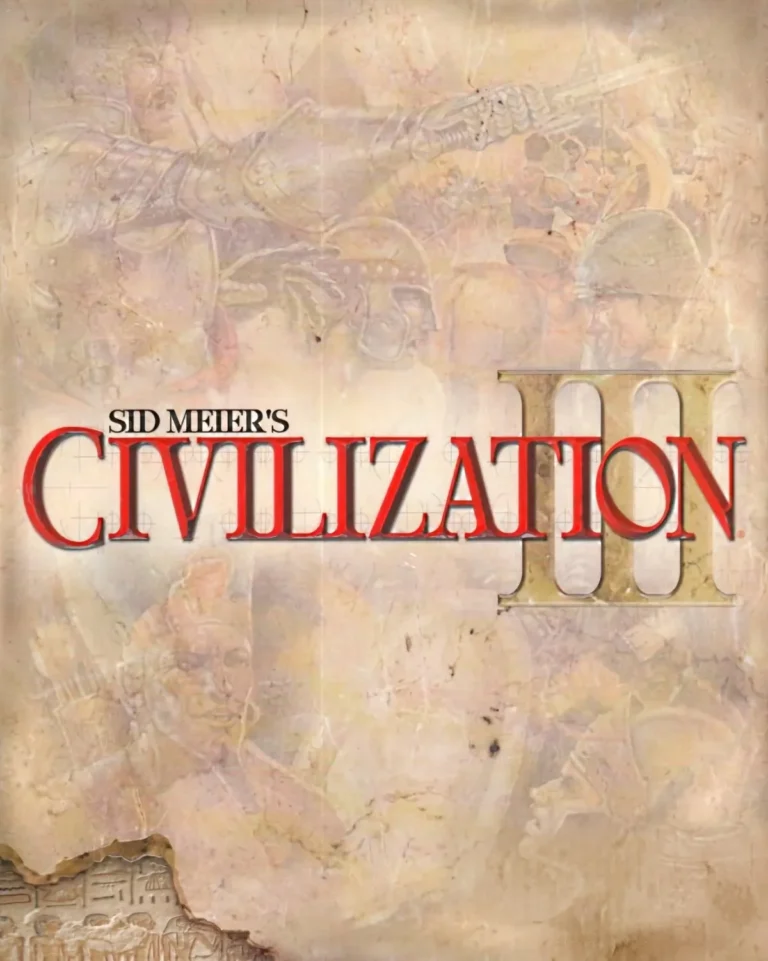
Sid Meier’s Civilization III
 90
★ /10
90
★ /10
 PC
PC
 Firaxis Games, Westlake Interactive
 1C Company,
  2K Games, Infogrames, MacSoft


Sid Meier’s Civilization III (commonly abbreviated as Civ 3 or Civ III) is a turn-based strategy 4X video game developed by Firaxis Games and published by Infogrames (later rebranded as Atari). Released in October 2001 for Microsoft Windows, with a Mac OS port developed by Westlake Interactive following in early 2002, it is the third mainline generation in the celebrated franchise.
Unlike its predecessors, Civilization III was not directly designed by series founder Sid Meier; instead, the structural design was helmed by Lead Designer Jeff Briggs alongside Lead Programmer and AI Designer Soren Johnson.
The game marks a major mechanical departure for the series, introducing the concept of dynamic national culture borders, establishing a resource-dependency system for military manufacturing, and laying down the framework for asymmetric civilization traits.
Supported by two retail expansion packs—Play the World and Conquests—the title solidified many design tropes that remain foundational to modern 4X strategy entries.
Technical Specifications
| Attribute | Details |
| Developer | Firaxis Games (Mac OS ports: Westlake Interactive / Aspyr) |
| Publisher | Infogrames / Atari (Mac OS ports: MacSoft / Aspyr) |
| Lead Designer | Jeff Briggs |
| AI / Lead Programmer | Soren Johnson |
| Engine | Proprietary Custom 2D Isometric Engine |
| Platform(s) | Microsoft Windows, Mac OS Classic, Mac OS X |
| Release Date | October 30, 2001 |
| Genre(s) | Turn-based strategy, 4X |
| Mode(s) | Single-player, Multiplayer (with expansions) |
The Cultural Border & Resource Revolution
Civilization III heavily altered the traditional spatial logistics of the franchise by rewriting how players interact with world territory and map tiles.
Dynamic National Borders
In previous entries, city borders were strictly binary; an empire only controlled the immediate tiles directly worked by a city center’s grid. Civilization III permanently changed this by introducing Culture and National Borders.
Cities construct cultural improvements—such as Temples, Libraries, and Cathedrals—to passively accumulate Culture points turn-by-turn. As a city’s total Culture hits specified thresholds, its physical territory dynamically expands outward across the map tiles.
This system transformed the map into a unified, continuous national layout, allowing empires to forcefully block foreign military movement without declaring war, claim neutral territory, or even culturally subvert and absorb adjacent, unhappy foreign border cities into their own kingdom via pure ideological pressure.
Strategic & Luxury Resource Interdependency
To limit rapid, unchecked military proliferation, the expansion introduced a comprehensive Resource Infrastructure split across three distinct categories:
- Strategic Resources (e.g., Iron, Horses, Saltpeter, Oil, Uranium): These resources are mandatory prerequisites to manufacture advanced military units. A civilization cannot build a Swordsman without access to Iron, or a Tank division without refining Oil. Crucially, resources are hidden along the technology tree, appearing dynamically on the map only after researching key milestones (such as The Wheel revealing Horses, or Refining exposing Oil).
- Luxury Resources (e.g., Wine, Silks, Gems, Spices): These assets generate passive commerce and serve as the primary mechanism for maintaining civil domestic happiness across your urban city grids.
- Bonus Resources (e.g., Cattle, Wheat, Gold): Flat terrain modifiers that multiply localized food or gold yields when worked by a citizen.
To exploit Strategic or Luxury resources, the node must physically sit inside your national borders and be connected back to your domestic trade network via a manual Worker road grid. If an invading army or covert pillager severs a single road tile along the trade route, your entire empire instantly loses access to that commodity, halting modern military production across all city factories.
Civilization Traits & Unique Units
To ensure highly asymmetric strategy paths, the game abandoned uniform nation templates. Every playable historical faction is uniquely defined by a combination of two permanent Civilization Traits chosen from six foundational pillars:
- Militaristic: Grants cheaper barracks construction costs, fast-tracks combat promotions, and multiplies the spawning rate of Great Military Leaders during combat.
- Industrious: Accelerates worker tile improvement and road building velocities, while granting extra shields to high-tier city center tiles.
- Religious: Eliminates the punishing multiple turns of crushing city anarchy whenever shifting governments, while heavily discounting the production cost of temples and cathedrals.
- Commercial: Minimizes localized financial corruption and waste metrics, compounding baseline gold commerce across massive, high-population metropolises.
- Scientific: Grants a free, random advanced technology breakthrough immediately upon advancing into a new historical era, while discounting libraries and universities.
- Expansionist: Starts the match with a free Scout unit and ensures ancient tribal villages (goody huts) always yield highly positive outcomes (like free gold, settlers, or tech) without ever spawning hostile barbarians.
Concurrently, Civilization III natives introduced the concept of the Unique Unit (UU). Every faction commands an exclusive, historically accurate military replacement division that overrides a generic unit pool (e.g., Rome’s heavy Legionary replacing the standard Swordsman, or Persia’s devastating Immortal division).
Winning a combat encounter using your faction’s Unique Unit automatically triggers an un-timed, map-wide Golden Age, multiplying your empire’s global production and gold yields for twenty consecutive turns.
Macro-Economics: Corruption and Waste
The dominant late-game mechanic and primary balance bottleneck in Civilization III is the strict application of Corruption and Waste.
Designed to simulate the limits of central authority and bureaucratic mismanagement over wide empires, corruption siphons away raw commerce gold, while waste systematically destroys localized shield manufacturing parameters. The levels are calculated dynamically using two rigid equations: Distance Corruption (how far a city center physically sits from the national capital) and Rank Corruption (the total number of cities operating inside your empire relative to map sizes).
Cities built on the outer rim of a wide empire can suffer up to a crippling 95% corruption rate, reducing their actual economic output to a single functional gold coin and shield regardless of infrastructure.
To combat this bottleneck, players must build Courthouses and Police Stations, or transition away from authoritarian Despotism into advanced representative governments like Republic or Democracy.
Furthermore, civilizations can hand-build or rush powerful Small Wonders like the Forbidden Palace or Secret Police HQ. These structures act as permanent secondary virtual capitals, establishing a clean, low-corruption radius over far-flung colonial continents to foster an industrial comeback.
Comprehensive Expansion Packs
Firaxis heavily expanded the baseline client through two major retail expansion packs:
Civilization III: Play the World (2002)
The first expansion focused on modern network connectivity, introducing native internet multiplayer systems, turn-based play modes, and an updated world editor map suite. It added exactly eight new civilizations—including the Mongols, Spanish, Celts, and Arabs—alongside new game modes like Regicide, where losing your physical Monarch unit triggers an automatic defeat exception.
Civilization III: Conquests (2003)
Widely recognized as the definitive edition of the title, this massive package added seven original civilizations (such as the Incas, Mayans, and Byzantines) and introduced two highly powerful new traits: Agricultural (spiking food growth curves) and Seafaring (boosting naval navigation speeds and coastal trade commerce).
The expansion’s centerpiece was its nine highly detailed, standalone historical scenarios, featuring custom balance maps and specialized rulesets for the Fall of Rome, The Middle Ages, Age of Discovery, and the high-intensity Pacific Theater WWII campaign.
Modern Preservation & Technical Adjustments (2026)
As of May 2026, Civilization III is fully preserved and widely active within retro strategy communities under the consolidated digital title Sid Meier’s Civilization III Complete, distributed via major storefronts including Steam and GOG.com for a standard price of $4.99. This digital package natively integrates the base game along with both Play the World and Conquests expansions into a singular optimized directory.
The game runs efficiently on modern 64-bit multi-core Windows 10 and Windows 11 operating systems out-of-the-box. However, because the title’s 2001 code is hardcoded to turn-of-the-century DirectX 8 rendering protocols and a static 16-bit color space, executing the application on contemporary high-end monitors can occasionally trigger immediate desktop crashes, display minimizes, or window positioning errors.
To safely bypass these hardware hitches, modern retro PC gamers rely on simple, community-tested initialization edits:
- The Resolution Override: Players navigate to the game’s local installation folder, locate the main configuration file (
conquests.ini), and manually append the lineKeepRes=1directly to the text script. This forces the engine to safely scale its isometric terrain rendering to perfectly match your monitor’s native desktop display resolution rather than forcing archaic $1024 \times 768$ aspect ratios. - Open-Source Wrappers: Utilizing lightweight translation tools (such as cnc-ddraw) maps the legacy graphic instructions cleanly into modern DirectX 11 containers, completely resolving window border flicker and securing a highly stable, flawless framerate for 4X historians.