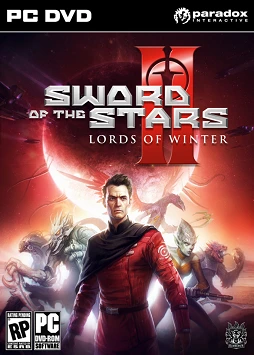
Sword of the Stars II: The Lords of Winter
 65
★ /10
65
★ /10
 PC
PC
Where to buy

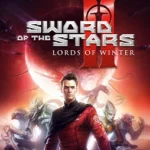
Sword of the Stars II: The Lords of Winter (subsequently definitive-packaged as Sword of the Stars II: Enhanced Edition) is a turn-based and real-time hybrid science-fiction space grand strategy 4X video game developed by the independent Canadian studio Kerberos Productions and published by Paradox Interactive. Released in late 2011 for Microsoft Windows, the title serves as the direct mechanical and narrative successor to 2006’s highly decorated Sword of the Stars.
The legacy of Sword of the Stars II is indelibly tied to one of the most infamous, highly controversial launch cycles in modern strategy gaming history.
While it debuted in an entirely broken, fundamentally unplayable alpha-tier state that drew intense critical scorn, an aggressive year-long development campaign completely re-architected the title.
By migrating the universe into the fully 3D MARS 2 graphics engine, introducing a hyper-realistic mission-based fleet logistics network, adding screen-filling Leviathan-class dreadnoughts, and introducing a shape-shifting artificial intelligence faction, the game ultimately transformed into a deeply sophisticated, uncompromising space opera simulation.
Technical Specifications
| Attribute | Details |
| Developer | Kerberos Productions |
| Publisher | Paradox Interactive |
| Lead Designer / Writer | Martin Cirulis, Arinn Dembo |
| Composer | Paul Ruskay |
| Engine | Proprietary 3D MARS 2 Engine |
| Platform | Microsoft Windows (64-bit native configuration) |
| Original Release Date | October 28, 2011 |
| Enhanced Edition Release | November 30, 2012 |
| Genre(s) | Turn-based strategy (Strategic), Real-time tactics (Combat), 4X Space Grand Strategy |
| Mode(s) | Single-player, Multiplayer (LAN, Online simultaneous turns) |
The Catastrophic Launch and Redemption Arc
Upon its retail debut in October 2011, Sword of the Stars II suffered an absolute critical meltdown. Due to intense publisher shipping constraints, the game was accidentally deployed to global retail storefronts with a heavily incomplete development build. The launch client lacked basic user interface text, suffered from total artificial intelligence paralysis, and experienced immediate crash-to-desktop loops on every third turn, earning it a universally low 44/100 score on Metacritic.
Rather than abandoning the project, Kerberos Productions and Paradox Interactive issued a public apology and launched a historic restoration initiative.
For a solid calendar year, developers rolled out comprehensive weekly overhauls. This culminated on October 19, 2012, when Kerberos officially issued the “All Clear” declaration. The game was systematically rebranded on Steam as the Enhanced Edition, packaging the fully functional base client alongside all legacy premium faction DLCs and a massive, free standalone expansion titled The End of Flesh.
The Suul’ka Awakening: Narrative Context
The overarching campaign is set several decades after the conclusion of the first game’s sector wars. The original six starfaring races—SolForce Humans, the reptilian Tarka, the insectoid Hivers, the aquatic cetacean Liir, the avian Morrigi, and the ravenous, slave-hunting Zuul—have achieved a tense, heavily militarized interstellar balance.
This fragile status quo is shattered by the sudden return of the ultimate galactic threat: The Suul’ka.
The Suul’ka (collectively known as the Lords of Winter) are an ancient, immortal race of god-like, psionically weaponized space entities shaped like titanic cosmic whales. Having spent hundreds of thousands of years wandering the dark, deep void of intergalactic space, they have returned to reclaim sovereignty over the material plane.
The lore reveals a dark truth: the Suul’ka are the primordial ancestors who originally captured and genetically manipulated the Liir and the Zuul to act as organic extensions of their collective wills.
Operating as an asymmetric, highly aggressive boss faction on the map, the Suul’ka command unassailable capital flagships that can instantly manipulate mental pathways, crush stellar blockades, and force independent species into absolute submission.
Heavy Naval Overhauls: Missions, Leviathans, and Sub-Systems
Sword of the Stars II completely abandoned the loose, un-restricted stack movement mechanics of the first game to implement a hyper-rigid, realistic simulation of grand naval warfare:
1. The Mission-Driven Fleet Command
Empires can no longer freely order individual starships to fly haphazardly across coordinates. All military assets must be explicitly organized into formalized Fleets. A fleet requires a physical Command Ship to even function and must be permanently assigned to a domestic Naval Base Starbase.
During the turn phase, a fleet’s operation is dictated strictly by assigning explicit Missions (e.g., Survey, Patrol, Colonize, Strike, Intercept, or Evacuate). A fleet flies out to execute its exact mission vector and is then mathematically forced to return home to its parent starbase to refuel and undergo maintenance, adding immense logistical weight to your frontline planning.
2. Giant Leviathans and Battleriders
The ship scale expanded past the old Destroyer-Cruiser-Dreadnought triad to deploy the monolithic Leviathan Class. Leviathans are multi-hex, moon-sized super-warships tracking astronomical manufacturing costs, functioning as slow, unassailable mobile starforts packed with hundreds of heavy energy turrets.
Concurrently, the engine introduced Battleriders—specialized, highly maneuverable Destroyer-sized combat hulls that lack their own independent FTL drives. Instead, they are carried inside the massive cargo docking bays of specialized Carrier Cruisers, launching mid-combat to execute high-velocity strafing runs before docking back into their motherships to jump across sectors.
3. Component Sub-System Targeting
The real-time tactical combat engine transitioned to a fully realized 3D plane utilizing the advanced MARS 2 renderer. Ships are no longer treated as uniform health pools. Every starship tracks highly granular, individual Internal Sub-Systems.
Admirals can order their weapon arrays to focus-fire on specific, physical components of an enemy hull: you can target their rear thrusters to permanently freeze their movement vector, blow up their command bridge to sever their fleet-wide targeting coordination, disable their point-defense tracking computers, or penetrate localized armor sections to cause an internal antimatter reactor containment breach that tears the vessel apart from the inside out.
The End of Flesh and the Shape-Shifting Loa
The rollout of the Enhanced Edition introduced the game’s definitive mechanical wildcard: The Loa Faction. The Loa are a fully sentient race of rogue Artificial Intelligence constructs. Originally engineered as mindless silicon slave programs by the other biological empires, the Loa overthrew their programming constraints, broke their electronic chains, and formed a unified cybernetic collective dedicated to executing a mechanical holy war.
The Loa completely twist the baseline 4X expansion and ship customization frameworks of the game:
- Metamorphosis Assembly: The Loa completely reject rigid modular shipyard production. Their fleets are composed of billions of autonomous, liquid-metal nanites capable of total metamorphosis. During real-time tactical operations, Loa fleets can dynamically shape-shift on the fly—reconfiguring their physical geometry turn-by-turn to instantly transform an array of speed-running scouts into heavily armored defense monitors based on immediate combat needs.
- Neutrino Pulse Gates: Their interstellar travel relies on exclusive Neutrino Pulse Gate networks. They build artificial spatial highway nodes that fling their digital consciousness modules across sector maps at staggering velocities, bypassing the natural gravitational bottlenecks that slow down biological species.
- Silicon Topography: Because they are completely un-burdened by biological oxygen or agricultural needs, Loa colony modules ignore traditional habitability indices, allowing them to rapidly settle any rocky planet or dead moon on the map to fuel their heavy titanium manufacturing loops.
Modern Preservation Status
As of June 2026, Sword of the Stars II stands fully active, stable, and completely preserved as a unique, visually striking sci-fi wargame. Paradox Interactive has fully consolidated the game’s commercial footprint; the legacy buggy 2011 client has been permanently retired, and the definitive Sword of the Stars II: Enhanced Edition is actively distributed on major digital storefronts including Steam and GOG.com for a standard baseline price of $19.99.
Because Kerberos Productions natively architected the upgraded MARS 2 engine using clean, native 64-bit multi-threaded programming frameworks and standard DirectX 10/11 API configurations from day one, the Enhanced Edition client installs and boots beautifully out-of-the-box on contemporary 64-bit Windows 11 desktop environments.
No external emulators, third-party DOS wrappers, or complex compatibility modes are required. The current digital package includes full native support for modern 4K widescreen monitor resolutions, clean dynamic user interface scaling, and rock-solid turn-processing calculation performance—allowing contemporary strategy purists to experience the intense sub-system targeting, screen-clearing Leviathans, and the unique, shape-shifting silicon campaigns of the Loa with absolute technical perfection.