Sword of the Stars
 68
★ /10
68
★ /10
 PC
PC


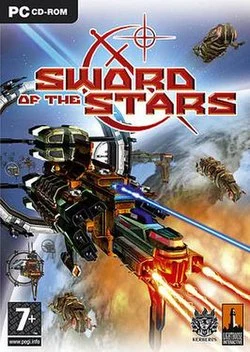
Sword of the Stars is a critically acclaimed science-fiction space grand strategy 4X video game developed by the independent Canadian studio Kerberos Productions and published by Lighthouse Interactive (with Paradox Interactive handling later distribution and expansions). Released in August 2006 for Microsoft Windows, the title represents a fascinating mechanical milestone, seamlessly blending a turn-based strategic empire-building overlay with fully 3D, real-time tactical space combat.
Created by core members of the development team behind Homeworld: Cataclysm, Sword of the Stars carved out a fierce cult legacy by completely rejecting the uniform, symmetry-focused design tropes of contemporary space strategy. By engineering a universe where every playable alien race utilizes a completely distinct, physics-defying method of Faster-Than-Light (FTL) propulsion, deploying a modular three-section ship architect, and implementing a dynamic, randomized technology tree, the title delivered an incredibly fluid and unpredictable interstellar wargame.
Technical Specifications
| Attribute | Details |
| Developer | Kerberos Productions |
| Publisher | Lighthouse Interactive / Paradox Interactive |
| Lead Designer | Martin Cirulis |
| Composer | Paul Ruskay |
| Engine | Proprietary 3D MARS Engine |
| Platform | Microsoft Windows |
| Release Date | August 22, 2006 |
| Genre(s) | Turn-based strategy (Strategic), Real-time tactics (Combat), 4X Space Grand Strategy |
| Mode(s) | Single-player, Multiplayer (LAN, Online up to 8 players) |
The Ultimate Asymmetry: Explicit FTL Propulsion Modes
The defining mechanical achievement of Sword of the Stars is its handling of interstellar travel. While other 4X games give factions uniform movement rules with minor speed variations, choosing a race in this game completely rewrites how you interact with the geography of the galaxy map:
Humans – The Node Drive
Humanity navigates the cosmos utilizing subspace strings known as “Node Lines.” They are incredibly fast when traveling down these pre-existing spatial pathways, allowing them to blitz across the galaxy ahead of their peers. However, they are completely locked to the grid; if two star systems are not naturally linked by a node line, human fleets cannot travel between them, creating hard geographic bottlenecks.
The Hivers – Teleportation Gates
The insectoid Hivers possess no traditional FTL drives. Their fleets must move through deep space utilizing sub-light propulsion, making their initial journeys to un-colonized worlds agonizingly slow. However, once a Hiver fleet physically arrives at a star system, they can deploy a Gate Station. Once active, any Hiver fleet anywhere in the galaxy can instantly teleport to that gate in a single turn, giving them unmatched defensive reinforcement capabilities.
The Tarka – Conventional Warp
A proud, reptilian warrior race that utilizes classic, free-form warp fields. The Tarka are completely unbound by node lines or gates, capable of flying their fleets in a perfectly straight vector to any coordinate on the map. While reliable and simple to plan around, their FTL speeds are static and mathematically average, meaning they are frequently outpaced by specialized races in early-game land grabs.
The Liir – Stutter Warp
An aquatic, cetacean-like species whose ships are essentially massive mobile aquariums. Because moving heavy water tanks through space introduces extreme mass issues, their ships do not fly; instead, they teleport microscopically hundreds of times per second. This “stutter warp” operates on an inverse gravity rule: their fleets travel at mind-boggling speeds through the deep void, but slow down to a crawl when approaching the heavy gravity wells of stars and planets.
The Three-Section Modular Ship Workshop
Interstellar military production completely avoids fixed hull presets to implement a highly tactile Three-Section Assembly Grid. When designing a military vessel across the game’s core hull scales (Destroyers, Cruisers, and massive Dreadnoughts), players manually mix, match, and bolt together three independent structural modules:
- The Command Section (The Bow): Dictates the ship’s tactical sensor ranges, command control caps, maneuverability vectors, and point-defense tracking speeds.
- The Mission Section (The Midship): The core utility slot that defines the ship’s strategic purpose. Players can drop in specialized combat segments like Armor Forges, Long-Range Missile Batteries, Bio-Warfare Labs, Carrier Starfighter Hangars, or Colony Pods.
- The Engine Section (The Stern): Houses the ship’s primary fuel reserves and dictates its FTL drive properties, tactical speed bursts, and turning agility.
Once the three components are locked together, players populate the hull’s hardpoints with specialized weapon systems. Weapons operate on explicit physics-based damage channels: heavy ballistic mass drivers knock target ships off their flight vectors, energy-based lasers melt thermal armor plates over time, and high-yield torpedoes blast structural components apart.
The Living, Randomized Technology Tree
To inject absolute replayability into every match, the developers permanently dismantled the concept of a predictable, static research path. In Sword of the Stars, the technology tree is alive, dynamic, and partially randomized behind the scenes upon map initialization.
While foundational technologies are guaranteed to spawn for every player, the evolutionary nodes linking higher-tier breakthroughs operate on a hidden percentage chance unique to each faction archetype. For example, when playing as the Tarka, your scientists might have a 95% probability of successfully unlocking Reflective Armor Plating, but only a 30% chance to reveal the path toward Antimatter Torpedoes.
This mechanic forces players to continuously adapt their tactical designs to the scientific realities of their current match. If a player realizes mid-game that their tech tree has completely locked them out of high-tier shielding systems, they must aggressively pivot their strategy—perhaps leaning heavily into cloaking fields or overwhelming electronic warfare to destroy the enemy before defensive limitations become fatal.
The Homeworld Lineage: 3D Real-Time Tactical Arenas
When two adversarial fleets cross paths on the turn-based galaxy grid, the game instantly freezes the strategic layer to drop players down into a fully 3D, real-time tactical combat arena. Drawing heavily from the developers’ lineage on Homeworld: Cataclysm, space battles are cinematic, physics-driven encounters.
Battles operate on a strict, adjustable three-minute tactical clock to prevent endless, grinding stalemates. Ships track independent, directional armor integrity values across four distinct facings (Front, Left, Right, Rear).
Tactical mastery requires continuous maneuvering; players must actively rotate their capital ships to present pristine armor facings to incoming fire while directing targeted weapon salvos to blow off an opponent’s engines or disable their command bow to break their fleet coordination.
Expansions and The Complete Collection Evolution
The strategic footprint of the base game was vastly expanded through three critically acclaimed, feature-rich expansions that added entire races, weapon tiers, and deep-space threats:
- Born of Blood (2007): Injected the horrifying, parasitic splinter faction known as the Zuul. The Zuul utilize a violent, artificial FTL drive that forcefully rips physical boreholes through node lines, creating unstable paths that decay over time. They also introduced the global Scavenger Economy.
- A Murder of Crows (2008): Deployed the ancient, avian Morrigi faction. The Morrigi utilize a “Void Swimming” propulsion system where their travel speed multiplies exponentially for every capital ship added to the fleet stack, encouraging the use of massive, traveling armadas. It also added independent space stations.
- Argonauts (2009): The final content wave that introduced tactical drone carriers and deep-space AMES survey ships.
The entire compiled saga is universally preserved under the definitive omnibus edition: Sword of the Stars: Complete Collection.
Modern Digital Preservation Status
As of June 2026, Sword of the Stars: Complete Collection stands beautifully preserved, fully active, and easily accessible to contemporary PC strategy purists. Maintained under stable digital distribution by Paradox Interactive, the entire finalized client is available on premier storefronts, including Steam and GOG.com, for a standard retail baseline price of $9.99.
Because Kerberos Productions natively engineered the game’s core architecture and MARS engine around highly stable 32-bit Windows API parameters and scalable multi-threaded coding frameworks, the Complete Collection installs and executes natively out-of-the-box under modern 64-bit Windows 11 environments without requiring external emulators or heavy configuration mods.
The current digital builds feature built-in widescreen monitor resolution support, stable multi-core CPU pathfinding calculations, and crisp UI menu scaling, allowing contemporary strategy enthusiasts to experience the cutthroat FTL asymmetry, modular ship design, and sweeping real-time tactical battles with absolute, rock-solid technical stability.