Distant Worlds
 78
★ /10
78
★ /10
 PC
PC


Distant Worlds is a real-time space grand strategy 4X video game developed by the independent New Zealand studio Code Force and published by Matrix Games (later under Slitherine Ltd.). Originally released on March 25, 2010, for Microsoft Windows, the title represents a monumental design paradigm shift in the space strategy ecosystem.
While contemporary space strategy franchises focused on abstracted, tightly structured maps or turn-based planet management, Distant Worlds constructed a fully simulation-driven, living “sandbox” galaxy operating at a staggering, mind-boggling mechanical scale.
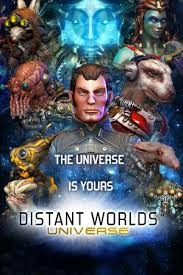
By introducing up to 1,400 unique star systems and 50,000 interacting cosmic entities in a single match, establishing a dual public-private economic system, and implementing an infinitely scalable automation matrix that allowed players to delegate any portion of the empire to artificial intelligence advisors, the game became a beloved cult classic, culminating in the definitive omnibus edition Distant Worlds: Universe in 2014.
Technical Specifications
| Attribute | Details |
| Developer | Code Force |
| Publisher | Matrix Games / Slitherine Ltd. |
| Lead Designer | Elliot Gerschwiler |
| Engine | Proprietary 2D Vector Multi-layered Sprites Engine |
| Platform | Microsoft Windows |
| Original Release Date | March 25, 2010 |
| Universe (Definitive) Edition | May 23, 2014 |
| Genre(s) | Real-time with pause (RTS/RTT), 4X Space Grand Strategy |
| Mode | Single-player |
Macro-Scale Scale and the Dual Economy
The defining structural triumph of Distant Worlds is its handling of a functioning, living galaxy. Space is not a sterile void containing isolated base cards. Instead, thousands of cargo freighters, mining vessels, passenger liners, and space stations actively travel across sectors in real time to haul materials and harvest nodes.
To manage this complex environment without triggering immediate cognitive overload, the engine separates the galaxy into an brilliant Dual-Tier Economy:
1. The State Economy (Player-Controlled)
The player steps into the traditional role of government. You directly fund and coordinate the state military navy, order the construction of orbital defense stations, manage macro-diplomacy with foreign races, hire spies for clandestine sabotage missions, and choose the fundamental direction of scientific research tracks. The State’s treasury is funded entirely by taxing colonies and collecting custom port duties from ship transactions.
2. The Private Economy (Civilian-Automated)
The civilian populace operates completely independently of the player’s direct control. Private mining corporations and commercial trading cartels possess their own independent funds. They automatically look at your scanned resource maps, place orders at your state spaceports to build private cargo freighters, fly out to tap deep-space gas clouds, ferry migrant populations between planets, and establish cross-border luxury tourism lines entirely on their own.
The Automation Matrix: Play Your Way
The absolute signature mechanical innovation of Distant Worlds is its Infinite Modular Automation Engine. Recognizing that managing 50,000 independent entities turns a game into an exhausting chore, Code Force granted players granular agency to toggle the artificial intelligence automation dials on any system at any time.
This creates a highly customizable playstyle spectrum. A player can choose to run the game as a absolute micromanager, manually designing every single mining station component and pathing cargo routes.
Alternatively, a player can turn on full automation for tax scales, technological research, city zoning, and colonization—choosing to play purely as a single frontline Admiral commanding a task force fleet, or even as a lone privateer pirate captain hunting freighters while the AI advisor matrix seamlessly pilots the rest of the empire in the background.
Logistical Friction: Fuel Dependencies and Resources
Interstellar warfare and exploration abandon generic credits to enforce a hyper-realistic, physics-based material matrix. The game models dozens of distinct resource types—divided into structural resources (used to physically forge ship hulls and station armor plates) and luxury resources (transported to colonies to multiply tax approval ratings).
The absolute critical bottleneck of the galaxy is Fuel. Ships do not possess infinite range; their warp hyperdrives require a continuous consumption of specialized gases—specifically Caslon for conventional reactors or Hydrogen for high-tier fusion drives.
If your mining fleets or private civilian cargo freighters fail to successfully harvest and route fuel to your orbital refueling stations, your massive starfleets will run completely dry mid-transit. A fleet stranded without gas drops its speed and weapon tracking to a crawl, rendering your million-credit dreadnoughts completely defenseless against roaming space pirates or territorial space monsters.
The Evacuation of History: The Shakturi Narrative
While the game functions brilliantly as a wide-open sandbox, it contains a deep, overarching historical campaign storyline that can be manually enabled. The narrative reveals that the galaxy is slowly recovering from an ancient, systemic cataclysm that occurred thousands of years ago.
As empires scan deep-space anomalies and locate ancient precursor data archives, they lift the veil on the ultimate threat: The Shakturi.
The Shakturi are an ancient, highly advanced, bio-mechanical alien race obsessed with genetic purification and absolute galactic dominance. They return to the map via an asymmetric end-game crisis script, utilizing massive planet-killing space dreadnoughts and bio-engineered viral plagues to systematically sweep across populated clusters.
To prevent total extinction, mortal empires—ranging from the peaceful, reptilian Securans to the hyper-scientific Quameno—must form fragile, massive global defense coalitions to push back the ancient invasion force.
Modern Digital Preservation Status
As of June 2026, the original Distant Worlds saga stands fully preserved, consolidated, and highly respected as a definitive benchmark in 4X space gaming history. Code Force and Slitherine have permanently retired the fragmented expansion installers (Return of the Shakturi, Legends, and Shadows), bundling the complete, finalized content matrix into a single, definitive client: Distant Worlds: Universe. Distributed across premier digital storefronts including Steam and GOG.com for a standard retail price of $29.99, the game features deep holiday sales cuts.
Because the game engine was architected around legacy 32-bit Windows API frameworks, GDI+ graphics parameters, and deep dependencies on legacy .NET Framework 3.5 and Windows Media Player codecs for video file calls, executing the stock retail version on modern 64-bit Windows 11 architectures out-of-the-box can sometimes trigger initialization crashes, window-scaling clipping errors, or immediate startup freezes.
To ensure rock-solid technical stability on contemporary hardware configurations, strategy purists apply key community-tested adjustments:
- Windows Features Initialization: Prior to installing the game, players must navigate to their Windows 11 Control Panel to manually check the box to turn on legacy .NET Framework 3.5 features, allowing the game’s old text-rendering libraries to execute without throwing errors.
- DirectX Wrapper (dgVoodoo2 / DXVK): To bypass severe mouse-cursor lag and menu stuttering caused by modern GPU drivers dropping native legacy GDI drawing loops, players frequently drop open-source translation wrappers directly into the root installation folder, smoothly forcing the 2D matrix to scale flawlessly onto high-resolution monitors.
- The “Distant Worlds 2” Horizon: For players seeking a modern native architecture, the series’ direct 3D sequel, Distant Worlds 2, is actively maintained and expanding with fresh content packs across the 2026 grand strategy market.