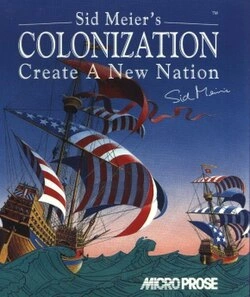
Sid Meier’s Colonization
 Amiga
Amiga PC
PC

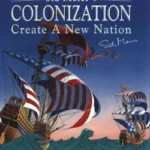
Sid Meier’s Colonization is a critically acclaimed turn-based strategy 4X video game designed by Brian Reynolds and Sid Meier, and developed and published by MicroProse. Released in 1994 for MS-DOS, it was subsequently ported to the Amiga, Macintosh, and Windows 3.1.
While it shares the graphical vocabulary and turn-based engine of the original 1991 Civilization, Colonization represents a fundamentally different macro-economic and political simulation.
Instead of guiding a civilization from prehistoric antiquity into the far future across a global landscape, players manage the targeted, cross-Atlantic territorial expansion of a European power in the New World from 1492 through the early 19th century.
The ultimate goal is to cultivate a self-sufficient colonial economy, appease or subjugate indigenous native populations, recruit historical Founding Fathers, declare independence from the Mother Country, and successfully defeat the King’s Royal Expeditionary Force in a localized revolutionary war.
Technical Specifications
| Attribute | Details |
|---|---|
| Developer | MicroProse (Chapel Hill Studio) |
| Publisher | MicroProse |
| Designers | Brian Reynolds, Sid Meier |
| Engine | Proprietary 2D Top-Down Orthogonal Grid Engine (Upgraded with 256-color VGA palette) |
| Platform(s) | MS-DOS, Amiga, Classic Mac OS, Microsoft Windows 3.1 |
| Release Date | September 1991 (North America) |
| Genre(s) | Turn-based strategy, 4X |
| Mode | Single-player |
The Four European Powers
At the start of a match, players select one of four playable European maritime nations. Each faction possesses an exclusive, asymmetric trait that heavily dictates early-game colonization strategies:
- England (The Immigration Advantage): Receives a permanent bonus to religious “Cross” generation metrics. This accelerates the rate at which new colonists flee religious persecution and pool at the home docks in Europe, providing a rapid, high-density stream of free labor.
- France (The Diplomatic Edge): Engineered for peaceful co-existence. French colonies generate significantly lower “Alarm” tension parameters among neighboring Native American tribes, allowing French players to smoothly establish missions, learn native skills, and trade resources with minimal risk of sudden indigenous raids.
- The Netherlands (The Commercial Monopoly): Built strictly for mercantile domination. The Dutch start the match with a high-capacity Merchantman trading ship instead of a fragile Caravel. They enjoy highly stable commodity market prices back in European ports and can open direct, tax-free trade routes with rival European colonies.
- Spain (The Conquistador Bonus): Designed for aggressive military pacification and territorial conquest. Spanish military units receive a permanent, massive +50% combat strength multiplier when attacking or defending against Native American settlements, harvesting immediate mounds of looted gold from conquered indigenous capitals.
The Raw-to-Processed Commodity Matrix
Unlike Civilization, where tile management is abstracted into generic science or production points, Colonization features a deeply detailed industrial processing supply chain.
To fund your treasury, you must harvest natural overworld resources using specialized laborers, route them into municipal colony warehouses, and task highly skilled craftsmen with converting raw elements into luxury manufactured goods for export.
The primary processing lines dictate the colonial economy:
- The Luxury Chains: * Sugar is refined by Master Distillers into high-value Rum.
- Tobacco is hand-rolled by Master Tobacconists into premium Cigars.
- Cotton is woven by Master Weavers into industrial Cloth.
- Furs are trapped and tailored by Master Furriers into winter Coats.
- The Industrial Chain: Ore is extracted from mountain tiles by Expert Miners and delivered to Blacksmiths to forge Tools. Tools are the absolute bottleneck of structural development; they are spent to build advanced city infrastructure, clear dense forests, and fund weapon smiths who melt tools down into Muskets to equip your citizen militias.
- The Monetary Asset: Silver can be direct-mined from specialized deposits. It has no processed variant and is shipped raw directly back to European docks for immediate, liquid cash infusions.
Specialized Labor, Class, and Education
Your workforce is entirely composed of individualized citizen units. Free Colonists can be assigned to any job but perform at baseline speeds. Indentured Servants and Petty Criminals operate under severe manufacturing penalties.
To optimize outputs, players must utilize Expert Specialists (who output double the production yields of a standard colonist). Specialists can be bought at high prices in Europe, earned by sending citizens to live inside friendly Native American villages to learn local crop skills, or bred organically by constructing Schoolhouses, Colleges, and Universities to manually educate criminals and servants into elite industrial craftsmen.
The Continental Congress & Founding Fathers
As your colonies produce Liberty Bells—a metric representing the political desire for self-governance—you accumulate political weight to elect historical figures into your Continental Congress.
These figures, known as Founding Fathers, grant powerful, game-altering global modifiers that permanently rewrite the rules of the match. They are split across five categories:
- Trade (e.g., Jan de Witt, Peter Stuyvesant): Streamlines economic operations. Jan de Witt automatically permits trading commodities directly with rival European colonies, while Stuyvesant fully legalizes foreign cargo operations even during a strict royal trade boycott.
- Exploration (e.g., Hernando de Soto, Francisco de Coronado): Optimizes map visibility and exploration. De Soto ensures all ancient burial mounds and ruins always yield highly positive financial outcomes, while Coronado lifts the fog of war surrounding all geographic coastal lines.
- Military (e.g., Paul Revere, George Washington): Overhauls defensive readiness. Paul Revere automatically arms unarmed citizens with stockpiled muskets if an enemy launched a surprise siege against a city, while Washington fast-tracks combat experience promotions.
- Religion (e.g., Jean de Brébeuf, William Brewster): Focuses on indigenous conversion and immigrant workflows. Brébeuf causes all native missions to operate with absolute success, transforming hostile braves into highly productive, converted agricultural workers.
- Politics (e.g., Thomas Jefferson, Benjamin Franklin): Accelerates the generation of Sons of Liberty sentiment across all colonies, dramatically speeding up your path to independence.
Rebel Sentiment & The War of Independence
The macro-strategy of the late game transitions from peaceful trade into a tense, high-stakes political standoff against your own home Monarch.
The Royal Tax Squeeze
Throughout the match, the King periodically raises the national Tax Rate to siphon cash away from your New World trade loops. If you refuse a tax increase, the Crown instantly levies a strict Trade Boycott on that specific commodity, completely locking you out of selling or buying that item in Europe until you pay a massive back-tax fee or dump the cargo entirely.
Declaring Independence
To win the match, you must break free from the Mother Country. When a colony’s internal Rebel Sentiment (fueled by continuous Liberty Bell generation) hits a minimum threshold of 50% of the population identifying as “Sons of Liberty,” you can open the palace terminal to officially sign the Declaration of Independence.
Signing the declaration immediately cuts off all transit and trade access to European ports and triggers the game’s ultimate endgame trial: The War of Independence.
The King immediately dispatches the massive Royal Expeditionary Force (REF)—a highly trained, overwhelming army composed of elite Regular Infantries, royal Cavalry, heavy Artillery, and massive Men-of-War battleships.
The REF launches coordinated amphibious invasions against your coastal strongholds. Because the King’s troops are individually far superior to your rag-tag colonial militias, you must leverage geographical choke points, use Dragoon cavalry to ambush units in rough terrain, and mobilize a homegrown arms industry to completely wipe out the royal invasion force to claim total victory.
Legacy & Modern Preservation Status (2026)
Within the grand strategy timeline, the 1994 original Colonization is preserved by strategy historians as an absolute masterpiece of elegant, tightly focused design. By narrowing the macro-scope of Civilization to zero in on a highly specific historical and industrial window, the title achieved a level of economic mechanical depth that remains incredibly compelling.
Current Preservation Footprint
As of May 2026, the 1994 classic is fully preserved and widely active on contemporary digital distribution storefronts including Steam and GOG.com for a standard price of $5.99. The digital installer natively packages the base game inside an optimized, pre-configured DOSBox emulation container, allowing the title to execute flawlessly with zero manual script editing required.
The client runs with absolute performance stability on modern 64-bit multi-core Windows 10, Windows 11, and current macOS setups. Strategy purists running the emulation can safely apply modern pixel-scaling filters and lock native 4:3 display aspect ratios, preserving the vibrant 256-color VGA art assets, hand-drawn advisor menus, and intense revolutionary battles of Colonization for contemporary setups.
The 2008 Standalone Remake
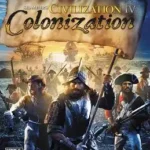
For fans seeking modern graphics engines, the game’s structural architecture remains actively active via its official remake: Sid Meier’s Civilization IV: Colonization. Released by Firaxis Games in September 2008, this standalone expansion completely rebuilt the 1994 game inside the full 3D Gamebryo engine of Civilization IV.
The remake modernizes visual aesthetics, integrates multiplayer networking features, implements a modular drafting constitution mechanic upon declaring independence, and continues to host an immense collection of total-conversion mods (such as Religion and Revolution and The Authentic Colonization) that keep the legacy of Brian Reynolds and Sid Meier’s foundational design thriving in 2026.