 80
80  PC
PC
 Firaxis Games
 1C-SoftClub,
  2K Games,
  Aspyr Media
Where to buy

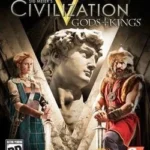
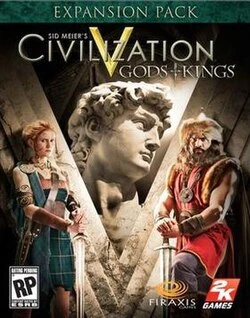
Sid Meier’s Civilization V: Gods & Kings is the first major expansion pack for the turn-based strategy 4X video game Civilization V. Developed by Firaxis Games and published by 2K Games, the expansion was released on June 19, 2012, for Microsoft Windows and macOS.
Designed by Lead Designer Ed Beach, Gods & Kings fundamentally shifted the mechanical landscape of the base game. While the 2010 vanilla release was critiqued for streamlining or omitting complex empire-management systems, this expansion re-engineered and restored two legacy pillars of the franchise—Religion and Espionage—while completely transforming tactical naval warfare, combat damage scaling, and city-state diplomacy.
Technical Specifications
| Attribute | Details |
|---|---|
| Developer | Firaxis Games |
| Publisher | 2K Games (Mac/Linux ports: Aspyr Media) |
| Lead Designer | Ed Beach |
| Platform(s) | Microsoft Windows, macOS, Linux |
| Release Date | June 19, 2012 |
| Genre(s) | Turn-based strategy, 4X |
| System Requirement | Requires the base Civilization V client to execute |
| Mode(s) | Single-player, Multiplayer |
The Religion & Faith Engine
The primary gameplay addition is the introduction of Faith, a dynamic domestic currency generated through specialized buildings (such as Shrines and Temples), world wonders, natural features, and alliance tracking with independent City-States.
Accumulating Faith allows empires to organically cultivate a customized world religion through a modular, step-by-step process:
- Founding a Pantheon: Early in the match, gathering a baseline pool of Faith unlocks the ability to select a Pantheon belief. These bonuses are tailored to physical geography, allowing players to farm extra resources from unique local tiles, such as gaining culture from plantations or extra faith from desert hexes.
- Spawning Great Prophets: As Faith continuously pools, the engine automatically spawns a Great Prophet. Prophets are consumed to officially convert a Pantheon into a full World Religion.
- Customizing Beliefs: Rather than assigning rigid, historical traits, players customize their religion by choosing from a pool of competitive, asymmetric bonuses. These include Founder Beliefs (yielding gold or science based on the global spread of your faith) and Follower Beliefs (permitting cities to purchase unique religious infrastructure, like Cathedrals or Pagodas, directly with Faith).
- Missionaries and Inquisitors: Later in the match, players buy specialized religious units. Missionaries cross national borders to actively spread your ideological influence to foreign populations, while Inquisitors are stationed inside domestic city centers to forcefully purge competing foreign religions.
The Espionage Matrix
Upon reaching the Renaissance Era, the global Espionage System is unlocked. Spies do not manifest as physical, movable military units on the hexagonal map grid. Instead, they are managed entirely through a specialized tactical interface and dispatched to project covert influence across the globe.
Offensive Espionage
Spies embedded within opposing foreign capitals passively siphon advanced technology. If a rival civilization has raced ahead along the technology tree, your spy can secretly download their research blueprints over a fixed number of turns, granting your empire a free technology breakthrough. Furthermore, spies serve as vital intelligence hubs, visually exposing the host city’s production queues and relaying secret diplomatic plots, such as warning you if an AI leader is actively preparing a surprise military invasion against your borders.
Defensive Counter-Espionage
To protect your own scientific investments, spies can be assigned to your home cities to act as counter-intelligence agents. Highly leveled agents stand a massive chance of intercepting, exposing, and executing foreign intruders before they can safely extract your technological secrets.
City-State Manipulation
Spies dispatched to independent City-States act as political operatives. They passively manipulate the local political ecosystem by rigging municipal elections every few turns or staging violent, high-stakes military coups. A successful coup instantly drops the standing diplomatic influence of rival civilizations to zero, safely flipping the City-State’s resource alignment and global alliance to your empire.
Combat Scaling & Naval Rebalancing
To smooth out tactical volatility and reduce the frustrating randomness of the baseline combat engine, Gods & Kings introduced two major mathematical and structural overhauls to the map grid:
The 100 HP Expansion
The expansion permanently expanded the health pool of all military units and cities from a maximum of 10 hit points to 100 hit points. This structural change allowed the engine to calculate combat damage with far greater precision. Instead of a high-tier unit occasionally being destroyed in two unlucky, randomized turns by a weaker primitive unit, combat encounters became highly predictable, rewarding proper terrain fortification, flanking maneuvers, and long-term tactical planning.
Naval Melee vs. Naval Ranged Separation
The expansion fundamentally decoupled naval warfare logistics by splitting ships into two distinct classifications:
- Naval Ranged Units (Frigates, Battleships): Prowl coastal grids to bombard land armies and soften city fortifications from a safe distance, but remain entirely incapable of physically capturing a city.
- Naval Melee Units (Privateers, Ironclads): Must move directly into contact with coastal targets. Privateers possess the exclusive mechanical ability to attack and capture weakened coastal enemy cities directly from the water, while successfully hijacking defeated enemy ships to add them to your private navy.
New Civilizations and Leaders
The expansion injected exactly nine original civilizations (alongside one alternate leader configuration) into the setup pools, introducing highly asymmetric strategies:
- Austria (Maria Theresa): Utilizes her extreme wealth to execute “Diplomatic Marriages,” spending gold to permanently annex allied independent City-States into her direct empire grid, bypassing traditional military conquest.
- Byzantium (Theodora): Seamlessly pairs with the religion engine; her unique trait grants her a free, bonus Belief slot upon founding a religion, allowing her to stack competitive traits that are locked away from other empires.
- Carthage (Dido): Grants free coastal harbors to all founded settlements immediately, while possessing the exclusive ability to physically march her military forces directly over impassable mountain tiles after earning her first Great General.
- The Celts (Boudicca): Optimizes early-game Faith generation; her cities harvest passive Faith out-of-the-box simply by sitting adjacent to unimproved forest tiles, allowing her to easily secure the world’s first Pantheon.
- Ethiopia (Haile Selassie): Engineered for compact, defensive play styles. His military units receive a permanent, massive 20% combat strength bonus when fighting against a civilization that commands a larger total number of cities.
- The Huns (Attila): A hyper-aggressive, early-game war machine. Attila starts the match with advanced animal husbandry research, razes captured cities at double velocity, and fields devastating Battering Rams to shatter ancient walls.
- The Maya (Pacal I): Relies on the unique Long Count calendar system. Every time a major historical Mayan Baktun cycle concludes, Pacal receives a free Great Person of his choice to fast-track economic or scientific booms.
- The Netherlands (William of Orange): Retains 50% of his native luxury resource happiness benefits even if he trades away his last remaining copy to a foreign leader, while constructing Polders to flood marshes with high-yield agriculture.
- Sweden (Gustavus Adolphus): Gains a massive 10% combat generation boost when military units fight in tight, clustered tiles alongside a Great General, while possessing the ability to gift Great People directly to City-States to harvest instant diplomatic alliances.
Legacy & Modern Status (2026)
As of May 2026, Gods & Kings is no longer viewed as an isolated patch or add-on product; its systems are fully recognized as the core foundational baseline that saved Civilization V from its rocky launch state. The expansion’s mechanics were subsequently expanded further by the cultural and economic overhauls of 2013’s Brave New World.
The expansion is completely preserved and packaged into the standard digital installer for the definitive Civilization V: Complete Edition on platforms like Steam and GOG.com. The codebase operates with absolute stability on modern Windows 11 architectures and Apple Silicon hardware configurations, scaling cleanly up to native 4K display resolutions to deliver a highly optimized 4X strategy experience.