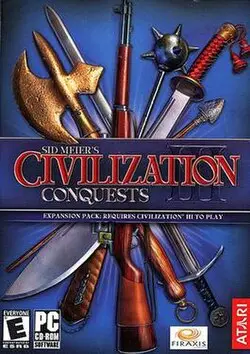
Sid Meier’s Civilization III: Conquests
Expansion of Sid Meier’s Civilization III 86
★ /10
86
★ /10
 PC
PC
 Firaxis Games
 Atari
Atari


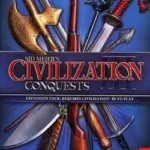
Sid Meier’s Civilization III: Conquests is the second and final official expansion pack for the turn-based strategy 4X video game Civilization III. Developed in partnership by independent studio BreakAway Games and series creator Firaxis Games, and published by Atari Interactive, the expansion launched on November 4, 2003, for Microsoft Windows.
While the previous 2002 expansion, Play the World, was notoriously critiqued for its buggy netcode and instability, Conquests received overwhelming critical acclaim from strategy communities. It serves as the definitive mechanical overhaul of the Civilization III ecosystem.
The expansion bundles all features and units from Play the World, while introducing two powerful civilization traits, two original government systems, extreme difficulty levels, dynamic natural disasters, and its defining centerpiece: nine highly detailed, standalone historical campaigns.
Technical Specifications
| Attribute | Details |
| Developer(s) | BreakAway Games, Firaxis Games |
| Publisher | Atari Interactive |
| Engine | Proprietary Custom 2D Isometric Engine |
| Platform | Microsoft Windows |
| Release Date | • NA: November 4, 2003 • EU: November 7, 2003 |
| Genre(s) | Turn-based strategy, 4X |
| System Requirement | Requires the base Civilization III client to execute |
| Mode(s) | Single-player, Multiplayer |
The Centerpiece: The Nine Conquests
The defining mechanical innovation of the expansion is the inclusion of The Conquests, a suite of nine meticulously crafted historical scenarios running on highly customized rulesets, independent research trees, and unique victory conditions.
Designed to be completed in far fewer turns than a standard epic campaign, these scenarios offer strategy purists localized mini-campaigns:
- Mesopotamia: Tracks the early dawn of civilization in the Fertile Crescent. Empires race to research early masonry and code-of-war protocols to construct seven unique wonders of the ancient world before their regional neighbors.
- Rise of Rome: Focuses on Mediterranean domination. Players command Rome, Carthage, Macedon, Egypt, or the Goths in a brutal, production-heavy struggle for regional hegemony.
- Fall of Rome: Reverses the geopolitical lens. Players control invading barbarian hordes (Vandal, Visigoth, Hun, Frank, Ostrogoth) attempting to successfully sack and pillage the eastern and western branches of the Roman Empire, which are desperately trying to stabilize their decaying borders.
- The Middle Ages: Centers on feudal European conflict. Kings protect their physical monarch units, wage localized holy wars, and manage economic cash streams while defending their duchies from sudden, devastating Viking raids and Mongol invasions.
- Mesoamerica: Tracks the pre-Columbian expansion of the Olmec, Toltec, Maya, and Aztec empires. The gameplay loop prioritizes high-intensity tribal warfare, sacrificing captured units at unique altar structures to farm massive culture and happiness infusions.
- Age of Discovery: Propels players into trans-oceanic colonization. European powers (Spain, Portugal, England, France, the Netherlands) race across random ocean coordinates to strip-mine luxury assets, capturing rare treasure chests in the New World to manually escort them back to their home capitals for instant cash and victory point boosts.
- Napoleonic Europe: A high-tier, industrial-scale war simulation. The map locks nations into rigid, massive diplomatic coalitions fighting for control of continental Europe using advanced artillery and musket columns.
- Sengoku: Sword of the Shogun: Centers on feudal Japanese internal warfare. Players act as independent Daimyos deploying stealth Ninjas, heavy Samurai divisions, and specialized Ronin mercenaries to capture regional capitals, accumulating victory consensus to be crowned Shogun.
- WWII in the Pacific: A massive, high-stakes modern military campaign. The scenario tracks the intense naval and aerial logistics battle between the Allied forces and the Empire of Japan, utilizing aircraft carriers, flak cannons, and mobile marine infantries across a sprawling Pacific map grid.
Advanced Traits & Roster Overhaul
To expand the asymmetric properties of the 4X sandbox, Conquests introduces two completely new Civilization Traits, permanently altering the operational parameters of both new and classic factions:
1. Seafaring
Designed to maximize coastal trade and naval supremacy. Seafaring empires receive a permanent +1 movement point bonus to all naval vessels immediately out-of-the-box, significantly lowering the risk of ships sinking when navigating dangerous deep ocean tiles in the early eras. Furthermore, coastal city centers constructed by Seafaring nations harvest an automatic bonus commerce gold coin from their central tile. Classic civilizations like the English and Carthaginians were officially reworked to inherit this trait.
2. Agricultural
Engineered to accelerate early-game population curves and combat economic stagnation. Agricultural societies yield an extra +1 food point from their city centers, and an additional +1 food modifier whenever a citizen works an irrigated desert or plain tile. This allows Agricultural empires to grow their workforce size far faster than competing nations.
The New Civilizations
The expansion updates the global setup pool by introducing seven brand-new playable civilizations (plus one hidden bonus faction unlocked via the custom map editor software), bringing the game’s total engine layout to an absolute maximum cap of 31 concurrent nations:
- The Byzantines (Theodora): Scientific and Seafaring traits, fielding the devastating Dromon unique naval ship (a primitive ranged vessel capable of firing lethal Greek fire to incinerate enemy fleets early).
- The Dutch (William I): Agricultural and Seafaring traits, protecting their maritime trade loops via the Swiss Mercenary (an exceptionally high-defense pikeman replacement).
- The Hittites (Mursili I): Expansionist and Commercial traits, swarming ancient square grids via the Three-Man Chariot unique division.
- The Incas (Pachacuti): Expansionist and Agricultural traits, exploring vast continent maps rapidly via the hyper-fast Chasqui Scout.
- The Mayans (Smoke Jaguar): Agricultural and Industrious traits, farming slave workers by defeating enemy infantries with the Javelin Thrower.
- The Portuguese (Henry the Navigator): Seafaring and Expansionist traits, dominating ocean exploration loops via the heavy, deep-sea Carrack ship.
- The Sumerians (Gilgamesh): Scientific and Agricultural traits, anchoring exceptionally cheap early defenses via the Enkidu Warrior.
- The Austrians (Charles V): A hidden “bonus” civilization whose graphics and code are natively embedded in the game’s editor files. Possessing the Militaristic and Industrious traits, they field the high-speed Hussar cavalry division.
Dynamic Terrain, Volcanoes & Governments
To increase structural unpredictability across overworld maps, Conquests updates terrain generation rulesets by introducing two dangerous landscape types:
Volcanic and Marsh Landscapes
- Volcanoes: Towering terrain tiles that are completely impassable and can never be manually improved by Workers. Volcanoes track a hidden ticking clock; periodically, they violently erupt, spewing molten ash and fire over all adjacent squares. The eruption instantly vaporizes any military units standing in the catchment zone, permanently shatters terrain improvements, and can completely erase an adjacent city center from the map.
- Marshes: Low-lying, waterlogged swamp hexes that heavily penalize unit movement speeds. Cities can never be constructed directly on a marsh tile unless Workers spend massive turn cycles clearing and draining the terrain into standard grassland. Citizens forced to work an uncleared marsh run a continuous risk of contracting catastrophic tropical diseases, severely draining city population counts.
Concurrently, the economic generator is expanded via the activation of four original resource nodes: Sugar, Tobacco, Oases, and Tropical Fruit.
The Two New Government Frameworks
Players gain access to specialized social philosophies designed to alter late-game macroeconomics:
- Feudalism: Unlocked early in the Middle Ages. It provides an excellent transition government for warlike societies, entirely eliminating city maintenance cash fees based on army sizes, though it severely penalizes food production curves if city populations grow past metropolitan boundaries.
- Fascism: A late-industrial authoritarian command structure. It grants absolute immunity to war weariness, drastically accelerates Worker improvement build velocities by a staggering +100%, and multiplies localized city defensive shielding parameters, at the severe expense of permanently erasing a chunk of your cultural growth metrics upon transition.
Difficulty Overhaul: Demigod & Sid
For veteran strategy tacticians who found the original highest difficulty tier (“Deity”) too easy to manipulate, the expansion introduces two ultimate difficulty options: Demigod and Sid difficulty.
Named as a humorous tribute to franchise founder Sid Meier, the “Sid” difficulty level scales the computer’s artificial intelligence handicaps to extreme proportions. When initializing a match on Sid difficulty, the AI kingdoms receive a permanent, massive 60% manufacturing discount on all buildings and units, start the match with four free defensive infantry units, three functional Settlers, and two Worker divisions immediately on Turn 1, forcing human players to execute perfect, error-free diplomatic manipulation and tactical choke point management simply to survive the ancient era.
Modern Preservation Status (2026)
As of May 2026, Conquests represents the definitive, universally accepted peak of the Civilization III timeline. The expansion’s asset library, multiplayer netcode updates, and balance patches are fully baked as the core architecture for the consolidated retail package, Sid Meier’s Civilization III Complete, distributed digitally across mainstream platforms including Steam and GOG.com for $4.99.
The application runs seamlessly under modern 64-bit multi-core Windows 10 and Windows 11 operating systems out-of-the-box.
Because the game’s structural 2D isometric viewport is hardcoded to legacy DirectX 8 framework metrics, retro PC strategy purists commonly utilize open-source presentation wrappers (such as cnc-ddraw) paired with manual configuration text overrides (appending the command line KeepRes=1 directly to the conquests.ini directory script). This optimization safely translates the legacy draw calls into modern DirectX 11 wrappers, enabling the intense historical campaigns, expanding cultural borders, and periodic volcanic eruptions of Conquests to render flawlessly in stable widescreen aspect ratios on high-resolution displays.