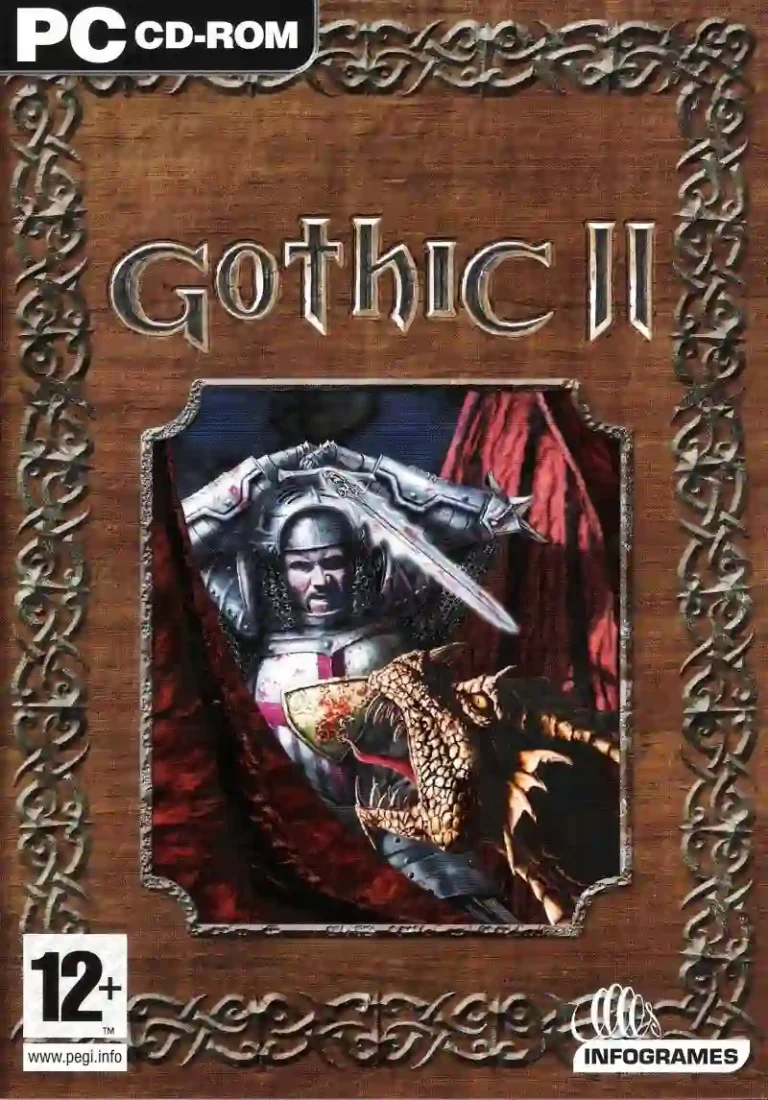
Gothic II
 79
★ /10
79
★ /10
 Nintendo Switch,
  PC,
PC,  PS4,
PS4,  PS5,
PS5,  Xbox One,
  Xbox Series X/S
 Akella,
  Atari, Infogrames, JoWooD Productions,
  THQ Nordic
Where to buy



Gothic II is a 2002 action role-playing game developed by Piranha Bytes and published by JoWooD Productions. Released in Germany on November 29, 2002, and in North America on January 28, 2003, it is the direct sequel to Gothic (2001) and the game that the series’ community most consistently describes as the peak of the franchise. Its Knowledge Panel contains an r/worldofgothic thread titled “Gothic 2 isn’t just a game it’s a feeling I’ve been trying to describe for years.” Its worldofplayers.de forum thread is headlined “Gothic 2 might be the best RPG I have ever played.”
These are not minority positions. They are the community consensus.
Technical Specifications
| Attribute | Details |
|---|---|
| Developer | Piranha Bytes |
| Publisher | JoWooD Productions (original) · THQ Nordic (current) |
| Engine | ZenGin (modified) |
| Platform(s) | PC · Nintendo Switch (2023, as Gothic II Complete Classic) · PS5/PS4/Xbox (Sep 29, 2026) |
| Original Release | Nov 29, 2002 (DE) · Jan 28, 2003 (NA) |
| Gold Edition | Gothic II + Night of the Raven (recommended) |
| Metacritic | 81 (PC) |
| Genre | Action RPG, Open world |
Play the Gold Edition
Gothic II was expanded substantially by its 2003 expansion Night of the Raven, which added the Valley of Mines from Gothic 1 as a fully explorable post-story location, a dragon-hunting questline, extensive new areas, and additional story content. The combined package — sold as the Gothic II Gold Edition on Steam and GOG — is the version the community universally recommends and the one Piranha Bytes themselves described as the “full Gothic 2 experience.”
Playing the base game without Night of the Raven is playing a lesser version of the game. The expansion is not supplementary; it is integral.
Return to Khorinis
The Nameless Hero wakes up in the ruins of the Valley of Mines following the events of Gothic 1, summoned by Xardas — the dark mage and ambiguous ally from the first game — with the warning that something worse than the Sleeper is coming. The orc armies that have long besieged the kingdom of Myrtana have breached new territories. The island of Khorinis — home to a trading port, the ore operations, and the seat of regional power — is under threat.
The game’s world is larger than Gothic 1‘s in every dimension. Khorinis city is the new hub: a functioning port town with merchants, craftsmen, a city guard, the local nobility, the poor quarter, and a population that has daily schedules, personal opinions about the Nameless Hero’s actions, and stories to tell about each other. The surrounding farmland, forests, and the Ore Barons’ estates extend the map in all directions. Night of the Raven reopens the Valley of Mines, connecting the new world to the old.
Three Paths: Paladin, Fire Mage, Mercenary
Where Gothic 1 offered three factional camps with distinct ideological positions, Gothic 2‘s guild system organises around three ways of acquiring power in Khorinis:
Paladins — the king’s military order defending the city from the orc advance. The most overtly heroic path: armour, swords, divine power. The Paladins’ questline connects most directly to the main story’s political and military dimensions.
Fire Mages — the scholarly magical order affiliated with the city’s upper classes. Access to increasingly powerful offensive and utility spells, but a path that requires patience and investment before combat capability feels rewarding.
Mercenaries (with a detour through the Bandits) — the outlaw route: fighting for pay, operating outside official authority, and building reputation through combat and contract work. The least politically connected and the most freely criminal path.
Each guild has its own questline, its own cast of characters, and its own access to sections of Khorinis that the other guilds do not interact with in the same way. The three paths do not produce meaningfully different story outcomes at the end — the hero’s path converges — but they produce substantially different experiences of the world that leads to it.
What Gothic 2 Improved
Virtually everything.
Gothic 1‘s opening hours are the game’s steepest difficulty curve — enemies that kill characters in seconds, a world that provides no guidance, and a control scheme that requires deliberate re-learning. Gothic 2 does not soften these things, but it provides more structure around them: the city of Khorinis offers more immediate social options, the early quests give the player a clearer sense of how to spend their time, and the balance between the early helplessness and the growing capability has been more carefully calibrated.
The world density is substantially greater. Where Gothic 1‘s three camps each felt distinct but limited, Khorinis and its surroundings support many more distinct locations, more named NPCs with individual histories, and a larger number of questlines that overlap and inform each other. The question of what to do next has more interesting answers than in the first game, and the process of finding those answers requires the same kind of NPC conversation and map-reading that the original established.
The Night of the Raven expansion took this density further still. Critics at the time noted that the expansion’s content rivalled the base game in volume — an unusual situation for an expansion pack that suggests the original game and its extension are best understood as a unified product.
Khorinis: A City That Deserves the Word
The town of Khorinis is one of the finest simulated settlements in the RPG genre. This is not a list that has many entries at the quality level the game achieves: Novigrad in The Witcher 3, Anor Londo in Dark Souls, New Vegas in Fallout: New Vegas — towns that function as social environments with their own logic rather than as backdrops for player activity.
Khorinis has its own class structure: the merchant families whose operations control the ore trade, the city guard who apply different scrutiny depending on who the player has allied with, the poor quarter whose residents are aware of their position relative to the rest of the city and respond accordingly. The guild the player joins determines which doors are open and which faces are welcoming. The city’s relationship to the player character is never neutral.
The worldofplayers.de community — a forum dedicated specifically to Piranha Bytes’ games and one of the longest-running dedicated game fansites in German gaming culture — has discussed Khorinis in this register for over two decades. The forum thread “Gothic 2 might be the best RPG I have ever played” has survived long enough to become a reference point for how new players arrive at the same conclusion.
The Feeling That Can’t Be Described
The r/worldofgothic post that currently occupies Gothic 2‘s Knowledge Panel — “Gothic 2 isn’t just a game it’s a feeling I’ve been trying to describe for years” — identifies something that critics have historically struggled with: the game produces a specific quality of immersion that most contemporary players had not experienced before and have not quite found again.
Part of this is the living-world design: the absence of waypoints, the requirement to navigate by observation and NPC direction, the way the world’s NPCs acknowledge the time of day and the player’s faction standing and the consequences of previous decisions. Part of it is the specific combination of the medieval fantasy aesthetic, Kai Rosenkranz’s score, and the Gothic series’ particular colour palette and sound design — a world that feels like it occupies its own cultural register rather than the generic European fantasy baseline.
The Souls series captures something adjacent to this feeling through difficulty and environmental storytelling. The Witcher 3 captures something adjacent through world density and character writing. Neither replicates exactly what the Gothic community is describing when it says the game is “a feeling.” The closest approximation is: a world that exists around the player rather than for the player, and the specific sense of belonging that develops from learning to navigate it.
Gothic II Today
Gothic II Complete Classic (the Gold Edition) has been available on Nintendo Switch since November 2023. It will arrive on PS5, PS4, Xbox Series X/S, and Xbox One on September 29, 2026, priced at $29.99 — five days after the first Gothic Classic arrives on those platforms on July 28. A physical disc edition is confirmed for PS5.
On PC, the Gold Edition is available on Steam and GOG. The community recommends the GOG version as the most stable out-of-the-box experience; the Steam version functions correctly but has generated more compatibility questions over the years. Both include updated controller support relative to the original 2002/2003 release.
Reception
Gothic II holds a Metacritic score of 81 — identical to its predecessor and, like its predecessor, a score that the game’s subsequent reputation has significantly outrun. Contemporary reviews praised the world design, the faction system, and the Night of the Raven expansion’s scope. The combination of limited North American publishing reach, the notoriously difficult controls, and a CRPG marketplace that was already shifting away from German-school design philosophy meant the game’s commercial impact was smaller than its creative ambition.
Two decades later, the Gothic community on worldofplayers.de and r/worldofgothic continues to produce new discussions at the same level of engagement as the communities around more commercially prominent classics. Gothic II is not a widely-known game. It is, for those who know it, the game they use to describe what games can be.