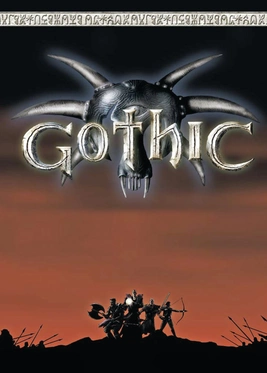
Gothic
 81
★ /10
81
★ /10
 Nintendo Switch,
  PC,
PC,  PS4,
PS4,  PS5,
PS5,  Xbox One,
  Xbox Series X/S
 1C Company, Egmont Interactive,
  THQ Nordic, Xicat
Where to buy




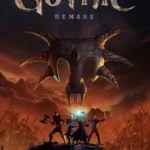
Gothic is a 2001 action role-playing game developed by Piranha Bytes and published by Egmont Interactive in Europe and Xicat Interactive in North America. Released in Germany on March 15, 2001, it is set in a sealed magical prison colony, has no minimap, no quest markers, and will kill you with wildlife in the first five minutes. It received a Metacritic score of 81 and influenced nearly every major European RPG that followed.
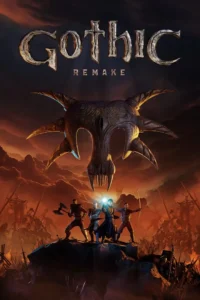
Gothic 1 Remake, developed by Alkimia Interactive and published by THQ Nordic, was released on June 5, 2026 — fifteen days ago — for PS5, Xbox Series X/S, and PC. It sold 500,000 copies in its first week, peaked at 78,000 concurrent Steam players, and currently holds an 85% “Very Positive” rating from over 15,000 user reviews. Critics were more divided.
Technical Specifications
| Gothic (2001) | Gothic 1 Remake (2026) | |
|---|---|---|
| Developer | Piranha Bytes | Alkimia Interactive |
| Publisher | Egmont Interactive / Xicat | THQ Nordic |
| Composer | Kai Rosenkranz | Kai Rosenkranz (returned) |
| Engine | ZenGin (proprietary) | Unreal Engine 5 |
| Platform(s) | PC · Nintendo Switch (2023) · PS5/PS4/Xbox (Jul 28, 2026) · iOS (2026) | PS5 · Xbox Series X/S · PC |
| Release | Mar 15, 2001 (DE) · Aug 24, 2001 (US) | June 5, 2026 |
| Metacritic | 81 | Mixed (critics) / Very Positive (players) |
The original Gothic and Gothic II Complete Classic have been available on Nintendo Switch since 2023 as Gothic Classic. Gothic Classic arrives on PS5, PS4, Xbox Series X/S, and Xbox One on July 28, 2026 ($29.99), with Gothic II Complete Classic following on September 29, 2026, and Gothic III Classic on November 24, 2026. All console versions include updated controls and full gamepad support. Players who pre-ordered Gothic 1 Remake on PlayStation or Xbox received Gothic Classic as a free digital bonus immediately upon pre-order.
The Valley of Mines: A Prison Without Walls
The setting of Gothic is one of the most distinctively conceived in the RPG genre: the Colony, a prison carved into the Valley of Mines in the kingdom of Myrtana. The king’s mages created a magical barrier to seal the valley, containing the kingdom’s worst criminals who are forced to mine ore essential for the war against orcs. The barrier was designed to keep prisoners in. It also kept the mages out — and then one of them made a catastrophic error, and the barrier sealed everyone inside. Now the mages are trapped with the criminals, the king can only send supplies and receive ore through a small transfer point, and the colony governs itself through violence and faction politics.
The player character is a nameless criminal thrown over the barrier as new labour. They land, take a punch from a thug, and are immediately informed of how things work. Three camps control the colony: the Old Camp (the largest, run by the Ore Baron and his mercenaries, controls most production), the New Camp (rebels who smuggle and are trying to find a way to break the barrier from within), and the Swamp Camp (a Brotherhood of the Sleeper, a religious cult worshipping a demon, using psionic powers). The player must join one of these factions to survive and eventually uncover what the Sleeper actually is.
The barrier overhead is the game’s most consistent atmospheric element: visible from everywhere, a constant reminder that the world extends beyond what is accessible, a physical constraint that shapes the entire social order below it.
Three Factions
The faction choice defines the playthrough more completely than in most RPGs of its era:
Old Camp offers the most conventional power progression — join the mercenaries, earn status, gain access to better weapons and training. The Ore Baron’s criminal apparatus is the dominant force in the colony, and working within it provides the most structured path to relevance.
New Camp is ideologically opposed to the Old Camp and technically more interesting: the rebels are engineers and smugglers trying to break the magical barrier from the inside, and their questlines reflect this — more lateral problem-solving, more political maneuvering, and closer proximity to the mages who understand what the Sleeper actually represents.
Swamp Camp is the game’s most unusual path — the Brotherhood deals in psionic mushrooms, worships the sleeping demon the game is building toward, and offers the player access to magic earlier than any other route. It is the path that most directly engages with the game’s supernatural premise.
What Makes Gothic 1 Good
The r/worldofgothic thread “What makes Gothic 1 good?” sits in the game’s Knowledge Panel, drawing persistent traffic from players who have heard about the game and want to understand its reputation before committing. The community answers consistently converge on the same things:
No level scaling. The Colony is dangerous from the first moment and remains dangerous regardless of how much time the player has spent in it. A creature that kills the player at the beginning of the game still kills the player at the middle of the game if they walk into its territory without the skills to handle it. The world’s difficulty is fixed; the player’s capability changes to meet it. This creates a sense of genuine progression that level-scaled games cannot replicate.
NPC schedules. Every named NPC in the Colony has a daily routine — they wake up, work, eat, socialise, sleep. They react to time of day, to the player’s faction standing, to specific game events. The Colony feels inhabited rather than staged. In 2001, this was genuinely uncommon; in 2026, it remains the standard Gothic’s descendants aspire to.
No hand-holding. There is no minimap. There are no quest markers. Directions to quest locations must be obtained by asking NPCs — who will help more readily if the player is in the right faction, or standing the right, or carrying the right items. Maps exist in the game world and must be purchased from merchants. Navigation is a skill.
The tone. Gothic does not present a heroic fantasy. The player character is a criminal. Their allies are criminals and exiles. The world they inhabit is brutal and largely unsentimental. The game’s writing does not sanitise this — it leans into the friction and moral ugliness of a society built on forced labour and maintained by violence.
The Original Controls and the Barrier to Entry
Gothic’s original control scheme is notorious. Combat uses mouse movement in combination with held buttons — moving the mouse up attacks, left slashes, right slashes the other direction, and so on — a system with no contemporary equivalent that requires several hours of practice before it becomes functional. Picking up items, interacting with objects, and talking to NPCs all require specific positioning relative to the target. The game does not explain any of this clearly.
The controls are the primary reason Gothic was not more commercially successful in the West at release and the primary reason returning to the original in 2026 requires preparation. They are also, for players who mastered them, a significant part of the game’s identity — combat has weight and commitment that modern re-implementations struggle to replicate exactly.
The Story and Chapter 5
Gothic’s main story unfolds through five chapters. The first three are the game’s finest — faction politics, the gradual revelation of the Sleeper’s nature, the discovery that the Brotherhood is summoning something genuinely dangerous, and the interlocking quests that advance the player’s standing within their chosen camp. The fourth chapter begins the confrontation with the Sleeper directly. The fifth chapter is famously truncated — a brief, rushed finale that the development team acknowledged was incomplete due to resource constraints. The game ends on a direct setup for Gothic 2 (2002).
The r/worldofgothic thread “Gothic 1: great game, but the story has a weird cut” — visible in the Things to Know block — reflects this precisely. The cut is real, the abruptness is real, and the game’s overall quality is real despite it.
Gothic’s Cultural Legacy
Game Informer’s review of the remake noted that Gothic “influenced a generation of European developers; its DNA can be seen in everything from The Witcher to STALKER and beyond.” This characterisation is accurate and documented:
CD Projekt Red’s founding developers played Gothic extensively and cited it as a direct influence on the open-world design philosophy of the early Witcher games — the sense of a world that exists independently of the player, where NPCs have their own priorities and schedules, and where exploration is genuinely dangerous rather than merely inconvenient.
The STALKER series, another landmark of Eastern European open-world design, shares Gothic’s preoccupation with zones that feel lived-in and hostile in equal measure.
Neither series is a direct clone — they developed their own identities substantially — but both inherit from Gothic a foundational assumption about how RPG worlds should behave.
Piranha Bytes
Piranha Bytes was founded in 1997 specifically to make Gothic. After its success, they made Gothic 2 (2002, widely regarded as the series’ peak), Gothic 3 (2006, critically divisive but commercially significant), the Risen trilogy (2009–2014), and two ELEX games (2017, 2022). THQ Nordic acquired Piranha Bytes in 2019. After ELEX II underperformed commercially in 2022, THQ Nordic closed Piranha Bytes in 2024. The studio that created Gothic no longer exists. The Gothic 1 Remake, developed by the Spanish studio Alkimia Interactive, is the franchise’s continuation under new hands.
Several members of the original Piranha Bytes team joined Alkimia Interactive specifically for the remake project, including the game’s composer Kai Rosenkranz — whose score for the original game is one of the defining medieval fantasy soundtracks of its era.
Gothic 1 Remake (June 5, 2026)
Alkimia Interactive was founded in Barcelona in March 2021, staffed partly by former Piranha Bytes developers, and spent five years rebuilding Gothic in Unreal Engine 5. The remake preserves the original’s design philosophy — no minimap, no quest markers, no level scaling, enemies that kill — while modernising the visual presentation, expanding questlines, restoring cut content from the original, and redesigning the notorious combat controls.
The remake adds 600+ unique NPC faces and body types (the original Colony had far fewer); expands several questlines; includes restored content that was cut from the 2001 game; and provides a new English voice cast while preserving the German, Polish, and Russian voice actors who worked on the original where possible. The new lockpicking minigame was the most commonly criticised addition — Game Informer called it “dreadful.”
Critical reception was genuinely mixed: <cite index=”6-1″>GamesRadar described it as “brilliant, bizarre, and a bit too obnoxious for its own good”</cite>, calling it “dedicated to keeping the deeply unique and unfriendly spirit of the original alive.” Player reception on Steam has been significantly more positive, with 85% of over 15,000 reviews recommending the game. The same quality that divides critics — the game’s refusal to soften Gothic’s unapologetic difficulty and opacity — is what players who specifically sought out the remake came to experience.
500,000 copies in the first week, 78,000 concurrent Steam players at peak, and an ongoing patch cycle from Alkimia Interactive indicate a successful if critically complicated launch.
Availability
The original Gothic is available on Steam and GOG. Gothic 1 Remake is available on Steam, PlayStation Store, and Xbox digital storefronts. THQ Nordic has additionally announced that the original Gothic Classic trilogy (Gothic, Gothic 2, Gothic 3) will come to PlayStation and Xbox consoles in 2026 — the first time the original games have been available on those platforms.