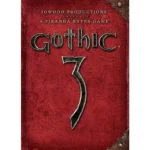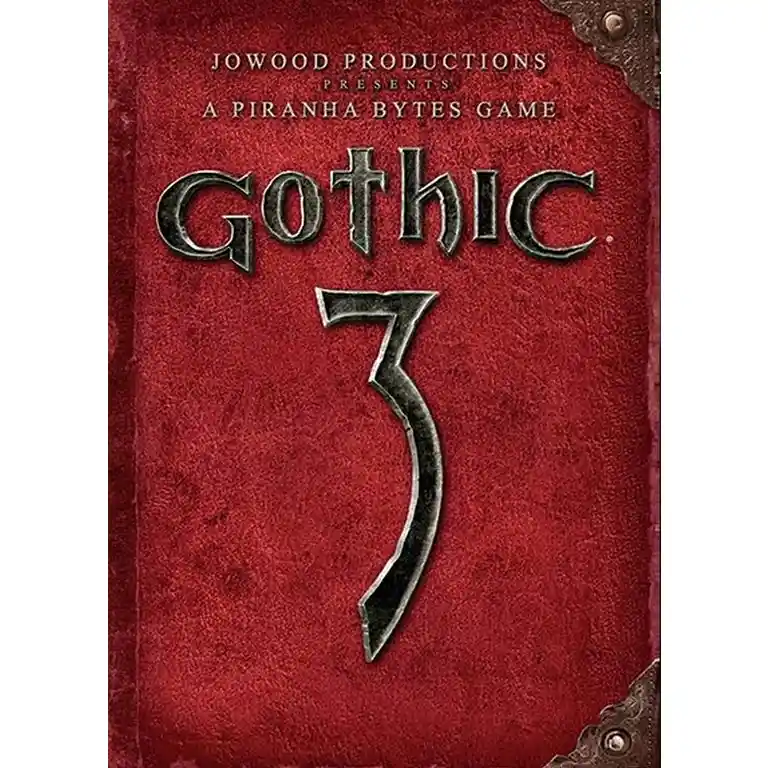
Gothic 3
 63
★ /10
63
★ /10
 Nintendo Switch 2,
  PC,
PC,  PS4,
PS4,  PS5,
PS5,  Xbox One,
  Xbox Series X/S
 Deep Silver, JoWooD Productions,
  Russobit-m,
  THQ Nordic


Gothic 3 is a 2006 action role-playing game developed by Piranha Bytes and published by JoWooD Productions. Released in Germany on October 13, 2006, and in North America on November 21, 2006, it is the third mainline entry in the Gothic series, the most ambitious project Piranha Bytes attempted, and the only entry that launched in a state the studio’s own fanbase considered unacceptable.
It holds a Metacritic score of 65. The r/worldofgothic thread “Why is Gothic 3 hated that much?” sits in both its Knowledge Panel and its People Also Ask results simultaneously. The answer to that question is complicated enough to require most of this page.
Technical Specifications
| Attribute | Details |
|---|---|
| Developer | Piranha Bytes |
| Publisher | JoWooD Productions (original) · THQ Nordic (current) |
| Engine | Genome Engine (new engine, replacing ZenGin) |
| Platform(s) | PC · PS5/Xbox Series/Switch 2 (Nov 24, 2026 — Gothic 3 Classic) |
| Original Release | Oct 13, 2006 (DE) · Nov 21, 2006 (NA) |
| Metacritic | 65 (PC) |
| Genre | Action RPG, Open world |
| Note | Install the Community Patch 1.75 before playing |
The Ambition
Gothic 3 was Piranha Bytes’ response to the open-world moment of 2006. The Elder Scrolls IV: Oblivion had released in March of that year and demonstrated what a large-budget open-world RPG could look like on contemporary hardware. Piranha Bytes, working with a fraction of Bethesda’s resources and team size, designed their answer: a game set across three entire continents — Myrtana (the ruined kingdom), Nordmar (a Norse-inspired northern mountainous region), and Varant (a vast eastern desert) — with hundreds of settlements, a fully dynamic reputation system, and a story in which the player’s choices about the orc occupation of Myrtana drive the entire narrative arc.
The scope was genuine. The team was not large enough to execute it in the time JoWooD’s financial situation allowed.
Three Continents: The Vision
The Nameless Hero arrives on the mainland of Myrtana — the kingdom seen only in fragments through the events of Gothic 1 and 2 — to find it under full orc occupation. What he does about this is the game’s central question, and it is a genuine question with multiple coherent answers:
Drive out the orcs: Side with the human rebel camps scattered across the occupied settlements, liberate cities and farmland, and push the orc forces back.
Consolidate the orcs’ control: Work with the orc commanders, earning reputation within their faction, and help establish a stable order under orc rule.
Negotiate peace: Work with specific characters toward a political resolution that neither requires total human victory nor permanent orc occupation.
All three paths are fully realised — meaning the game will play out to completion down any of them, with distinct endings. This faction flexibility was, in 2006, an unusual structural ambition for an open-world game.
Nordmar is the Norse-inflected snowy north: mountain passes, giant camps, the ancient human warrior culture that predates the current kingdom. Visually it is among the most striking environments in the series.
Varant is the eastern desert: temples, ruins, the sun-baked settlements of a different culture. The scale of the desert is genuinely immense.
What Went Wrong
JoWooD Productions, Piranha Bytes’ publisher, had financial difficulties in 2006 and required the game to ship by a specific date regardless of its state. The game was released in October 2006 several months before it was ready.
The Genome Engine — Piranha Bytes’ new proprietary technology, replacing the ZenGin used in Gothic 1 and 2 — had not been sufficiently tested at the game’s scale. Performance on most hardware configurations of 2006 was catastrophic: framerates that dropped below ten in populated areas, stuttering during combat, and a memory management system that degraded over extended play sessions.
AI pathfinding was broken. Enemies fell through terrain, walked into obstacles, and behaved unpredictably in ways that made combat both unfair and tedious.
Quest tracking was incomplete. Some quest resolutions failed to trigger properly. Dialogue states did not always update correctly after significant story events.
Balance across the three-continent world was inconsistent: sections of the game were clearly less developed than others, reflecting the studio’s incomplete pass over the full scope of what they had designed.
Reviews at launch reflected the broken state of the product, not the underlying game’s design quality. Critics who revisited the game after patches consistently described a more positive experience than the original release scores suggested.
The Community Patch
A dedicated group of modders and fans — working independently of both Piranha Bytes and JoWooD — produced a series of patches addressing Gothic 3’s bugs. The Community Patch 1.75 is the current standard, addressing hundreds of quest bugs, AI pathfinding issues, performance problems, balance inconsistencies, and dialogue errors.
Installing the Community Patch before starting Gothic 3 is universally recommended by the r/worldofgothic community and everyone who writes about the game in 2026. The Community Patch transforms the experience from “broken but ambitious” to “flawed but playable with a genuine vision underneath.” It is available on the official Gothic website and is included in most digital storefronts’ recommended configuration guides.
Even with the patch, Gothic 3 is a rougher experience than either predecessor. The patch addresses bugs; it cannot rebuild the parts of the design that were genuinely undercooked.
The Defenders’ Case
Gothic 3’s defenders — and there are enough of them to produce active forum discussion two decades after release — make a set of arguments the game genuinely supports:
The world is vast and beautiful. The three continents’ visual identities are distinct and realised with more visual ambition than either previous game. The settlements of Varant, the snowbound passes of Nordmar, and the occupied towns of Myrtana each feel like different places in a way that the Gothic series’ earlier games, for all their strengths, did not attempt.
The scale was unprecedented for the team’s size. Piranha Bytes built more open-world content in Gothic 3 than any previous European RPG team of comparable size had attempted. The failure of execution does not negate the ambition.
The reputation system — while different from the guild system of Gothic 2 — has depth when engaged with seriously. The way different settlements respond to the player’s choices across all three paths creates a genuinely reactive world in the moments where the implementation works.
The score is exceptional. Kai Rosenkranz’s compositions for Gothic 3 are the most orchestrally ambitious of the series, matching the game’s larger scale with sweeping themes for each region. The main theme is among the most beloved pieces in the franchise’s history.
How Gothic 3 Differs From 1 and 2
The specific elements that made the first two games distinctive were modified or absent in the third:
No guild joining. The intimate process of choosing a faction and being initiated into its culture — the Old Camp’s criminal hierarchy, Khorinis’s Paladins and Fire Mages — is replaced by a more diffuse reputation system. The player earns standing with groups across a continent rather than embedding within a specific community.
Less NPC density per location. The enormous number of settlements means each individual settlement is less densely populated with characters than Khorinis or the Valley of Mines. The living-world feeling is more stretched across a larger canvas.
Combat redesigned. The combat system was rebuilt from the ZenGin’s implementation, and the community’s assessment of the result ranges from “different but acceptable” to “worse.” Opinions depend heavily on which version the player experienced — early launch, post-JoWooD patch, or Community Patch.
No minimap or quest markers is preserved — the Gothic design philosophy on navigation remained intact.
Gothic 3 Classic: November 2026
Gothic 3 Classic arrives on PlayStation 5, Xbox Series X/S, PlayStation 4, and Nintendo Switch 2 on November 24, 2026, priced at $29.99. It is the last of the three original Gothic games to arrive on console, following Gothic Classic (July 28) and Gothic II Complete Classic (September 29). A Switch 2 version is confirmed alongside the PlayStation and Xbox editions — the only Classic entry with a confirmed Switch 2 physical release.
The console version will include updated controls and full gamepad support. Whether it will include the Community Patch’s fixes or a publisher-equivalent is not confirmed as of June 2026; the THQ Nordic Classic releases have generally prioritised stability over expanded content.
Reception
Gothic 3’s Metacritic score of 65 was earned by a broken product and reflects that product accurately. Critics in 2006 reviewed what shipped, and what shipped was not ready. The RPGCodex community — whose presence in the SERP reflects the game’s positioning within hardcore CRPG discourse — has produced one of the more nuanced long-term assessments of Gothic 3: a game whose vision was more coherent than its reception suggested, whose execution was genuinely insufficient, and whose community-patched version is a different experience than what critics evaluated.
The r/worldofgothic question “Why is Gothic 3 hated that much?” has multiple correct answers. The most complete one: because JoWooD needed the money, because Piranha Bytes ran out of time, and because the game that reached players in 2006 was not the game that could have been made with six more months and a publisher who was not facing bankruptcy. That game exists in the Community Patch version, imperfectly. It is worth knowing about.