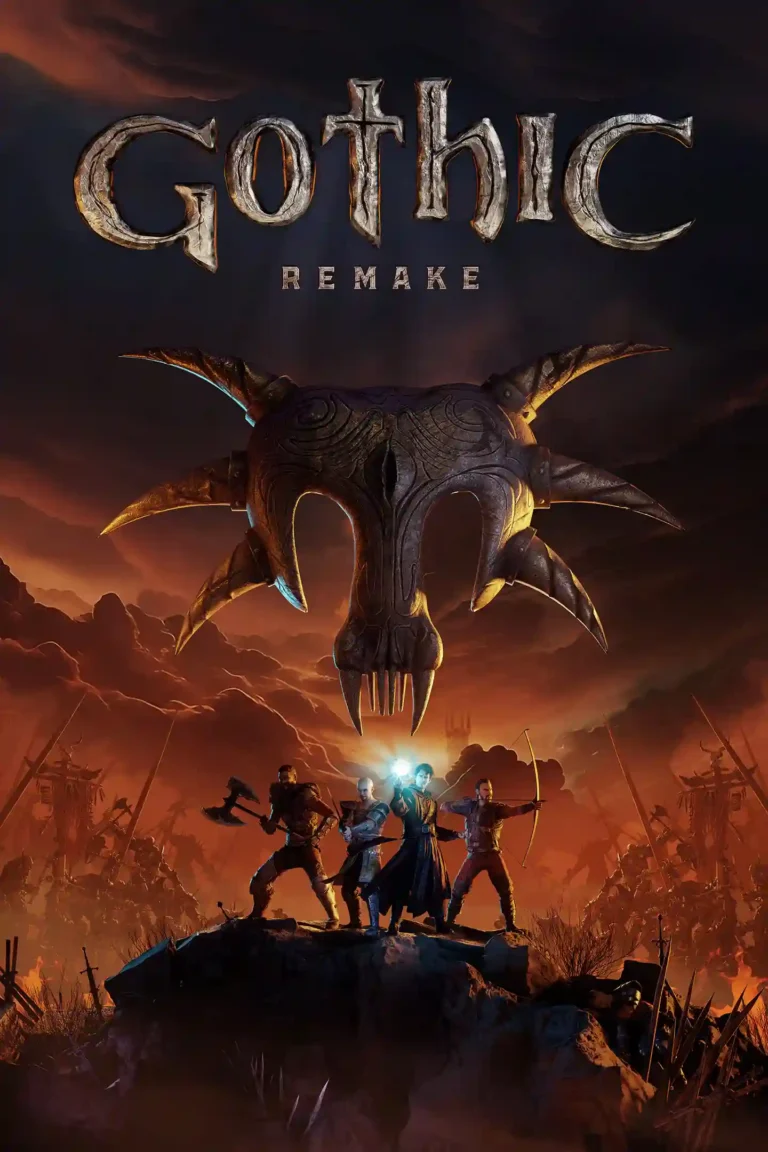
Gothic 1 Remake
 73
★ /10
73
★ /10
 PC
PC PS5
PS5 Xbox Series X/S
 THQ Nordic


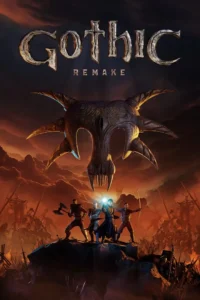
Gothic 1 Remake is a 2026 action role-playing game developed by Alkimia Interactive and published by THQ Nordic. Released on June 5, 2026 — fifteen days ago — for PlayStation 5, Xbox Series X/S, and PC via Steam and GOG, it is a ground-up rebuild of Gothic (2001) on Unreal Engine 5, retaining the original’s design philosophy while replacing every technical component.
It sold 500,000 copies in its first week. The Steam page records 28,894 reviews at 85% “Very Positive.” Wikipedia categorises the critical reception as “mixed.” This gap reflects a remake that serves its source material’s existing audience almost entirely, and serves it well, while remaining opaque to those who did not already know why Gothic matters.
Technical Specifications
| Attribute | Details |
|---|---|
| Developer | Alkimia Interactive (Barcelona, Spain) |
| Publisher | THQ Nordic |
| Engine | Unreal Engine 5.4 (Lumen, Nanite) |
| Platform(s) | PlayStation 5 · Xbox Series X/S · PC (Steam, GOG) |
| Release Date | June 5, 2026 |
| Price | €49.99 / $49.99 |
| Genre | Action RPG, Open world |
| Mode | Single-player |
Seven Years in the Making
The history of this remake begins in December 2019 with a Gothic Playable Teaser — a brief playable proof-of-concept on Unreal Engine 4, released by THQ Nordic to test whether interest in a Gothic remake existed among contemporary players. The teaser was intended as community research: after it went live, THQ Nordic collected responses and ultimately decided to proceed with a full production.
Alkimia Interactive was founded in Barcelona in March 2021 specifically to build the remake. The studio recruited from the existing European RPG development pool, including former Gothic and Gothic II modders who had spent years in the original game’s community. The composer of the original game, Kai Rosenkranz, joined the project. Several members of the original Piranha Bytes team contributed in advisory or direct capacities.
Development proceeded through 45 employees in 2023 to over 50 by 2024. The engine shifted from UE4 to UE5.4 during production as Unreal Engine 5’s capabilities advanced to the point where Alkimia could better realise their visual targets. THQ Nordic announced the June 5, 2026 release date in February 2026.
One constraint built into the studio’s culture from the start: every employee was required to play the original Gothic before beginning work on the remake.
What Was Built From Scratch
Gothic 1 Remake does not upscale or remaster the 2001 game. Every asset, character, environment, and system was built from scratch using the original as reference.
The Valley of Mines is reconstructed from the ground up in UE5 — larger than the original, with dramatically higher geometric and texture detail, but unmistakably recognisable as the same space. PCGH’s benchmark testing described it as “unmistakably and unquestionably still the world of Gothic.” The landmarks, the layout, the atmosphere of a sealed colony operating under criminal power structures — all preserved, all rebuilt.
NPC behaviour received particular development attention. Alkimia built a system they called “motion magic”: 20–30-minute motion capture recording sessions divided into individual sequences and categorised, creating a library of believable NPC movement and behaviour that drives the Colony’s living-world feel. The AI routines — NPCs who wake, work, eat, and sleep on schedules — were rebuilt to replicate and expand what the original achieved.
Combat was redesigned from the original’s mouse-movement system into a modern third-person action framework: dodging, parrying, combos, dodge cancels, and executions. The new system addresses the original’s single largest accessibility barrier without, in Alkimia’s intent, losing the weight and consequence that distinguished Gothic‘s combat from lighter action games.
Dialogue was rewritten where it needed to be and preserved where it didn’t. “Some dialogue from the original was rewritten, and new dialogue was added,” per Wikipedia’s assessment of the production. The crude directness of the original — the NPCs who punch you when they’re done explaining something, the complete absence of softened language — was an explicit preservation target.
Kai Rosenkranz returned to reinterpret the original score he composed for Gothic in 2001, creating new arrangements of the original themes alongside new compositions. He used FMOD for implementation.
What Was Preserved
The design philosophy that made Gothic distinctive is present in the remake:
No minimap. Navigation requires asking NPCs for directions, buying maps from merchants, and developing spatial understanding of the Valley of Mines through repeated traversal.
No quest markers. Objective locations are described in dialogue and player notes. The game does not place waypoints on the screen.
No level scaling. The Colony is dangerous from the start and remains dangerous. Creatures that kill the player in the opening hour will still kill them at the midpoint if they enter that creature’s territory unprepared.
Three factions. The Old Camp, New Camp, and Swamp Camp each represent a distinct path through the game, each with its own access, questlines, and social dynamics. The choice to join one of them shapes the remainder of the playthrough.
The economic friction. Skills must be bought from specific trainers using learning points. Lockpicking was rebuilt in presentation but retains similar underlying principles to the original.
Nyras Prologue: The Demo
The Nyras Prologue is a free standalone demo available on Steam and GOG under its own app ID, created as new content for the remake rather than extracted from the main game. Players control Nyras, a character affiliated with the Sect (the Swamp Camp’s Brotherhood), navigating a self-contained slice of the Colony. Nyras is not the Nameless Hero and does not appear in the main game; the prologue exists specifically as a taste test.
The demo was first shown at Gamescom in August 2024 and released publicly in February 2025. After release, Alkimia conducted a survey among the 15,000 players who participated, used the feedback to adjust art direction and tone mapping, and incorporated those changes into the final game. A second version of the demo was released during Steam Next Fest 2025 with the updated UE5.4 build and combat tuning.
Playing the Nyras Prologue before purchasing the full game is the recommended evaluation approach: it accurately represents the remake’s combat feel, visual tone, and atmosphere, and the progress does not carry over to the main campaign.
UE5 and the Performance Demands
Gothic 1 Remake runs on Unreal Engine 5.4 with Lumen global illumination and Nanite virtualized geometry active throughout. An SSD is mandatory — the engine’s constant asset streaming cannot function on a mechanical drive. Install size is approximately 50GB.
The game supports DLSS 4.5 (NVIDIA RTX), FSR (AMD), and XeSS (Intel Arc). At the game’s highest preset, “Alkimia Overdose,” achieving stable 60fps at 1440p natively requires RTX 5090-class hardware. This preset is designed for screenshots and benchmarking. At the standard “Gothic” preset with upscaling enabled, mid-range hardware (RTX 3060 / RX 6600 XT class) achieves playable 60fps at 1080p. DLSS and FSR are practical requirements for most players at 1440p and above, not optional enhancements.
PCGH ran over 500 benchmarks across 62 CPUs and 40 GPUs on launch day. The game was described in their coverage as “a contemporary UE5 stress test wearing a chainmail shirt.”
A post-launch patch (1.0.2) introduced a progression bug affecting a specific demon interaction, subsequently documented on PCGamingWiki with a workaround. Alkimia has been issuing patches actively.
The Pre-Order Classic Bonus
Players who pre-ordered Gothic 1 Remake on PlayStation or Xbox received Gothic Classic (the original 2001 game) as a free digital bonus immediately upon pre-order — providing access to the original months before the Classic’s standalone console release date of July 28, 2026. This is no longer available for new purchases after the remake’s June 5 release.
Reception
German-language critical reception was strongly positive: 4P gave it 9/10 (“ultimate gaming highlight of 2026”), PC Games gave 8/10, GamersGlobal gave 8.5/10. These are the outlets with the deepest familiarity with the original franchise’s context and audience.
English-language critical reception was more divided, reflecting the gap between players who understand what Gothic is trying to do and players evaluating it against contemporary action RPG expectations. The Sixth Axis’s framing — “Gothic Revival or Gothic Ruin?” — captures the critical split without resolving it.
Player reception on Steam is 85% Very Positive across 28,894 reviews, with Very Positive ratings in Russian, English, German, and Polish (the four largest language communities). Chinese reviews are Mixed, reflecting different audience expectations in a market where the original Gothic had limited reach.
Steam review peak was 78,000 concurrent players on launch weekend. The game has 28,894 Steam reviews as of June 20, 2026, suggesting ongoing engagement rather than a spike-and-decline pattern.
For players who know why Gothic matters, the remake delivers it. For players who do not, the Nyras Prologue demo is the fastest path to finding out whether they are in that group.