Suicide Squad: Kill the Justice League
 60
★ /10
60
★ /10
 PC,
PC,  PS5,
PS5,  Xbox Series X/S
Where to buy



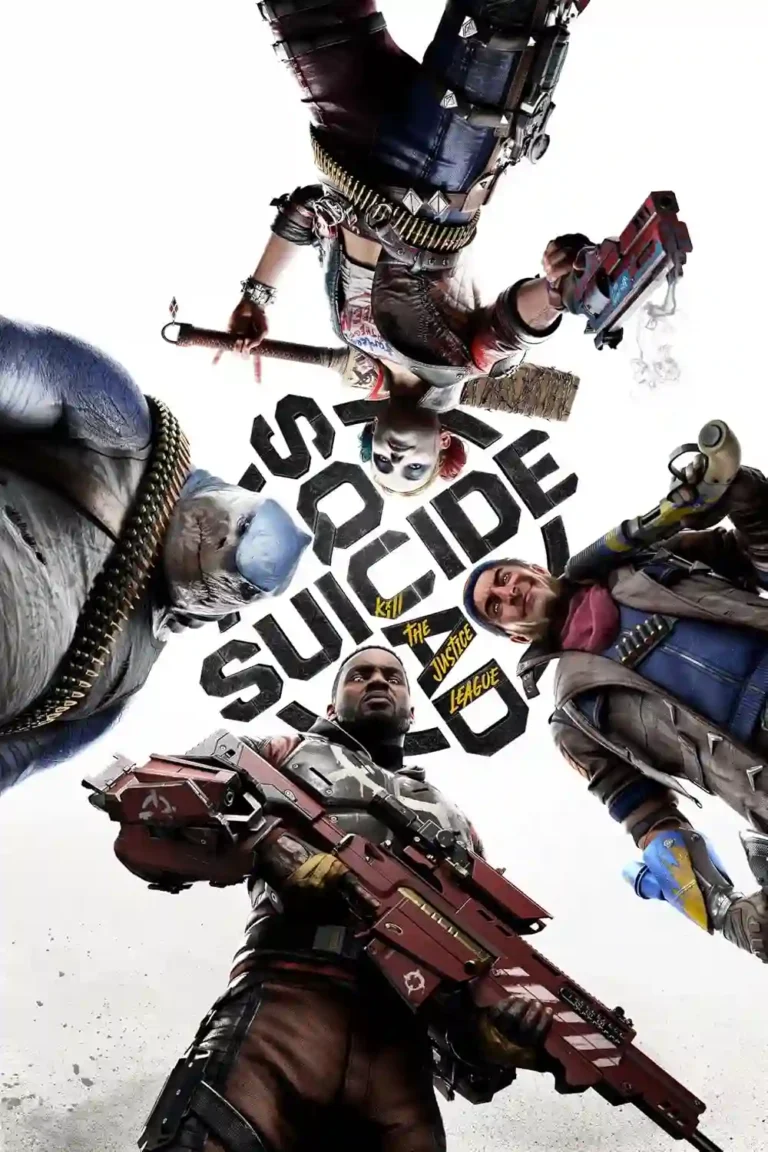
Suicide Squad: Kill the Justice League is a 2024 third-person action shooter developed by Rocksteady Studios and published by Warner Bros. Games. Released on February 2, 2024, for PlayStation 5, Xbox Series X/S, and PC, it is the fourth game set in Rocksteady’s Batman: Arkham universe — taking place five years after Batman: Arkham Knight (2015) — and the studio’s first release in nearly a decade.
It received a Metacritic score of 53 on PS5. It peaked at 13,459 concurrent players on Steam, fell below 120 within weeks, and currently registers approximately 62 concurrent players. Kevin Conroy, who voiced Batman in all three Rocksteady Arkham games and in Batman: The Animated Series, died on November 10, 2022. His final performance as Batman was recorded for this game.
Technical Specifications
| Attribute | Details |
|---|---|
| Developer | Rocksteady Studios |
| Publisher | Warner Bros. Games |
| Directors | Sefton Hill · Jamie Walker |
| Composer | Lorne Balfe |
| Engine | Unreal Engine 4 |
| Platform(s) | PlayStation 5 · Xbox Series X/S · PC |
| Release Date | February 2, 2024 |
| Genre | Third-person shooter, Looter-shooter, Live service |
| Mode(s) | Single-player · Online co-op (up to 4 players) |
The Premise and the Arkham Connection
The game is set in Metropolis — Superman’s city, not Gotham — five years after the events of Arkham Knight. Brainiac, an alien intelligence of vast capability, has invaded Earth and used his technology to brainwash the Justice League: Superman, The Flash, Green Lantern, and Batman are now weapons in service of Brainiac’s designs. The only people in position to stop them are the last people anyone would choose: Task Force X — the Suicide Squad, a group of imprisoned supervillains forced into service by ARGUS Director Amanda Waller with lethal implants ensuring compliance.
The Suicide Squad must kill the Justice League.
The premise is the game’s most commercially legible hook and its most controversial story choice simultaneously. Killing Batman — in the Arkham universe, where Batman has been the protagonist for three games — was never going to be received neutrally. That Kevin Conroy’s death made the moment the literal end of his tenure as the character added a dimension to the controversy that no amount of comic-book “alternate universe” framing could dissolve.
Kevin Conroy’s Final Batman
Kevin Conroy voiced Batman in Batman: The Animated Series (1992), both Batman animated film continuations, Batman Beyond, Justice League, and every Rocksteady Arkham game. He died of intestinal cancer on November 10, 2022. His recording sessions for Suicide Squad: Kill the Justice League — including his scenes as the brainwashed Batman and a substantial role across the game’s narrative — were completed before his death.
At The Game Awards in December 2022, one month after Conroy’s death, Rocksteady revealed the game’s release date alongside the announcement that Batman’s appearance was “Kevin Conroy’s final performance” as the character. The framing — using a deceased actor’s last work as marketing — was uncomfortable to some.
The performance itself was praised by critics and players regardless of the game’s other qualities. Polygon noted that Batman’s depiction “was in keeping with prior entries.” IGN’s Jesse Schedeen, more critical, felt it was “a waste of potential compared to how he was last seen in Arkham Knight.” Both responses exist simultaneously, and neither is wrong.
For players who came to the game primarily as the conclusion of the Arkham saga, the scenes of the infected Batman — carrying the accumulated weight of three games and thirty years of Conroy voicing the character — represent the game’s most significant content. This is true regardless of what surrounds those scenes.
The Four Squad Members
Harley Quinn (voiced by Tara Strong) is the most immediately recognisable, acrobatic, and dialogue-central of the four. She uses a bat as a melee weapon and her trapeze skill for traversal, and the game’s humour is largely channelled through her.
Deadshot (Bumper Robinson) is the ranged specialist — rifles, long-range precision, a jetpack enabling aerial movement. His personal stakes in the mission involve his daughter.
Captain Boomerang (Daniel Lapaine) uses boomerangs with various gadget properties and has the most comedic characterisation of the four, his Australian incompetence a running counterpoint to the danger around him.
King Shark (Joe Seanoa) is physically the strongest, a giant humanoid shark who functions as the group’s heavy and its least predictably violent member. He is the Squad’s earnest heart.
The character dynamics — their banter, their relationships with each other, their comedic friction against the deadly situation — are what critics most consistently praised. The writing of the four as a group produces the specific tone the game is aiming for and does so well.
Jason Isaacs voices Brainiac with cold alien intelligence. Debra Wilson voices Amanda Waller, the game’s moral architect, with an authority that makes Waller exactly as frightening as the character warrants.
What Kind of Game
Suicide Squad: Kill the Justice League is not a Batman: Arkham game in any mechanical sense. It is a third-person looter-shooter in the tradition of Destiny or Borderlands: players shoot enemies to collect progressively more powerful weapons, run missions that scale in difficulty, and engage with a seasonal live-service content delivery structure. The four Squad members move through Metropolis using their individual traversal abilities — swinging, jetting, dashing — and engage enemies primarily with firearms and special abilities rather than melee combat.
The FreeFlow combat system of the Arkham trilogy is absent. The Predator stealth system is absent. The Metroidvania structure and open-world traversal of those games are replaced by a map of Metropolis’s districts through which players run repeated mission variants of limited type variety.
The individual gunplay was acknowledged by several reviewers as competent — “fast, frantic, and fun” per Metacritic’s review aggregation — and the traversal system, each character moving through the city differently, provided initial variety. The problem identified in nearly every critical assessment was not the combat itself but what surrounded it: a campaign that required running the same encounter types repeatedly, an endgame that extended that repetition indefinitely, and a live-service structure that placed the game’s ongoing narrative behind seasonal update gates rather than delivering it in the purchased product.
Metropolis
Metropolis — Gotham’s sunlit counterpart in DC mythology — is the game’s open world. It is a brighter, taller, more conventionally modern-city environment than Gotham, and the contrast is intentional: the squad are criminals operating in a hero’s city. The visual design is competent and the environment is used for traversal, but it did not carry the atmospheric identity of Gotham City across the trilogy. Critics described it as “hollow” and “devoid of detail” compared to both the Arkham games and contemporary open-world games.
The Commercial Collapse
Suicide Squad: Kill the Justice League‘s Steam performance is among the most stark in recent AAA history:
- Launch peak: 13,459 concurrent players (February 3, 2024)
- Three weeks post-launch: 916 concurrent players
- April 2024 all-time low: 118 concurrent players
- Current (June 2026): approximately 62 concurrent players
For context, Batman: Arkham Knight — a 2015 game — recorded more concurrent players on Steam during a Batman sale in early 2024 than Suicide Squad had at its peak.
The Metacritic user score of 3.7 — driven partly by players who had not played the game and partly by players who had — made a distinction between protest voting and genuine assessment difficult to parse. The critic score of 53 and the player count are more reliable indicators of how the game was actually received by people who engaged with it.
Season 1 of the live-service content added The Joker — voiced by Mark Hamill, returning to the role he had “retired” from after Arkham City — as a playable character from an alternate universe. The player count briefly spiked with the update before declining further. There was no subsequent recovery.
Is It Really That Bad?
The PAA question “Is Suicide Squad really that bad?” is the game’s defining question in 2026, and the r/SuicideSquadGaming video in the video carousel asks a version of the same thing.
The measured answer, assembled from what patient players found when they approached the game outside the hype-and-disaster cycle:
The story is the game’s strongest element and the element most connected to the Arkham franchise’s established quality. The cutscenes are produced at Rocksteady’s usual standard. The Squad dynamics are effective. Kevin Conroy’s final performance is genuinely moving. For players who came to find those things, the game delivers them.
The gameplay loop, evaluated as a looter-shooter, is functional but substantially below the genre’s standards: less content variety than Destiny 2 at launch, less personality than Borderlands, less satisfying progression than Diablo. The campaign is structured around that loop in ways that expose its limitations rather than compensate for them. For players who came expecting a Rocksteady action game, the disappointment is total and not unreasonable.
A Metacritic review quoted on the aggregator page captured both: “I almost wish this was a complete disaster, but the glimpses of the old Rocksteady razzle-dazzle under the awful mission design and exhausting live service elements just make you mourn what could have been.”
Eurogamer, GameSpot, and the End
Eurogamer’s article in the current SERP is titled “Suicide Squad: Kill the Justice League’s final chapter brings game to a cheap end.” GameSpot’s is “Suicide Squad: Kill the Justice League — Finale Gives Everyone a Happy Ending.” One of these is sincere.
The game’s active development has ended. Content updates have stopped. Servers remain online. The Arkham saga — which began with the Joker taking over Arkham Asylum in 2009, ran through Arkham City’s Joker death, Origins’ first meeting of Batman and the Joker, and Knight’s Knightfall Protocol — concluded here, in a game whose Steam player count is currently in the double digits, with the final Batman performance of a man who spent thirty years making the character his own.
The legacy is complicated. The conclusion is real.